Recombinant Human Mucin-5B (MUC5B), partial

Recombinant Human Mucin-5B (MUC5B), partial — recombinant protein from Homo sapiens (Human), expressed in E.coli. Purity >85%.

SKU: BCRECP-001201 Category:

Product Specifications

Product SkuBCRECP-001201
Product DescriptionRecombinant Human Mucin-5B (MUC5B) Protein is expressed from E.coli with N-terminal 10xHis-tagged and C-terminal Myc-tagged. It contains 4186-4295aa. [Accession | Q9HC84].
Uniprot No.Q9HC84
Gene NamesMUC5B
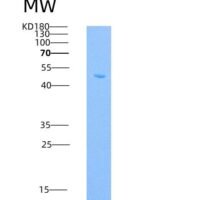
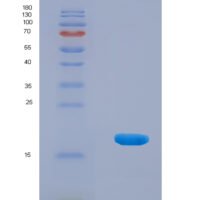
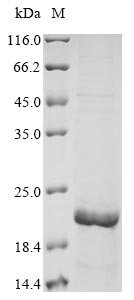
PurityGreater than 85% as determined by SDS-PAGE.
Expression SystemE.coli
Expression Region4186-4295aa
SpeciesHomo sapiens (Human)
Tag InfoN-terminal 10xHis-tagged and C-terminal Myc-tagged
Molecular weight18.9kDa
ActivityPlease contact us to obtain bioactivity data.
BufferIf the delivery form is liquid, the default storage buffer is Tris/PBS-based buffer, 5%-50% glycerol. If the delivery form is lyophilized powder, the buffer before lyophilization is Tris/PBS-based buffer, 6% Trehalose.
StorageStore at -20°C/-80°C upon receipt, aliquoting is necessary for mutiple use. Avoid repeated freeze-thaw cycles.
Research AreasCell Biology

Function

Gel-forming mucin that is thought to contribute to the lubricating and viscoelastic properties of whole saliva and cervical mucus.

Biological Context

Subcellular Location: Secreted
Tissue Specificity: Expressed on surface airway epithelia. Expressed mainly in mucous cells of submucosal glands of airway tissues. Highly expressed in the sublingual gland. Also found in submaxillary glands, endocervix, gall bladder, and pancreas
Disease Association: Interstitial lung disease 2 (ILD2) : A form of interstitial lung disease, a heterogeneous group of diseases affecting the distal part of the lung and characterized by a progressive remodeling of the alveolar interstitium. The disease spectrum ranges from idiopathic interstitial pneumonia or pneumonitis to idiopathic pulmonary fibrosis, that is associated with an increased risk of developing lung cancer. Clinical features of interstitial lung disease include dyspnea, clubbing of the fingers, and restrictive lung capacity. ILD2 inheritance is autosomal dominant. [Disease susceptibility is associated with variants affecting the gene represented in this entry. A common polymorphism in the promoter of MUC5B is associated with familial interstitial pneumonia and idiopathic pulmonary fibrosis, suggesting that dysregulated MUC5B expression in the lung may be involved in the pathogenesis of pulmonary fibrosis ]

Product Specifications

Recombinant Human Mucin-5B (MUC5B), partial is a recombinant protein from Homo sapiens (Human), expressed in E.coli, covering amino acids 4186-4295aa, with N-terminal 10xHis-tagged and C-terminal Myc-tagged tag, molecular weight 18.9kDa, purity Greater than 85% as determined by SDS-PAGE.. Suitable for ELISA and Western Blot applications.
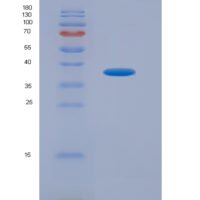
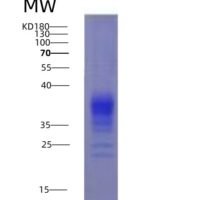
SDS-PAGE: Single band at expected molecular weight confirming purity.

ELISA: Suitable as coating antigen or detection standard.

Western Blot: Compatible with standard Western Blot protocols.

Protein Interaction: Validated for SPR (Surface Plasmon Resonance) and BLI (Bio-Layer Interferometry) studies.

Shipping: Shipped at ambient temperature. Lyophilized protein is stable during transit.

Storage: Store lyophilized protein at -20°C to -80°C. Reconstituted protein should be aliquoted and stored at -80°C. Avoid repeated freeze-thaw cycles.

Shelf Life: 12 months from date of receipt when stored as recommended.

Shipping Time: Orders placed before 2 PM EST ship same day. International orders typically deliver within 5-10 business days.

Protein Biology

Function

Gel-forming mucin that is thought to contribute to the lubricating and viscoelastic properties of whole saliva and cervical mucus

Subcellular Location

Secreted

Disease Association

Interstitial lung disease 2 (ILD2) : A form of interstitial lung disease, a heterogeneous group of diseases affecting the distal part of the lung and characterized by a progressive remodeling of the alveolar interstitium. The disease spectrum ranges from idiopathic interstitial pneumonia or pneumonitis to idiopathic pulmonary fibrosis, that is associated with an increased risk of developing lung cancer. Clinical features of interstitial lung disease include dyspnea, clubbing of the fingers, and restrictive lung capacity. ILD2 inheritance is autosomal dominant. [Disease susceptibility is associated with variants affecting the gene represented in this entry. A common polymorphism in the promoter of MUC5B is associated with familial interstitial pneumonia and idiopathic pulmonary fibrosis, suggesting that dysregulated MUC5B expression in the lung may be involved in the pathogenesis of pulmonary fibrosis (PubMed:21506741)]

Tissue Specificity

Expressed on surface airway epithelia. Expressed mainly in mucous cells of submucosal glands of airway tissues. Highly expressed in the sublingual gland. Also found in submaxillary glands, endocervix, gall bladder, and pancreas

Subunit

Homomultimer; disulfide-linked (PubMed:31570524). The N- and C-terminus mediate their assembly into higher order structures to form filaments (By similarity). The CTCK domains of two polypeptides associate in the endoplasmic reticulum to generate intermolecularly disulfide-bonded dimers (PubMed:31570524). These dimers progress to the Golgi apparatus, which is a more acidic environment than the endoplasmic reticulum (By similarity). Under acidic conditions, the N-termini form non-covalent intermolecular interactions that juxtapose assemblies from different CTCK-linked dimers to produce long, disulfide-linked polymers that remain highly compact until secretion (By similarity)

Gene: MUC5B  |  Organism: Homo sapiens  |  Synonyms: Cervical mucin; High molecular weight salivary mucin MG1; Mucin-5 subtype B, tracheobronchial; Sublingual gland mucin
Key Publications

Frequently Asked Questions

How do I order or inquire about this product?

Fill out the Online Inquiry form with your required quantity and specifications. You can also email sales@biocrestsci.com. Our team typically responds within 4 business hours with a quote and availability confirmation.

What is the shipping and delivery time?

Orders placed before 2 PM EST ship the same day. Domestic (US) delivery typically takes 2-3 business days. International orders deliver within 5-10 business days. All products are shipped at ambient temperature with appropriate packaging to ensure stability.

How should I store this recombinant protein?

Lyophilized proteins should be stored at -20°C to -80°C upon receipt. After reconstitution, aliquot and store at -80°C. Avoid repeated freeze-thaw cycles. Shelf life is 12 months from date of receipt when stored as recommended.

What quality controls are performed on your products?

Each product undergoes SDS-PAGE purity analysis (typically >85-95%), endotoxin testing, and bioactivity validation. Products are validated for ELISA, Western Blot, and SPR/BLI applications as specified on this product page. A Certificate of Analysis (CoA) is available upon request.

Shopping Cart
Scroll to Top