Recombinant Programmed Cell Death Protein 1 Ligand 1 (PDL1)

Recombinant Programmed Cell Death Protein 1 Ligand 1 (PDL1) — The PDCD1-mediated inhibitory pathway is exploited by tumors to attenuate anti-tumor immunity and escape destruction by the immune system, thereby facilitating tumor survival. Purity >90%.

SKU: BCRETP-000022 Category:

Product Specifications

Product SkuBCRETP-000022
Product DescriptionRecombinant Programmed Cell Death Protein 1 Ligand 1 (PDL1) is expressed from E.coli with His tag at the N-Terminus. It contains 18-134aa. [Accession | Q9NZQ7].
Uniprot No.Q9NZQ7
SynonymsCD274; PDCD1LG1; B7-H; B7H1; PD-L1; PDCD1L1; PDCD1-LG1; Programed Death Ligand 1
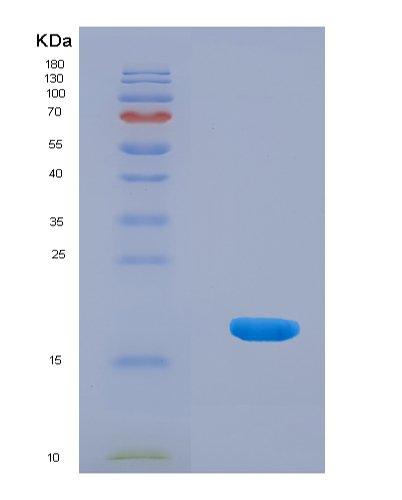
PurityGreater than 90% as determined by SDS-PAGE.
Expression SystemE.coli
Expression Region18-134aa
Tag InfoN-6His
Molecular weight17.2 kDa
EndotoxinLess than 1.0 EU/μg as determined by LAL method.

Function

The PDCD1-mediated inhibitory pathway is exploited by tumors to attenuate anti-tumor immunity and escape destruction by the immune system, thereby facilitating tumor survival. The interaction with PDCD1/PD-1 inhibits cytotoxic T lymphocytes (CTLs) effector function. The blockage of the PDCD1-mediated pathway results in the reversal of the exhausted T-cell phenotype and the normalization of the anti-tumor response, providing a rationale for cancer immunotherapy.

Product Specifications

Recombinant Programmed Cell Death Protein 1 Ligand 1 (PDL1) is a recombinant protein, expressed in E.coli, covering amino acids 18-134aa, with N-6His tag, molecular weight 17.2 kDa, purity Greater than 90% as determined by SDS-PAGE.. Suitable for ELISA and Western Blot applications.
Recommended applications depend on the target, product format, and product-specific validation data. Refer to the product datasheet or Certificate of Analysis (CoA), or contact BioCrest Sci for application guidance.

Biological Activity: Not implied unless activity data are explicitly listed on this product page, the datasheet, or the CoA.

Storage: PBS pH 7.4, 0.01% SKL, 5% Trehalose, 1% Mannitol

Shipping & Lead Time: Availability, shipping conditions, and estimated lead time are confirmed in the formal quotation or order confirmation based on the product format, destination, and order requirements.

Protein Biology

Function

The PDCD1-mediated inhibitory pathway is exploited by tumors to attenuate anti-tumor immunity and escape destruction by the immune system, thereby facilitating tumor survival (PubMed:28813410, PubMed:28813417). The interaction with PDCD1/PD-1 inhibits cytotoxic T lymphocytes (CTLs) effector function (By similarity). The blockage of the PDCD1-mediated pathway results in the reversal of the exhausted T-cell phenotype and the normalization of the anti-tumor response, providing a rationale for cancer immunotherapy (By similarity)

Gene: CD274  |  Organism: Homo sapiens

Frequently Asked Questions

How do I order or inquire about this product?

Submit the Online Inquiry form with your required quantity and specifications, or email sales@biocrestsci.com. Available sizes, pricing, stock status, documentation, and estimated lead time are confirmed in the formal quotation.

What is the shipping and delivery time?

Availability, dispatch timing, shipping conditions, and delivery estimates depend on the product format, destination, and order requirements. These details are confirmed in the formal quotation or order confirmation.

How should this product be stored?

Follow the storage and handling instructions in the product-specific datasheet and Certificate of Analysis (CoA). Requirements may vary by product form and formulation; contact BioCrest Sci if product-specific guidance is needed.

What quality controls are performed on your products?

Quality-control data such as identity, purity, endotoxin level, or biological activity are provided only when specified on this product page, the datasheet, or Certificate of Analysis (CoA). Biological activity is not implied unless explicitly stated.

Shopping Cart
Scroll to Top