Recombinant Human Poly [ADP-ribose] polymerase 9 (PARP9), partial

Recombinant Human Poly [ADP-ribose] polymerase 9 (PARP9), partial — ADP-ribosyltransferase which, in association with E3 ligase DTX3L, plays a role in DNA damage repair and in immune responses including interferon-mediated antiviral defenses. Purity >90%.

SKU: BCRECP-001344 Category:

Product Specifications

Product SkuBCRECP-001344
Product DescriptionRecombinant Human Poly [ADP-ribose] polymerase 9 (PARP9) Protein is expressed from E.coli with N-terminal 6xHis-tagged. It contains 628-854aa. [Accession | Q8IXQ6].
Uniprot No.Q8IXQ6
Gene NamesPARP9
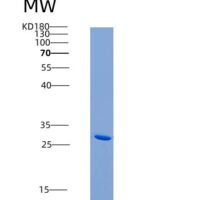
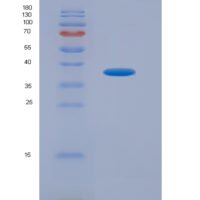
PurityGreater than 90% as determined by SDS-PAGE.
Expression SystemE.coli
Expression Region628-854aa
SpeciesHomo sapiens (Human)
Tag InfoN-terminal 6xHis-tagged
Molecular weight30.0kDa
ActivityPlease contact us to obtain bioactivity data.
BufferIf the delivery form is liquid, the default storage buffer is Tris/PBS-based buffer, 5%-50% glycerol. If the delivery form is lyophilized powder, the buffer before lyophilization is Tris/PBS-based buffer, 6% Trehalose.
StorageStore at -20°C/-80°C upon receipt, aliquoting is necessary for mutiple use. Avoid repeated freeze-thaw cycles.
Research AreasCancer

Function

ADP-ribosyltransferase which, in association with E3 ligase DTX3L, plays a role in DNA damage repair and in immune responses including interferon-mediated antiviral defenses. Within the complex, enhances DTX3L E3 ligase activity which is further enhanced by PARP9 binding to poly(ADP-ribose). In association with DTX3L and in presence of E1 and E2 enzymes, mediates NAD(+)-dependent mono-ADP-ribosylation of ubiquitin which prevents ubiquitin conjugation to substrates such as histones.

Biological Context

Subcellular Location: Cytoplasm, cytosol; Nucleus
Tissue Specificity: Expressed in lymphocyte-rich tissues, spleen, lymph nodes, peripheral blood lymphocytes and colonic mucosa. Expressed in macrophages. Also expressed in nonhematopoietic tissues such as heart and skeletal muscle. Isoform 2 is the predominant form. Most abundantly expressed in lymphomas with a brisk host inflammatory response. In diffuse large B-cell lymphomas tumors, expressed specifically by malignant B-cells
Disease Association: [Overexpressed at significantly higher levels in fatal high-risk diffuse large B-cell lymphomas (DLB-CL) compared to cured low-risk tumors. Overexpression in B-cell lymphoma transfectants may promote malignant B-cell migration. May therefore be involved in promoting B-cell migration and dissemination of high-risk DLB-CL tumors ]

Product Specifications

Recombinant Human Poly [ADP-ribose] polymerase 9 (PARP9), partial is a recombinant protein from Homo sapiens (Human), expressed in E.coli, covering amino acids 628-854aa, with N-terminal 6xHis-tagged tag, molecular weight 30.0kDa, purity Greater than 90% as determined by SDS-PAGE.. Suitable for ELISA and Western Blot applications.
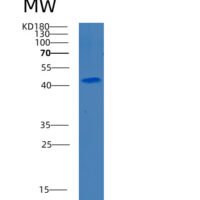
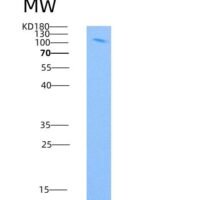
SDS-PAGE: Single band at expected molecular weight confirming purity.

ELISA: Suitable as coating antigen or detection standard.

Western Blot: Compatible with standard Western Blot protocols.

Protein Interaction: Validated for SPR (Surface Plasmon Resonance) and BLI (Bio-Layer Interferometry) studies.

Shipping: Shipped at ambient temperature. Lyophilized protein is stable during transit.

Storage: Store lyophilized protein at -20°C to -80°C. Reconstituted protein should be aliquoted and stored at -80°C. Avoid repeated freeze-thaw cycles.

Shelf Life: 12 months from date of receipt when stored as recommended.

Shipping Time: Orders placed before 2 PM EST ship same day. International orders typically deliver within 5-10 business days.

Protein Biology

Function

ADP-ribosyltransferase which, in association with E3 ligase DTX3L, plays a role in DNA damage repair and in immune responses including interferon-mediated antiviral defenses (PubMed:16809771, PubMed:23230272, PubMed:26479788, PubMed:27796300). Within the complex, enhances DTX3L E3 ligase activity which is further enhanced by PARP9 binding to poly(ADP-ribose) (PubMed:28525742). In association with DTX3L and in presence of E1 and E2 enzymes, mediates NAD(+)-dependent mono-ADP-ribosylation of ubiquitin which prevents ubiquitin conjugation to substrates such as histones (PubMed:28525742). During DNA repair, PARP1 recruits PARP9/BAL1-DTX3L complex to DNA damage sites via PARP9 binding to ribosylated PARP1 (PubMed:23230272). Subsequent PARP1-dependent PARP9/BAL1-DTX3L-mediated ubiquitination promotes the rapid and specific recruitment of 53BP1/TP53BP1, UIMC1/RAP80, and BRCA1 to DNA damage sites (PubMed:23230272, PubMed:28525742). In response to DNA damage, PARP9-DTX3L complex is required for efficient non-homologous end joining (NHEJ); the complex function is negatively modulated by PARP9 activity (PubMed:28525742). Dispensable for B-cell receptor (BCR) assembly through V(D)J recombination and class switch recombination (CSR) (By similarity). In macrophages, positively regulates pro-inflammatory cytokines production in response to IFNG stimulation by suppressing PARP14-mediated STAT1 ADP-ribosylation and thus promoting STAT1 phosphorylation (PubMed:27796300). Also suppresses PARP14-mediated STAT6 ADP-ribosylation (PubMed:27796300)

Subcellular Location

Cytoplasm, cytosol; Nucleus

Disease Association

[Overexpressed at significantly higher levels in fatal high-risk diffuse large B-cell lymphomas (DLB-CL) compared to cured low-risk tumors. Overexpression in B-cell lymphoma transfectants may promote malignant B-cell migration. May therefore be involved in promoting B-cell migration and dissemination of high-risk DLB-CL tumors (PubMed:11110709)]

Tissue Specificity

Expressed in lymphocyte-rich tissues, spleen, lymph nodes, peripheral blood lymphocytes and colonic mucosa (PubMed:11110709, PubMed:16809771). Expressed in macrophages (PubMed:27796300). Also expressed in nonhematopoietic tissues such as heart and skeletal muscle (PubMed:11110709, PubMed:16809771). Isoform 2 is the predominant form (PubMed:11110709). Most abundantly expressed in lymphomas with a brisk host inflammatory response (PubMed:11110709, PubMed:16809771). In diffuse large B-cell lymphomas tumors, expressed specifically by malignant B-cells (PubMed:11110709, PubMed:16809771)

Subunit

Forms a stable complex with E3 ligase DTX3L; the interaction is required for PARP9 mediated ADP-ribosylation of ubiquitin (PubMed:12670957, PubMed:28525742). Interacts (via PARP catalytic domain) with DTX3L (via N-terminus) (PubMed:26479788). Forms a complex with STAT1 and DTX3L independently of IFNB1 or IFNG-mediated STAT1 'Tyr-701' phosphorylation (PubMed:26479788). Forms a complex with STAT1, DTX3L and histone H2B H2BC9/H2BJ; the interaction is likely to induce H2BC9/H2BJ ubiquitination (PubMed:26479788). Interacts (via N-terminus) with STAT1 (PubMed:26479788). Interacts with PARP14 in IFNG-stimulated macrophages; the interaction prevents PARP14-mediated STAT1 and STAT6 ADP-riboslylation (PubMed:27796300). Interacts with PARP1 (when poly-ADP-ribosylated) (PubMed:23230272)

Gene: PARP9  |  Organism: Homo sapiens  |  Synonyms: ADP-ribosyltransferase diphtheria toxin-like 9; B aggressive lymphoma protein; Poly [ADP-ribose] polymerase 9
Key Publications

Frequently Asked Questions

How do I order or inquire about this product?

Fill out the Online Inquiry form with your required quantity and specifications. You can also email sales@biocrestsci.com. Our team typically responds within 4 business hours with a quote and availability confirmation.

What is the shipping and delivery time?

Orders placed before 2 PM EST ship the same day. Domestic (US) delivery typically takes 2-3 business days. International orders deliver within 5-10 business days. All products are shipped at ambient temperature with appropriate packaging to ensure stability.

How should I store this recombinant protein?

Lyophilized proteins should be stored at -20°C to -80°C upon receipt. After reconstitution, aliquot and store at -80°C. Avoid repeated freeze-thaw cycles. Shelf life is 12 months from date of receipt when stored as recommended.

What quality controls are performed on your products?

Each product undergoes SDS-PAGE purity analysis (typically >85-95%), endotoxin testing, and bioactivity validation. Products are validated for ELISA, Western Blot, and SPR/BLI applications as specified on this product page. A Certificate of Analysis (CoA) is available upon request.

Shopping Cart
Scroll to Top