Recombinant Human Antiviral innate immune response receptor RIG-I (RIGI), partial

Recombinant Human Antiviral innate immune response receptor RIG-I (RIGI), partial — Innate immune receptor that senses cytoplasmic viral nucleic acids and activates a downstream signaling cascade leading to the production of type I interferons and pro-inflammatory cytokines. Purity >90%.

SKU: BCRECP-001537 Category:

Product Specifications

Product SkuBCRECP-001537
Product DescriptionRecombinant Human Antiviral innate immune response receptor RIG-I (RIGI) Protein is expressed from E.coli with N-terminal 6xHis-tagged. It contains 1-430aa. [Accession | O95786].
Uniprot No.O95786
Gene NamesRIGI
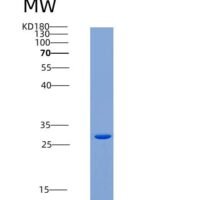
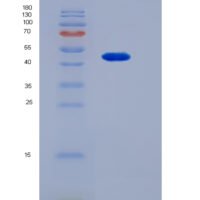
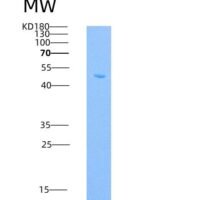
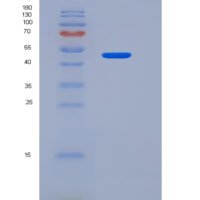
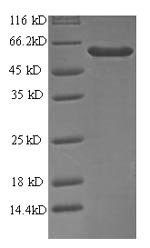
PurityGreater than 90% as determined by SDS-PAGE.
Expression SystemE.coli
Expression Region1-430aa
SpeciesHomo sapiens (Human)
Tag InfoN-terminal 6xHis-tagged
Molecular weight53.3kDa
ActivityPlease contact us to obtain bioactivity data.
BufferIf the delivery form is liquid, the default storage buffer is Tris/PBS-based buffer, 5%-50% glycerol. If the delivery form is lyophilized powder, the buffer before lyophilization is Tris/PBS-based buffer, 6% Trehalose.
StorageStore at -20°C/-80°C upon receipt, aliquoting is necessary for mutiple use. Avoid repeated freeze-thaw cycles.
Research AreasImmunology

Function

Innate immune receptor that senses cytoplasmic viral nucleic acids and activates a downstream signaling cascade leading to the production of type I interferons and pro-inflammatory cytokines. Forms a ribonucleoprotein complex with viral RNAs on which it homooligomerizes to form filaments.

Product Specifications

Recombinant Human Antiviral innate immune response receptor RIG-I (RIGI), partial — Innate immune receptor that senses cytoplasmic viral nucleic acids and activates a downstream signaling cascade leading to the production of type I interferons and pro-inflammatory cytokines. Purity >90%. Suitable for ELISA and Western Blot applications.

SDS-PAGE: Single band at expected molecular weight confirming purity.

ELISA: Suitable as coating antigen or detection standard.

Western Blot: Compatible with standard Western Blot protocols.

Protein Interaction: Validated for SPR (Surface Plasmon Resonance) and BLI (Bio-Layer Interferometry) studies.

Shipping: Shipped at ambient temperature. Lyophilized protein is stable during transit.

Storage: Store lyophilized protein at -20°C to -80°C. Reconstituted protein should be aliquoted and stored at -80°C. Avoid repeated freeze-thaw cycles.

Shelf Life: 12 months from date of receipt when stored as recommended.

Shipping Time: Orders placed before 2 PM EST ship same day. International orders typically deliver within 5-10 business days.

Protein Biology

Function

Innate immune receptor that senses cytoplasmic viral nucleic acids and activates a downstream signaling cascade leading to the production of type I interferons and pro-inflammatory cytokines (PubMed:15208624, PubMed:15708988, PubMed:16125763, PubMed:16127453, PubMed:16153868, PubMed:17190814, PubMed:18636086, PubMed:19122199, PubMed:19211564, PubMed:24366338, PubMed:28469175, PubMed:29117565, PubMed:31006531, PubMed:34935440, PubMed:35263596, PubMed:36793726). Forms a ribonucleoprotein complex with viral RNAs on which it homooligomerizes to form filaments (PubMed:15208624, PubMed:15708988). The homooligomerization allows the recruitment of RNF135 an E3 ubiquitin-protein ligase that activates and amplifies the RIG-I-mediated antiviral signaling in an RNA length-dependent manner through ubiquitination-dependent and -independent mechanisms (PubMed:28469175, PubMed:31006531). Upon activation, associates with mitochondria antiviral signaling protein (MAVS/IPS1) that activates the IKK-related kinases TBK1 and IKBKE which in turn phosphorylate the interferon regulatory factors IRF3 and IRF7, activating transcription of antiviral immunological genes including the IFN-alpha and IFN-beta interferons (PubMed:28469175, PubMed:31006531). Ligands include 5'-triphosphorylated ssRNAs and dsRNAs but also short dsRNAs (<1 kb in length) (PubMed:15208624, PubMed:15708988, PubMed:19576794, PubMed:19609254, PubMed:21742966). In addition to the 5'-triphosphate moiety, blunt-end base pairing at the 5'-end of the RNA is very essential (PubMed:15208624, PubMed:15708988, PubMed:19576794, PubMed:19609254, PubMed:21742966). Overhangs at the non-triphosphorylated end of the dsRNA RNA have no major impact on its activity (PubMed:15208624, PubMed:15708988, PubMed:19576794, PubMed:19609254, PubMed:21742966). A 3'overhang at the 5'triphosphate end decreases and any 5'overhang at the 5' triphosphate end abolishes its activity (PubMed:15208624, PubMed:15708988, PubMed:19576794, PubMed:19609254, PubMed:21742966). Detects both positive and negative strand RNA viruses including members of the families Paramyxoviridae: Human respiratory syncytial virus and measles virus (MeV), Rhabdoviridae: vesicular stomatitis virus (VSV), Orthomyxoviridae: influenza A and B virus, Flaviviridae: Japanese encephalitis virus (JEV), hepatitis C virus (HCV), dengue virus (DENV) and west Nile virus (WNV) (PubMed:21616437, PubMed:21884169). It also detects rotaviruses and reoviruses (PubMed:21616437, PubMed:21884169). Detects and binds to SARS-CoV-2 RNAs which is inhibited by m6A RNA modifications (Ref.74). Also involved in antiviral signaling in response to viruses containing a dsDNA genome such as Epstein-Barr virus (EBV) (PubMed:19631370). Detects dsRNA produced from non-self dsDNA by RNA polymerase III, such as Epstein-Barr virus-encoded RNAs (EBERs). May play important roles in granulocyte production and differentiation, bacterial phagocytosis and in the regulation of cell migration

Subcellular Location

Cytoplasm; Cell projection, ruffle membrane; Cytoplasm, cytoskeleton; Cell junction, tight junction

Disease Association

Singleton-Merten syndrome 2 (SGMRT2) : A form of Singleton-Merten syndrome, an autosomal dominant disorder characterized by marked aortic calcification, dental anomalies, osteopenia, acro-osteolysis, and to a lesser extent glaucoma, psoriasis, muscle weakness, and joint laxity. Additional clinical manifestations include particular facial characteristics and abnormal joint and muscle ligaments. SGMRT2 is an atypical form characterized by variable expression of glaucoma, aortic calcification, and skeletal abnormalities, without dental anomalies. [The disease is caused by variants affecting the gene represented in this entry]

Tissue Specificity

Present in vascular smooth cells (at protein level)

Subunit

(Microbial infection) Interacts with Severe fever with thrombocytopenia virus (SFTSV) NSs; this interaction this interaction sequesters RIGI in NSs-induced cytoplasmic inclusion bodies thereby inhibiting the IFN responses

Gene: RIGI  |  Organism: Homo sapiens  |  Synonyms: ATP-dependent RNA helicase DDX58; DEAD box protein 58; RIG-I-like receptor 1; RNA sensor RIG-I; Retinoic acid-inducible gene 1 protein; Retinoic acid-inducible gene I protein
Key Publications

Frequently Asked Questions

How do I order or inquire about this product?

Fill out the Online Inquiry form with your required quantity and specifications. You can also email sales@biocrestsci.com. Our team typically responds within 4 business hours with a quote and availability confirmation.

What is the shipping and delivery time?

Orders placed before 2 PM EST ship the same day. Domestic (US) delivery typically takes 2-3 business days. International orders deliver within 5-10 business days. All products are shipped at ambient temperature with appropriate packaging to ensure stability.

How should I store this recombinant protein?

Lyophilized proteins should be stored at -20°C to -80°C upon receipt. After reconstitution, aliquot and store at -80°C. Avoid repeated freeze-thaw cycles. Shelf life is 12 months from date of receipt when stored as recommended.

What quality controls are performed on your products?

Each product undergoes SDS-PAGE purity analysis (typically >85-95%), endotoxin testing, and bioactivity validation. Products are validated for ELISA, Western Blot, and SPR/BLI applications as specified on this product page. A Certificate of Analysis (CoA) is available upon request.

Shopping Cart
Scroll to Top