Function
Binds to photoactivated, phosphorylated RHO and terminates RHO signaling via G proteins by competing with G proteins for the same binding site on RHO. May play a role in preventing light-dependent degeneration of retinal photoreceptor cells.
Biological Context
Subcellular Location: Cell projection, cilium, photoreceptor outer segment; Membrane (Peripheral membrane protein)
Tissue Specificity: Detected in retina, in the proximal portion of the outer segment of rod photoreceptor cells (at protein level)
Disease Association: Night blindness, congenital stationary, Oguchi type 1 (CSNBO1) : A non-progressive retinal disorder characterized by impaired night vision, often associated with nystagmus and myopia. Congenital stationary night blindness Oguchi type is an autosomal recessive form associated with fundus discoloration and abnormally slow dark adaptation. [The disease is caused by variants affecting the gene represented in this entry] | Retinitis pigmentosa 47 (RP47) : A retinal dystrophy belonging to the group of pigmentary retinopathies. Retinitis pigmentosa is characterized by retinal pigment deposits visible on fundus examination and primary loss of rod photoreceptor cells followed by secondary loss of cone photoreceptors. Patients typically have night vision blindness and loss of midperipheral visual field. As their condition progresses, they lose their far peripheral visual field and eventually central vision as well. [The disease is caused by variants affecting the gene represented in this entry] | Retinitis pigmentosa 96 (RP96) : An autosomal dominant form of retinitis pigmentosa, a retinal dystrophy belonging to the group of pigmentary retinopathies. Retinitis pigmentosa is characterized by retinal pigment deposits visible on fundus examination and primary loss of rod photoreceptor cells followed by secondary loss of cone photoreceptors. Patients typically have night vision blindness and loss of midperipheral visual field. [The disease is caused by variants affecting the gene represented in this entry]
Product Specifications
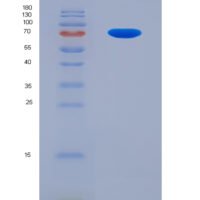
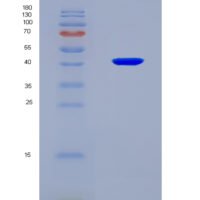
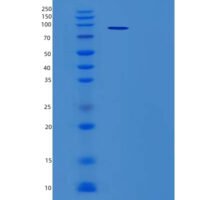
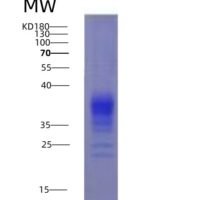
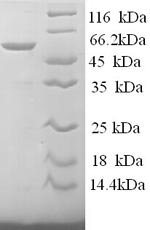
Recombinant Human S-arrestin (SAG) is a recombinant protein from Homo sapiens (Human), expressed in Yeast, covering amino acids 1-405aa, with N-terminal 6xHis-tagged tag, molecular weight 47.1kDa, purity Greater than 90% as determined by SDS-PAGE.. Suitable for ELISA and Western Blot applications.