Function
Pore-forming subunit of Nav1.1, a voltage-gated sodium (Nav) channel that directly mediates the depolarizing phase of action potentials in excitable membranes. Navs, also called VGSCs (voltage-gated sodium channels) or VDSCs (voltage-dependent sodium channels), operate by switching between closed and open conformations depending on the voltage difference across the membrane. In the open conformation they allow Na(+) ions to selectively pass through the pore, along their electrochemical gradient.
Biological Context
Subcellular Location: Cell membrane (Multi-pass membrane protein)
Disease Association: Generalized epilepsy with febrile seizures plus 2 (GEFSP2) : A rare autosomal dominant, familial condition with incomplete penetrance and large intrafamilial variability. Patients display febrile seizures persisting sometimes beyond the age of 6 years and/or a variety of afebrile seizure types. This disease combines febrile seizures, generalized seizures often precipitated by fever at age 6 years or more, and partial seizures, with a variable degree of severity. [The disease is caused by variants affecting the gene represented in this entry] | Dravet syndrome (DRVT) : A severe form of epileptic encephalopathy characterized by generalized tonic, clonic, and tonic-clonic seizures that are initially induced by fever and begin during the first year of life. Later, patients also manifest other seizure types, including absence, myoclonic, and simple and complex partial seizures. Psychomotor development delay is observed around the second year of life. Some patients manifest a borderline disease phenotype and do not necessarily fulfill all diagnostic criteria for core DRVT. DRVT is considered to be the most severe phenotype within the spectrum of generalized epilepsies with febrile seizures-plus. [The disease is caused by variants affecting the gene represented in this entry] | Intractable childhood epilepsy with generalized tonic-clonic seizures (ICEGTC) : A disorder characterized by generalized tonic-clonic seizures beginning usually in infancy and induced by fever. Seizures are associated with subsequent mental decline, as well as ataxia or hypotonia. ICEGTC is similar to SMEI, except for the absence of myoclonic seizures. [The disease is caused by variants affecting the gene represented in this entry] | Migraine, familial hemiplegic, 3 (FHM3) : A subtype of migraine associated with transient blindness in some families. Migraine is a disabling symptom complex of periodic headaches, usually temporal and unilateral. Headaches are often accompanied by irritability, nausea, vomiting and photophobia, preceded by constriction of the cranial arteries. The two major subtypes are common migraine (migraine without aura) and classic migraine (migraine with aura). Classic migraine is characterized by recurrent attacks of reversible neurological symptoms (aura) that precede or accompany the headache. Aura may include a combination of sensory disturbances, such as blurred vision, hallucinations, vertigo, numbness and difficulty in concentrating and speaking. [The disease is caused by variants affecting the gene represented in this entry] | Febrile seizures, familial, 3A (FEB3A) : Seizures associated with febrile episodes in childhood without any evidence of intracranial infection or defined pathologic or traumatic cause. It is a common condition, affecting 2-5% of children aged 3 months to 5 years. The majority are simple febrile seizures (generally defined as generalized onset, single seizures with a duration of less than 30 minutes). Complex febrile seizures are characterized by focal onset, duration greater than 30 minutes, and/or more than one seizure in a 24 hour period. The likelihood of developing epilepsy following simple febrile seizures is low. Complex febrile seizures are associated with a moderately increased incidence of epilepsy. [The disease is caused by variants affecting the gene represented in this entry] | Developmental and epileptic encephalopathy 6B (DEE6B) : A form of epileptic encephalopathy, a heterogeneous group of severe early-onset epilepsies characterized by refractory seizures, neurodevelopmental impairment, and poor prognosis. Development is normal prior to seizure onset, after which cognitive and motor delays become apparent. DEE6B is an autosomal dominant condition characterized by onset of seizures in early infancy, profoundly impaired intellectual development, and a hyperkinetic movement disorder. [The disease is caused by variants affecting the gene represented in this entry] | [SCN1A mutations may be involved in Panayiotopoulos syndrome, a benign age-related focal seizure disorder occurring in early and mid-childhood. It is characterized by seizures, often prolonged, with predominantly autonomic symptoms, and by an electroencephalogram that shows shifting and/or multiple foci, often with occipital predominance. Autonomic seizures in Panayiotopoulos syndrome consist of episodes of disturbed autonomic function with emesis as the predominant symptom. Cardiorespiratory arrest is exceptional]
Product Specifications
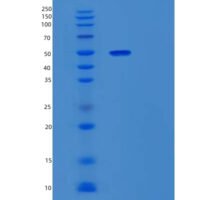
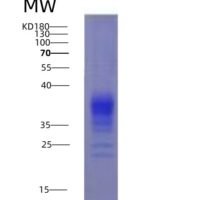
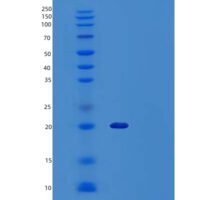
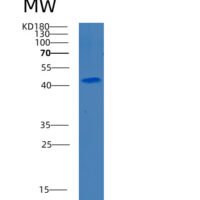
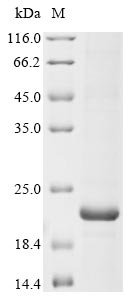
Recombinant Human Sodium channel protein type 1 subunit alpha (SCN1A), partial is a recombinant protein from Homo sapiens (Human), expressed in E.coli, covering amino acids 1-128aa, with N-terminal 6xHis-tagged tag, molecular weight 18.5kDa, purity Greater than 85% as determined by SDS-PAGE.. Suitable for ELISA and Western Blot applications.