Function
Electroneutral transporter of the plasma membrane mediating the cellular uptake of the divalent metal cations zinc, manganese and iron that are important for tissue homeostasis, metabolism, development and immunity. Functions as an energy-dependent symporter, transporting through the membranes an electroneutral complex composed of a divalent metal cation and two bicarbonate anions. Beside these endogenous cellular substrates, can also import cadmium a non-essential metal which is cytotoxic and carcinogenic.
Biological Context
Subcellular Location: Cell membrane (Multi-pass membrane protein); Apical cell membrane (Multi-pass membrane protein); Basolateral cell membrane (Multi-pass membrane protein); Early endosome membrane (Multi-pass membrane protein); Late endosome membrane (Multi-pass membrane protein); Lysosome membrane (Multi-pass membrane protein)
Tissue Specificity: Widely expressed but not detected in brain, heart, skeletal muscle, placenta and fetal skin
Disease Association: Hypermanganesemia with dystonia 2 (HMNDYT2) : A metabolic autosomal recessive disorder characterized by increased blood manganese levels, neurodegeneration, and rapidly progressive parkinsonism and dystonia. Affected individuals present with loss of developmental milestones, progressive dystonia and bulbar dysfunction in infancy or early childhood. Towards the end of the first decade, they manifest severe generalized pharmacoresistant dystonia, spasticity, limb contractures and scoliosis, and loss of independent ambulation. Cognition may be impaired, but is better preserved than motor function. [The disease is caused by variants affecting the gene represented in this entry] | Hyperostosis cranialis interna (HCIN) : An autosomal dominant bone disorder characterized by endosteal hyperostosis and osteosclerosis of the calvaria and the skull base. The progressive bone overgrowth causes entrapment and dysfunction of cranial nerves I, II, V, VII, and VIII, its first symptoms often presenting during the second decade of life. [The disease is caused by variants affecting the gene represented in this entry. Conditional knockin mice overexpressing Arg-438 variant, which is the mouse equivalent of human variant Leu-441, in osteoblasts have a severe skeletal phenotype marked by a drastic increase in cortical thickness due to an enhanced endosteal bone formation, resembling the underlying pathology in HCI patients]
Product Specifications
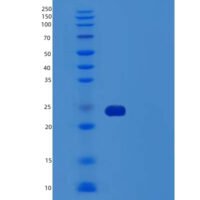
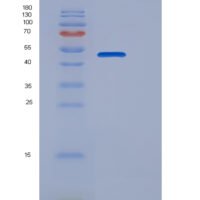
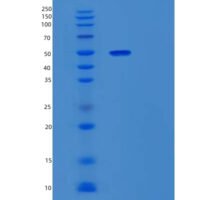
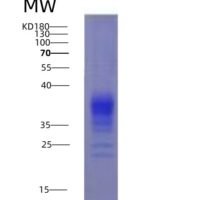
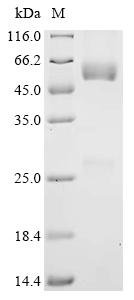
Recombinant Human Metal cation symporter ZIP14 (SLC39A14), partial is a recombinant protein from Homo sapiens (Human), expressed in Mammalian cell, covering amino acids 31-157aa, with C-terminal hFc1-tagged tag, molecular weight 42.7kDa, purity Greater than 85% as determined by SDS-PAGE.. Suitable for ELISA and Western Blot applications.