Function
(Microbial infection) Acts as a receptor for P.falciparum (isolate 3D7) MSP9 and thus, facilitates merozoite invasion of erythrocytes. Acts as a receptor for P.falciparum (isolate 3D7) MSP1 and thus, facilitates merozoite invasion of erythrocytes.
Biological Context
Subcellular Location: Cell membrane (Multi-pass membrane protein); Basolateral cell membrane (Multi-pass membrane protein)
Tissue Specificity: Expressed in kidney (at protein level)
Disease Association: Ovalocytosis, Southeast Asian (SAO) : An autosomal dominant hematologic disorder characterized by ovalocytic erythrocytes that are rigid and exhibit reduced expression of many erythrocyte antigens. Clinical manifestations include mild hemolysis, intermittent jaundice and gallstones. However, the disorder is most often asymptomatic. [The disease is caused by variants affecting the gene represented in this entry] | Spherocytosis 4 (SPH4) : An autosomal dominant form of spherocytosis, a group of hematologic disorders characterized by the presence of numerous abnormally shaped erythrocytes which are generally spheroidal. Affected individuals have anemia, jaundice, and splenomegaly. Clinical severity is variable. Some individuals are asymptomatic, whereas others have severe hemolytic anemia requiring erythrocyte transfusion. [The disease is caused by variants affecting the gene represented in this entry] | Renal tubular acidosis, distal, 1 (DRTA1) : An autosomal dominant disease characterized by reduced ability to acidify urine, variable hyperchloremic hypokalemic metabolic acidosis, nephrocalcinosis, and nephrolithiasis. It is due to functional failure of alpha-intercalated cells of the cortical collecting duct of the distal nephron, where vectorial proton transport is required for urinary acidification. [The disease is caused by variants affecting the gene represented in this entry] | Renal tubular acidosis, distal, 4, with hemolytic anemia (DRTA4) : An autosomal recessive disease characterized by the association of hemolytic anemia with distal renal tubular acidosis, the reduced ability to acidify urine resulting in variable hyperchloremic hypokalemic metabolic acidosis, nephrocalcinosis, and nephrolithiasis. [The disease is caused by variants affecting the gene represented in this entry] | Cryohydrocytosis (CHC) : An autosomal dominant disorder of red cell membrane permeability characterized by cold-induced changes in cell volume, resulting in cold-sensitive stomatocytosis, and increased erythrocyte osmotic fragility and autohemolysis at 4 degrees Celsius. Patients present with mild to moderate hemolytic anemia, splenomegaly, fatigue, and pseudohyperkalemia due to a potassium leak from the erythrocytes. [The disease is caused by variants affecting distinct genetic loci, including the gene represented in this entry]
Product Specifications
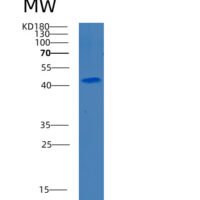
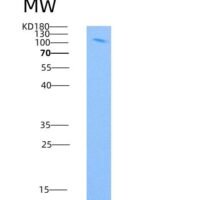
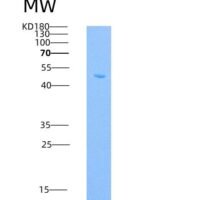
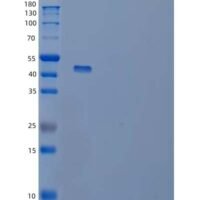
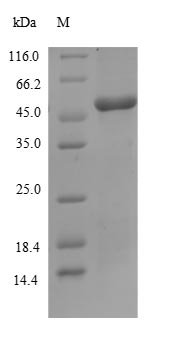
Recombinant Human Band 3 anion transport protein (SLC4A1), partial is a recombinant protein from Homo sapiens (Human), expressed in E.coli, covering amino acids 1-403aa, with N-terminal 10xHis-tagged and C-terminal Myc-tagged tag, molecular weight 50.3kDa, purity Greater than 90% as determined by SDS-PAGE.. Suitable for ELISA and Western Blot applications.