Function
Transfers the sialyl group (N-acetyl-alpha-neuraminyl or NeuAc) from CMP-NeuAc to the non-reducing terminal galactose (Gal) of glycosphingolipids forming gangliosides (important molecules involved in the regulation of multiple cellular processes, including cell proliferation and differentiation, apoptosis, embryogenesis, development, and oncogenesis). Mainly involved in the biosynthesis of ganglioside GM3 but can also use different glycolipids as substrate acceptors such as D-galactosylceramide (GalCer), asialo-GM2 (GA2) and asialo-GM1 (GA1), although less preferentially than beta-D-Gal-(1->4)-beta-D-Glc-(1<->1)-Cer (LacCer).
Biological Context
Subcellular Location: Golgi apparatus membrane (Single-pass type II membrane protein)
Tissue Specificity: Ubiquitous. High expression in brain, skeletal muscle, placenta, and testis. mRNA widely distributed in human brain, but slightly elevated expression was observed in the cerebral cortex, temporal lobe, and putamen
Disease Association: Salt and pepper developmental regression syndrome (SPDRS) : A rare autosomal recessive disorder characterized by infantile onset of severe, recurrent and refractory seizures, failure to thrive, psychomotor delay, developmental stagnation, and cortical blindness. Deafness is observed in some patients. Affected individuals have patches of skin hypo- or hyperpigmentation on the trunk, face, and extremities. [The disease is caused by variants affecting the gene represented in this entry]
Pathway: Glycolipid biosynthesis
Product Specifications
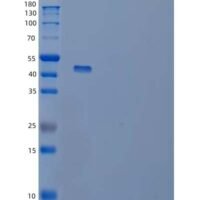
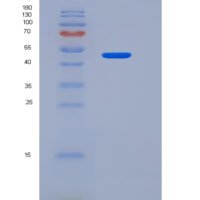
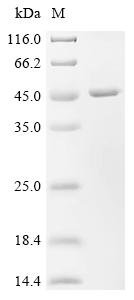
Recombinant Human Lactosylceramide alpha-2,3-sialyltransferase (ST3GAL5), partial is a recombinant protein from Homo sapiens (Human), expressed in E.coli, covering amino acids 83-418aa, with C-terminal 6xHis-tagged tag, molecular weight 45.6kDa, purity Greater than 90% as determined by SDS-PAGE.. Suitable for ELISA and Western Blot applications. Explore more Enzyme proteins →