Function
Telomerase is a ribonucleoprotein enzyme essential for the replication of chromosome termini in most eukaryotes. Active in progenitor and cancer cells. Inactive, or very low activity, in normal somatic cells.
Biological Context
Subcellular Location: Nucleus, nucleolus; Nucleus, nucleoplasm; Nucleus; Chromosome, telomere; Cytoplasm; Nucleus, PML body
Tissue Specificity: Expressed at a high level in thymocyte subpopulations, at an intermediate level in tonsil T-lymphocytes, and at a low to undetectable level in peripheral blood T-lymphocytes
Disease Association: [Activation of telomerase has been implicated in cell immortalization and cancer cell pathogenesis] | Aplastic anemia (AA) : A form of anemia in which the bone marrow fails to produce adequate numbers of peripheral blood elements. It is characterized by peripheral pancytopenia and marrow hypoplasia. [Disease susceptibility is associated with variants affecting the gene represented in this entry] | [Genetic variations in TERT are associated with coronary artery disease (CAD)] | Dyskeratosis congenita, autosomal dominant, 2 (DKCA2) : A rare multisystem disorder caused by defective telomere maintenance. It is characterized by progressive bone marrow failure, and the clinical triad of reticulated skin hyperpigmentation, nail dystrophy, and mucosal leukoplakia. Common but variable features include premature graying, aplastic anemia, low platelets, osteoporosis, pulmonary fibrosis, and liver fibrosis among others. Early mortality is often associated with bone marrow failure, infections, fatal pulmonary complications, or malignancy. [The disease is caused by variants affecting the gene represented in this entry] | Pulmonary fibrosis, and/or bone marrow failure syndrome, telomere-related, 1 (PFBMFT1) : An autosomal dominant disease associated with shortened telomeres. Pulmonary fibrosis is the most common manifestation. Other manifestations include aplastic anemia due to bone marrow failure, hepatic fibrosis, and increased cancer risk, particularly myelodysplastic syndrome and acute myeloid leukemia. Phenotype, age at onset, and severity are determined by telomere length. [The disease is caused by variants affecting the gene represented in this entry] | Dyskeratosis congenita, autosomal recessive, 4 (DKCB4) : A severe form of dyskeratosis congenita, a rare multisystem disorder caused by defective telomere maintenance. It is characterized by progressive bone marrow failure, and the clinical triad of reticulated skin hyperpigmentation, nail dystrophy, and mucosal leukoplakia. Common but variable features include premature graying, aplastic anemia, low platelets, osteoporosis, pulmonary fibrosis, and liver fibrosis among others. Early mortality is often associated with bone marrow failure, infections, fatal pulmonary complications, or malignancy. [The disease is caused by variants affecting the gene represented in this entry] | Melanoma, cutaneous malignant 9 (CMM9) : A malignant neoplasm of melanocytes, arising de novo or from a pre-existing benign nevus, which occurs most often in the skin but may also involve other sites. [Disease susceptibility is associated with variants affecting the gene represented in this entry]
Product Specifications
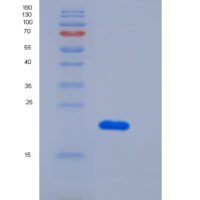
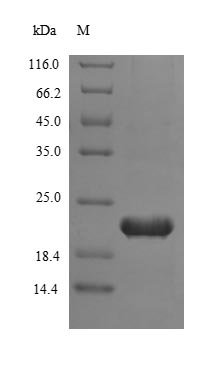
Recombinant Human Telomerase reverse transcriptase (TERT), partial is a recombinant protein from Homo sapiens (Human), expressed in E.coli, covering amino acids 281-436aa, with N-terminal 6xHis-tagged tag, molecular weight 22.7kDa, purity Greater than 85% as determined by SDS-PAGE.. Suitable for ELISA and Western Blot applications.