Function
Receptor for TNFSF11/RANKL/TRANCE/OPGL; essential for RANKL-mediated osteoclastogenesis. Its interaction with EEIG1 promotes osteoclastogenesis via facilitating the transcription of NFATC1 and activation of PLCG2. Involved in the regulation of interactions between T-cells and dendritic cells.
Biological Context
Subcellular Location: Cell membrane (Single-pass type I membrane protein)
Tissue Specificity: Ubiquitous expression with high levels in skeletal muscle, thymus, liver, colon, small intestine and adrenal gland
Disease Association: Familial expansile osteolysis (FEO) : Rare autosomal dominant bone disorder characterized by focal areas of increased bone remodeling. The osteolytic lesions develop usually in the long bones during early adulthood. FEO is often associated with early-onset deafness and loss of dentition. [The disease is caused by variants affecting the gene represented in this entry] | Paget disease of bone 2, early-onset (PDB2) : A form of Paget disease, a disorder of bone remodeling characterized by increased bone turnover affecting one or more sites throughout the skeleton, primarily the axial skeleton. Osteoclastic overactivity followed by compensatory osteoblastic activity leads to a structurally disorganized mosaic of bone (woven bone), which is mechanically weaker, larger, less compact, more vascular, and more susceptible to fracture than normal adult lamellar bone. [The disease is caused by variants affecting the gene represented in this entry] | Osteopetrosis, autosomal recessive 7 (OPTB7) : A rare genetic disease characterized by abnormally dense bone, due to defective resorption of immature bone. Osteopetrosis occurs in two forms: a severe autosomal recessive form occurring in utero, infancy, or childhood, and a benign autosomal dominant form occurring in adolescence or adulthood. Recessive osteopetrosis commonly manifests in early infancy with macrocephaly, feeding difficulties, evolving blindness and deafness, bone marrow failure, severe anemia, and hepatosplenomegaly. Deafness and blindness are generally thought to represent effects of pressure on nerves. OPTB7 is characterized by paucity of osteoclasts, suggesting a molecular defect in osteoclast development. OPTB7 is associated with hypogammaglobulinemia. [The disease is caused by variants affecting the gene represented in this entry]
Product Specifications
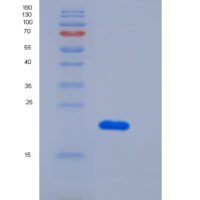
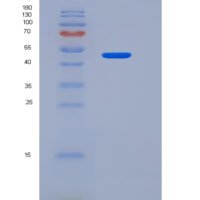
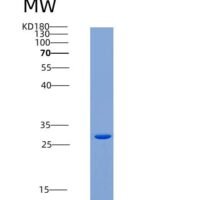
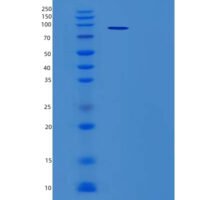
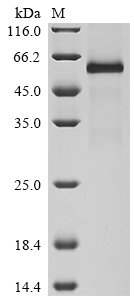
Recombinant Human Tumor necrosis factor receptor superfamily member 11A (TNFRSF11A), partial is a recombinant protein from Homo sapiens (Human), expressed in Mammalian cell, covering amino acids 30-212aa, with C-terminal hFc1-Flag-tagged tag, molecular weight 50.0kDa, purity Greater than 90% as determined by SDS-PAGE.. Suitable for ELISA and Western Blot applications. Explore more TNF Family proteins →