Recombinant Human DNA repair protein XRCC3 (XRCC3)

Recombinant Human DNA repair protein XRCC3 (XRCC3) — Involved in the homologous recombination repair (HRR) pathway of double-stranded DNA, thought to repair chromosomal fragmentation, translocations and deletions. Purity >90%.

SKU: BCRECP-001919 Category:

Product Specifications

Product SkuBCRECP-001919
Product DescriptionRecombinant Human DNA repair protein XRCC3 (XRCC3) Protein is expressed from E.coli with N-terminal 6xHis-SUMO-tagged. It contains 1-346aa. [Accession | O43542].
Uniprot No.O43542
Gene NamesXRCC3
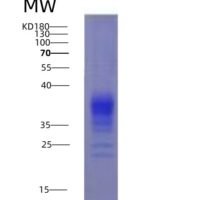
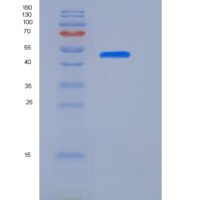
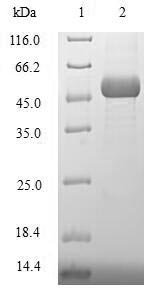
PurityGreater than 90% as determined by SDS-PAGE.
Expression SystemE.coli
Expression Region1-346aa
SpeciesHomo sapiens (Human)
Tag InfoN-terminal 6xHis-SUMO-tagged
Molecular weight50.8kDa
ActivityPlease contact us to obtain bioactivity data.
BufferIf the delivery form is liquid, the default storage buffer is Tris/PBS-based buffer, 5%-50% glycerol. If the delivery form is lyophilized powder, the buffer before lyophilization is Tris/PBS-based buffer, 6% Trehalose.
StorageStore at -20°C/-80°C upon receipt, aliquoting is necessary for mutiple use. Avoid repeated freeze-thaw cycles.
Research AreasEpigenetics and Nuclear Signaling

Function

Involved in the homologous recombination repair (HRR) pathway of double-stranded DNA, thought to repair chromosomal fragmentation, translocations and deletions. Part of the RAD51 paralog protein complex CX3 which acts in the BRCA1-BRCA2-dependent HR pathway. Upon DNA damage, CX3 acts downstream of RAD51 recruitment; the complex binds predominantly to the intersection of the four duplex arms of the Holliday junction (HJ) and to junctions of replication forks.

Biological Context

Subcellular Location: Nucleus; Cytoplasm; Cytoplasm, perinuclear region; Mitochondrion
Disease Association: Breast cancer (BC) : A common malignancy originating from breast epithelial tissue. Breast neoplasms can be distinguished by their histologic pattern. Invasive ductal carcinoma is by far the most common type. Breast cancer is etiologically and genetically heterogeneous. Important genetic factors have been indicated by familial occurrence and bilateral involvement. Mutations at more than one locus can be involved in different families or even in the same case. [Disease susceptibility is associated with variants affecting the gene represented in this entry] | Melanoma, cutaneous malignant 6 (CMM6) : A malignant neoplasm of melanocytes, arising de novo or from a pre-existing benign nevus, which occurs most often in the skin but may also involve other sites. [Disease susceptibility may be associated with variants affecting the gene represented in this entry. Variant p.Thr341Met has been reported to be associated with an increased risk for CMM6. Further studies have shown that this variant is functional in homology-directed DNA repair, and the association of XRCC3 with CMM6 has not been confirmed ]

Product Specifications

Recombinant Human DNA repair protein XRCC3 (XRCC3) is a recombinant protein from Homo sapiens (Human), expressed in E.coli, covering amino acids 1-346aa, with N-terminal 6xHis-SUMO-tagged tag, molecular weight 50.8kDa, purity Greater than 90% as determined by SDS-PAGE.. Suitable for ELISA and Western Blot applications.
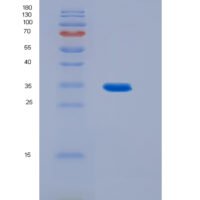
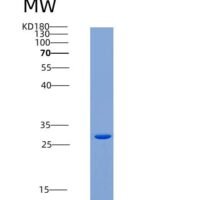
SDS-PAGE: Single band at expected molecular weight confirming purity.

ELISA: Suitable as coating antigen or detection standard.

Western Blot: Compatible with standard Western Blot protocols.

Protein Interaction: Validated for SPR (Surface Plasmon Resonance) and BLI (Bio-Layer Interferometry) studies.

Shipping: Shipped at ambient temperature. Lyophilized protein is stable during transit.

Storage: Store lyophilized protein at -20°C to -80°C. Reconstituted protein should be aliquoted and stored at -80°C. Avoid repeated freeze-thaw cycles.

Shelf Life: 12 months from date of receipt when stored as recommended.

Shipping Time: Orders placed before 2 PM EST ship same day. International orders typically deliver within 5-10 business days.

Protein Biology

Function

Involved in the homologous recombination repair (HRR) pathway of double-stranded DNA, thought to repair chromosomal fragmentation, translocations and deletions. Part of the RAD51 paralog protein complex CX3 which acts in the BRCA1-BRCA2-dependent HR pathway. Upon DNA damage, CX3 acts downstream of RAD51 recruitment; the complex binds predominantly to the intersection of the four duplex arms of the Holliday junction (HJ) and to junctions of replication forks. Involved in HJ resolution and thus in processing HR intermediates late in the DNA repair process; the function may be linked to the CX3 complex and seems to involve GEN1 during mitotic cell cycle progression. Part of a PALB2-scaffolded HR complex containing BRCA2 and RAD51C and which is thought to play a role in DNA repair by HR. Plays a role in regulating mitochondrial DNA copy number under conditions of oxidative stress in the presence of RAD51 and RAD51C

Subcellular Location

Nucleus; Cytoplasm; Cytoplasm, perinuclear region; Mitochondrion

Disease Association

Breast cancer (BC) : A common malignancy originating from breast epithelial tissue. Breast neoplasms can be distinguished by their histologic pattern. Invasive ductal carcinoma is by far the most common type. Breast cancer is etiologically and genetically heterogeneous. Important genetic factors have been indicated by familial occurrence and bilateral involvement. Mutations at more than one locus can be involved in different families or even in the same case. [Disease susceptibility is associated with variants affecting the gene represented in this entry] | Melanoma, cutaneous malignant 6 (CMM6) : A malignant neoplasm of melanocytes, arising de novo or from a pre-existing benign nevus, which occurs most often in the skin but may also involve other sites. [Disease susceptibility may be associated with variants affecting the gene represented in this entry. Variant p.Thr341Met has been reported to be associated with an increased risk for CMM6 (PubMed:11059748). Further studies have shown that this variant is functional in homology-directed DNA repair, and the association of XRCC3 with CMM6 has not been confirmed (PubMed:12037675, PubMed:12376526, PubMed:26137085, PubMed:26922354)]

Subunit

Interacts with RAD51C and RAD51. Part of the CX3 complex consisting of RAD51C and XRCC3; the complex has a ring-like structure arranged into a flat disk around a central channel; CX3 can interact with RAD51 in vitro. Forms a complex with FANCD2, BRCA2 and phosphorylated FANCG. Interacts with SWSAP1 and ZSWIM7; involved in homologous recombination repair. Interacts directly with PALB2 which may serve as a scaffold for a HR complex containing PALB2, BRCA2, RAD51C, RAD51 and XRCC3

Gene: XRCC3  |  Organism: Homo sapiens  |  Synonyms: X-ray repair cross-complementing protein 3
Key Publications

Frequently Asked Questions

How do I order or inquire about this product?

Fill out the Online Inquiry form with your required quantity and specifications. You can also email sales@biocrestsci.com. Our team typically responds within 4 business hours with a quote and availability confirmation.

What is the shipping and delivery time?

Orders placed before 2 PM EST ship the same day. Domestic (US) delivery typically takes 2-3 business days. International orders deliver within 5-10 business days. All products are shipped at ambient temperature with appropriate packaging to ensure stability.

How should I store this recombinant protein?

Lyophilized proteins should be stored at -20°C to -80°C upon receipt. After reconstitution, aliquot and store at -80°C. Avoid repeated freeze-thaw cycles. Shelf life is 12 months from date of receipt when stored as recommended.

What quality controls are performed on your products?

Each product undergoes SDS-PAGE purity analysis (typically >85-95%), endotoxin testing, and bioactivity validation. Products are validated for ELISA, Western Blot, and SPR/BLI applications as specified on this product page. A Certificate of Analysis (CoA) is available upon request.

Shopping Cart
Scroll to Top