Function
Contributes to various developmental events and other processes such as wound healing and cholesterol homeostasis through its interactions with multiple signaling pathways. Wnt signaling inhibitor which competes with WNT2B for binding to Wnt receptor FZD4 and represses WNT2B-dependent development of the peripheral eye. Plays a role in regulating the hair cycle by controlling TGFB1 signaling.
Biological Context
Subcellular Location: Secreted
Tissue Specificity: Expressed in macrophages in inflamed wounds with wound expression starting 2 days post-wounding (dpw) (at protein level). At 7 dpw, expressed from epidermis and extracellular matrix in the wound edge to neoepidermis and granulation tissue and in panniculus carnosus under the granulation tissue (at protein level). After fibrosis, disappears in the dermal area at 11 dpw (at protein level). Expressed in the hair follicle during morphogenesis and the hair cycle (at protein level). In embryonic brain, strong expression in the olfactory bulb, anterior olfactory nucleus, neocortex, piriform cortex, glial wedge, midline zipper glia, indusium griseum and the area surrounding the anterior commissure (AC) but not on AC axons (at protein level). In the adult eye, expressed in retinal layers, lens epithelium, and ciliary body where it is expressed predominantly in the inner non-pigmented layer. Expressed in almost all brain regions in the embryo, in the cortex and the lateral ventricle at P0 and is restricted to the subventricular zone and lateral nucleus of the amygdala in adults. Prominent expression in hippocampal regions from early postnatal stages until postnatal day 15 and gradually declines at later stages. Expressed in almost all bone regions in the femurs of juveniles. In the inner ear, accumulates in nonprosensory regions during early embryonic stages and in both nonprosensory and prosensory regions in late embryonic stages. In the adult ear, expressed in the organ of Corti, spiral ganglion cells, and the stria vascularis. Highly expressed in the liver where it is detected primarily in hepatocytes but not in non-parenchymal cells
Product Specifications
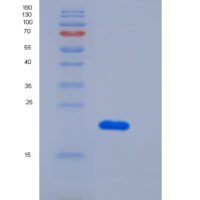
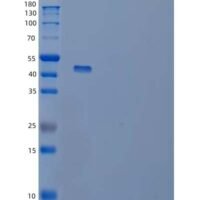
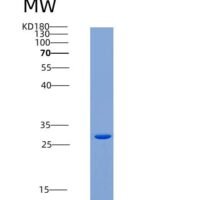
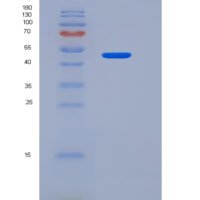
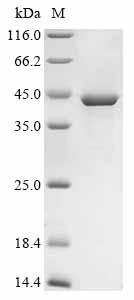
Recombinant Mouse Tsukushi (Tsku) is a recombinant protein from Mus musculus (Mouse), expressed in E.coli, covering amino acids 18-354aa, with N-terminal 10xHis-tagged and C-terminal Myc-tagged tag, molecular weight 44.0kDa, purity Greater than 90% as determined by SDS-PAGE.. Suitable for ELISA and Western Blot applications.