Recombinant Mouse Double-stranded RNA-specific adenosine deaminase (Adar), partial

Recombinant Mouse Double-stranded RNA-specific adenosine deaminase (Adar), partial — Catalyzes the hydrolytic deamination of adenosine to inosine in double-stranded RNA (dsRNA) referred to as A-to-I RNA editing. Purity >95%.

SKU: BCRECP-002015 Category:

Product Specifications

Product SkuBCRECP-002015
Product DescriptionRecombinant Mouse Double-stranded RNA-specific adenosine deaminase (Adar) Protein is expressed from E.coli with C-terminal 6xHis-tagged. It contains 835-1170aa. [Accession | Q99MU3].
Uniprot No.Q99MU3
Gene NamesAdar
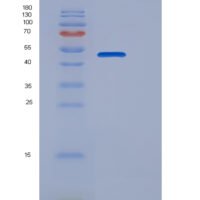
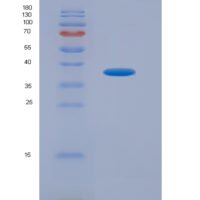
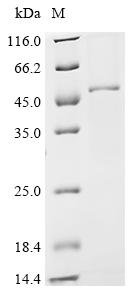
PurityGreater than 95% as determined by SDS-PAGE.
Expression SystemE.coli
Expression Region835-1170aa
SpeciesMus musculus (Mouse)
Tag InfoC-terminal 6xHis-tagged
Molecular weight44.9kDa
ActivityPlease contact us to obtain bioactivity data.
BufferIf the delivery form is liquid, the default storage buffer is Tris/PBS-based buffer, 5%-50% glycerol. If the delivery form is lyophilized powder, the buffer before lyophilization is Tris/PBS-based buffer, 6% Trehalose.
StorageStore at -20°C/-80°C upon receipt, aliquoting is necessary for mutiple use. Avoid repeated freeze-thaw cycles.
Research AreasEpigenetics and Nuclear Signaling

Function

Catalyzes the hydrolytic deamination of adenosine to inosine in double-stranded RNA (dsRNA) referred to as A-to-I RNA editing. This may affect gene expression and function in a number of ways that include mRNA translation by changing codons and hence the amino acid sequence of proteins since the translational machinery read the inosine as a guanosine; pre-mRNA splicing by altering splice site recognition sequences; RNA stability by changing sequences involved in nuclease recognition; genetic stability in the case of RNA virus genomes by changing sequences during viral RNA replication; and RNA structure-dependent activities such as microRNA production or targeting or protein-RNA interactions. Can edit both viral and cellular RNAs and can edit RNAs at multiple sites (hyper-editing) or at specific sites (site-specific editing).

Biological Context

Subcellular Location: Nucleus, nucleolus
Tissue Specificity: Highest levels in brain and spleen. Lowest levels in liver

Product Specifications

Recombinant Mouse Double-stranded RNA-specific adenosine deaminase (Adar), partial is a recombinant protein from Mus musculus (Mouse), expressed in E.coli, covering amino acids 835-1170aa, with C-terminal 6xHis-tagged tag, molecular weight 44.9kDa, purity Greater than 95% as determined by SDS-PAGE.. Suitable for ELISA and Western Blot applications.
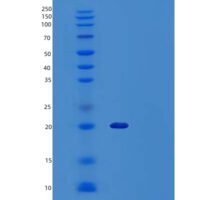
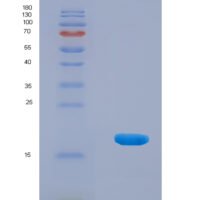
SDS-PAGE: Single band at expected molecular weight confirming purity.

ELISA: Suitable as coating antigen or detection standard.

Western Blot: Compatible with standard Western Blot protocols.

Protein Interaction: Validated for SPR (Surface Plasmon Resonance) and BLI (Bio-Layer Interferometry) studies.

Shipping: Shipped at ambient temperature. Lyophilized protein is stable during transit.

Storage: Store lyophilized protein at -20°C to -80°C. Reconstituted protein should be aliquoted and stored at -80°C. Avoid repeated freeze-thaw cycles.

Shelf Life: 12 months from date of receipt when stored as recommended.

Shipping Time: Orders placed before 2 PM EST ship same day. International orders typically deliver within 5-10 business days.

Protein Biology

Function

Catalyzes the hydrolytic deamination of adenosine to inosine in double-stranded RNA (dsRNA) referred to as A-to-I RNA editing. This may affect gene expression and function in a number of ways that include mRNA translation by changing codons and hence the amino acid sequence of proteins since the translational machinery read the inosine as a guanosine; pre-mRNA splicing by altering splice site recognition sequences; RNA stability by changing sequences involved in nuclease recognition; genetic stability in the case of RNA virus genomes by changing sequences during viral RNA replication; and RNA structure-dependent activities such as microRNA production or targeting or protein-RNA interactions. Can edit both viral and cellular RNAs and can edit RNAs at multiple sites (hyper-editing) or at specific sites (site-specific editing). Its cellular RNA substrates include: bladder cancer-associated protein (BLCAP), neurotransmitter receptors for glutamate (GRIA2) and serotonin (HTR2C) and GABA receptor (GABRA3). Site-specific RNA editing of transcripts encoding these proteins results in amino acid substitutions which consequently alters their functional activities. Exhibits low-level editing at the GRIA2 Q/R site, but edits efficiently at the R/G site and HOTSPOT1. Does not affect polyomavirus replication but provides protection against virus-induced cytopathic effects. Essential for embryonic development and cell survival and plays a critical role in the maintenance of hematopoietic stem cells

Subcellular Location

Nucleus, nucleolus

Tissue Specificity

Highest levels in brain and spleen. Lowest levels in liver

Subunit

Homodimer. Homodimerization is essential for its catalytic activity (PubMed:12618436). Isoform 5 can form heterodimers with ADARB1/ADAR2. Isoform 1 and isoform 5 (via DRBM 3 domain) interact with TNPO1. Isoform 5 (via DRBM domains) interacts with XPO5. Isoform 1 and isoform 5 can interact with UPF1 (By similarity). Isoform 1 interacts with ILF2/NF45 and ILF3/NF90 (PubMed:16055709). Binding to ILF3/NF90 up-regulates ILF3-mediated gene expression. Isoform 1 and isoform 5 interact with EIF2AK2/PKR (PubMed:17079286)

Gene: Adar  |  Organism: Mus musculus  |  Synonyms: RNA adenosine deaminase 1
Key Publications

Frequently Asked Questions

How do I order or inquire about this product?

Fill out the Online Inquiry form with your required quantity and specifications. You can also email sales@biocrestsci.com. Our team typically responds within 4 business hours with a quote and availability confirmation.

What is the shipping and delivery time?

Orders placed before 2 PM EST ship the same day. Domestic (US) delivery typically takes 2-3 business days. International orders deliver within 5-10 business days. All products are shipped at ambient temperature with appropriate packaging to ensure stability.

How should I store this recombinant protein?

Lyophilized proteins should be stored at -20°C to -80°C upon receipt. After reconstitution, aliquot and store at -80°C. Avoid repeated freeze-thaw cycles. Shelf life is 12 months from date of receipt when stored as recommended.

What quality controls are performed on your products?

Each product undergoes SDS-PAGE purity analysis (typically >85-95%), endotoxin testing, and bioactivity validation. Products are validated for ELISA, Western Blot, and SPR/BLI applications as specified on this product page. A Certificate of Analysis (CoA) is available upon request.

Shopping Cart
Scroll to Top