Recombinant Mouse Cyclic AMP-dependent transcription factor ATF-5 (Atf5)

Recombinant Mouse Cyclic AMP-dependent transcription factor ATF-5 (Atf5) — Transcription factor that either stimulates or represses gene transcription through binding of different DNA regulatory elements such as cAMP response element (CRE) (consensus: 5′-GTGACGT[AC][AG]-3… Purity >85%.

SKU: BCRECP-002158 Category:

Product Specifications

Product SkuBCRECP-002158
Product DescriptionRecombinant Mouse Cyclic AMP-dependent transcription factor ATF-5 (Atf5) Protein is expressed from E.coli with N-terminal 6xHis-tagged. It contains 1-283aa. [Accession | O70191].
Uniprot No.O70191
Gene NamesAtf5
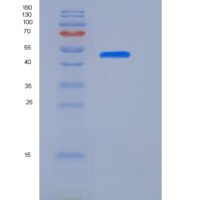
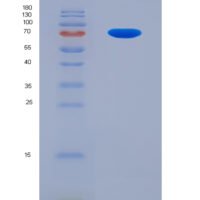
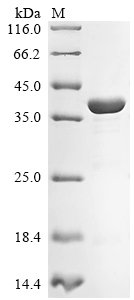
PurityGreater than 85% as determined by SDS-PAGE.
Expression SystemE.coli
Expression Region1-283aa
SpeciesMus musculus (Mouse)
Tag InfoN-terminal 6xHis-tagged
Molecular weight36.3kDa
ActivityPlease contact us to obtain bioactivity data.
BufferIf the delivery form is liquid, the default storage buffer is Tris/PBS-based buffer, 5%-50% glycerol. If the delivery form is lyophilized powder, the buffer before lyophilization is Tris/PBS-based buffer, 6% Trehalose.
StorageStore at -20°C/-80°C upon receipt, aliquoting is necessary for mutiple use. Avoid repeated freeze-thaw cycles.
Research AreasOthers

Function

Transcription factor that either stimulates or represses gene transcription through binding of different DNA regulatory elements such as cAMP response element (CRE) (consensus: 5'-GTGACGT[AC][AG]-3'), ATF5-specific response element (ARE) (consensus: 5'-C[CT]TCT[CT]CCTT[AT]-3') but also the amino acid response element (AARE), present in many viral and cellular promoters. Critically involved, often in a cell type-dependent manner, in cell survival, proliferation, and differentiation. Its transcriptional activity is enhanced by CCND3 and slightly inhibited by CDK4.

Biological Context

Subcellular Location: Cytoplasm; Nucleus; Cytoplasm, cytoskeleton, microtubule organizing center, centrosome
Tissue Specificity: Highly expressed in liver and at lower levels in heart, brain, lung, kidney, adipose tissue, and skeletal muscle. Expressed in some immature and in all mature olfactory sensory neurons (at protein level)

Product Specifications

Recombinant Mouse Cyclic AMP-dependent transcription factor ATF-5 (Atf5) is a recombinant protein from Mus musculus (Mouse), expressed in E.coli, covering amino acids 1-283aa, with N-terminal 6xHis-tagged tag, molecular weight 36.3kDa, purity Greater than 85% as determined by SDS-PAGE.. Suitable for ELISA and Western Blot applications.
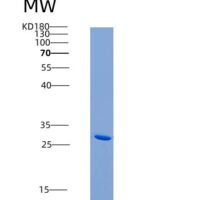
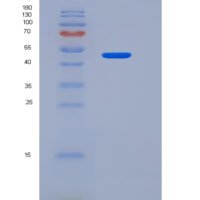
SDS-PAGE: Single band at expected molecular weight confirming purity.

ELISA: Suitable as coating antigen or detection standard.

Western Blot: Compatible with standard Western Blot protocols.

Protein Interaction: Validated for SPR (Surface Plasmon Resonance) and BLI (Bio-Layer Interferometry) studies.

Shipping: Shipped at ambient temperature. Lyophilized protein is stable during transit.

Storage: Store lyophilized protein at -20°C to -80°C. Reconstituted protein should be aliquoted and stored at -80°C. Avoid repeated freeze-thaw cycles.

Shelf Life: 12 months from date of receipt when stored as recommended.

Shipping Time: Orders placed before 2 PM EST ship same day. International orders typically deliver within 5-10 business days.

Protein Biology

Function

Transcription factor that either stimulates or represses gene transcription through binding of different DNA regulatory elements such as cAMP response element (CRE) (consensus: 5'-GTGACGT[AC][AG]-3'), ATF5-specific response element (ARE) (consensus: 5'-C[CT]TCT[CT]CCTT[AT]-3') but also the amino acid response element (AARE), present in many viral and cellular promoters. Critically involved, often in a cell type-dependent manner, in cell survival, proliferation, and differentiation. Its transcriptional activity is enhanced by CCND3 and slightly inhibited by CDK4 (By similarity). Important regulator of the cerebral cortex formation, functions in cerebral cortical neuroprogenitor cells to maintain proliferation and to block differentiation into neurons. Must be down-regulated in order for such cells to exit the cycle and differentiate. Participates in the pathways by which SHH promotes cerebellar granule neuron progenitor cells proliferation (PubMed:22095825). Critical for survival of mature olfactory sensory neurons (OSN), directs expression of OSN-specific genes (PubMed:23090999). May be involved in osteogenic differentiation. Promotes cell proliferation and survival by inducing the expression of EGR1 sinergistically with ELK1. Once acetylated by EP300, binds to ARE sequences on target genes promoters, such as BCL2 and EGR1 (By similarity). Plays an anti-apoptotic role through the transcriptional regulation of BCL2, this function seems to be cell type-dependent (By similarity) (PubMed:12130540). Cooperates with NR1I3/CAR in the transcriptional activation of CYP2B6 in liver. In hepatic cells, represses CRE-dependent transcription and inhibits proliferation by blocking at G2/M phase. May act as a negative regulator of IL1B transduction pathway in liver. Upon IL1B stimulus, cooperates with NLK to activate the transactivation activity of C/EBP subfamily members. Besides its function of transcription factor, acts as a cofactor of CEBPB to activate CEBPA and promote adipocyte differentiation. Regulates centrosome dynamics in a cell-cycle- and centriole-age-dependent manner. Forms 9-foci symmetrical ring scaffold around the mother centriole to control centrosome function and the interaction between centrioles and pericentriolar material (By similarity)

Subcellular Location

Cytoplasm; Nucleus; Cytoplasm, cytoskeleton, microtubule organizing center, centrosome

Tissue Specificity

Highly expressed in liver and at lower levels in heart, brain, lung, kidney, adipose tissue, and skeletal muscle. Expressed in some immature and in all mature olfactory sensory neurons (at protein level) (PubMed:23090999)

Subunit

Binds DNA as a dimer. Interacts with PTP4A1/PRL-1 (By similarity). Interacts with CCND3, but not with CCND1 or CCND2. Interacts with HSPA1A or HSPA1B; the interaction protects ATF5 from degradation via proteasome-dependent and caspase-dependent processes. Interacts (via C-terminal region) with NPM1 (via C-terminal region); the interaction leads to loss of association between HSPA1A or HSPA1B and ATF5 and promotes ATF5 degradation via proteasome-dependent and caspase-dependent processes. Interacts with NLK; the interaction stabilizes ATF5 at the protein level in a kinase-independent manner. Interacts with alpha-tubulin, gamma-tubulin members TUBGCP2 and TUBGCP4, PCNT; the ATF5:PCNT:polyglutamylated tubulin (PGT) tripartite unites the mother centriole and the pericentriolar material (PCM) in the centrosome (By similarity). Interacts with CEBPB and EP300; EP300 is required for ATF5 and CEBPB interaction and DNA binding (PubMed:24216764)

Gene: Atf5  |  Organism: Mus musculus  |  Synonyms: Activating transcription factor 5-alpha/beta; BZIP protein ATF7; NAP1; NRIF3-associated protein; Transcription factor ATFx; Transcription factor-like protein ODA-10
Key Publications

Frequently Asked Questions

How do I order or inquire about this product?

Fill out the Online Inquiry form with your required quantity and specifications. You can also email sales@biocrestsci.com. Our team typically responds within 4 business hours with a quote and availability confirmation.

What is the shipping and delivery time?

Orders placed before 2 PM EST ship the same day. Domestic (US) delivery typically takes 2-3 business days. International orders deliver within 5-10 business days. All products are shipped at ambient temperature with appropriate packaging to ensure stability.

How should I store this recombinant protein?

Lyophilized proteins should be stored at -20°C to -80°C upon receipt. After reconstitution, aliquot and store at -80°C. Avoid repeated freeze-thaw cycles. Shelf life is 12 months from date of receipt when stored as recommended.

What quality controls are performed on your products?

Each product undergoes SDS-PAGE purity analysis (typically >85-95%), endotoxin testing, and bioactivity validation. Products are validated for ELISA, Western Blot, and SPR/BLI applications as specified on this product page. A Certificate of Analysis (CoA) is available upon request.

Shopping Cart
Scroll to Top