
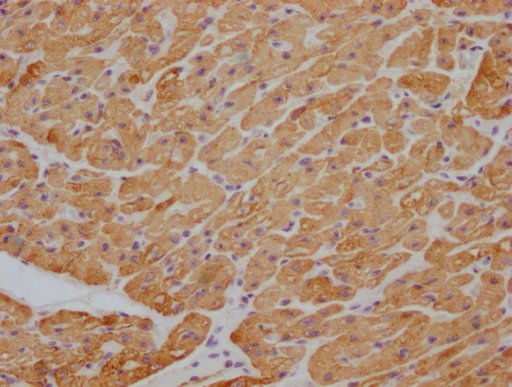
Mouse anti-Human ACTB/POTEKP/ACTG1 Monoclonal Antibody

Mouse anti-Human ACTB/POTEKP/ACTG1 Monoclonal Antibody — Actin is a highly conserved protein that polymerizes to produce filaments that form cross-linked networks in the cytoplasm of cells.

SKU: BCREC-000794MA Category:

Product Specifications

Uniprot No.P60709
Species ReactivityMouse
ImmunogenSynthesized peptide derived from human Actin pan
Immunogen SpeciesHomo sapiens (Human)
ConjugateNon-conjugated
IsotypeIgG2b, Kappa
ClonalityMonoclonal
ApplicationsELISA, IHC
BufferPBS, 50% glycerol, 0.05% Proclin 300, 0.05%BSA
StorageUpon receipt, store at -20°C or -80°C. Avoid repeated freeze.

Function

Actin is a highly conserved protein that polymerizes to produce filaments that form cross-linked networks in the cytoplasm of cells. Actin exists in both monomeric (G-actin) and polymeric (F-actin) forms, both forms playing key functions, such as cell motility and contraction. In addition to their role in the cytoplasmic cytoskeleton, G- and F-actin also localize in the nucleus, and regulate gene transcription and motility and repair of damaged DNA.

Biological Context

Subcellular Location: Cytoplasm, cytoskeleton; Nucleus
Disease Association: Dystonia-deafness syndrome 1 (DDS1) : An autosomal dominant form of dystonia with juvenile onset, associated with congenital or childhood-onset sensorineural deafness. Dystonia is defined by the presence of sustained involuntary muscle contraction, often leading to abnormal postures. Some DDS1 patients have dysmorphic features, skeletal anomalies, and/or mild developmental delay with impaired intellectual development. [The disease is caused by variants affecting the gene represented in this entry] | Baraitser-Winter syndrome 1 (BRWS1) : A rare developmental disorder characterized by the combination of congenital ptosis, high-arched eyebrows, hypertelorism, ocular colobomata, and a brain malformation consisting of anterior-predominant lissencephaly. Other typical features include postnatal short stature and microcephaly, intellectual disability, seizures, and hearing loss. [The disease is caused by variants affecting the gene represented in this entry] | Thrombocytopenia 8, with dysmorphic features and developmental delay (THC8) : A form of thrombocytopenia, a hematologic disorder defined by a decrease in the number of platelets in circulating blood, resulting in the potential for increased bleeding and decreased ability for clotting. THC8 is an autosomal dominant form characterized by early-childhood onset of thrombocytopenia with platelet anisotropy. Affected individuals also have dysmorphic facial features and variable developmental delay with speech delay and mildly impaired intellectual development. [The disease is caused by variants affecting the gene represented in this entry] | Becker nevus syndrome (BNS) : A syndrome characterized by the association of Becker nevi with musculoskeletal abnormalities, unilateral breast hypoplasia, intellectual disability, developmental delay, and cardiomyopathy. Becker nevus is a cutaneous hamartoma that appears in childhood as a unilateral tan patch and increases in thickness, pigmentation, and hair growth during adolescence. Histologically, epidermal acanthosis is accompanied by irregularly dispersed ectopic smooth muscle bundles and increased terminal hair follicles. Most cases are sporadic. [The disease is caused by variants affecting the gene represented in this entry] | Congenital smooth muscle hamartoma, with or without hemihypertrophy (CSMH) : A benign skin lesion that usually presents as an indurated, slightly pigmented or flesh-colored plaque with perifollicular papules or coarse hair. Histopathologically, there is excessive proliferation of ectopic smooth muscle within the dermis. Hair follicles are normal in number and hyperkeratosis, acanthosis and hyperpigmentation of the basal cell layer can sometimes be seen. Rarely, CSMH is associated with hemihypertrophy. [The disease is caused by variants affecting the gene represented in this entry]

Product Specifications

Mouse anti-Human ACTB/POTEKP/ACTG1 Monoclonal Antibody is a recombinant protein. Suitable for ELISA and Western Blot applications.

SDS-PAGE: Single band at expected molecular weight confirming purity.

ELISA: Suitable as coating antigen or detection standard.

Western Blot: Compatible with standard Western Blot protocols.

Protein Interaction: Validated for SPR (Surface Plasmon Resonance) and BLI (Bio-Layer Interferometry) studies.

Shipping: Shipped at ambient temperature. Lyophilized protein is stable during transit.

Storage: Store lyophilized protein at -20°C to -80°C. Reconstituted protein should be aliquoted and stored at -80°C. Avoid repeated freeze-thaw cycles.

Shelf Life: 12 months from date of receipt when stored as recommended.

Shipping Time: Orders placed before 2 PM EST ship same day. International orders typically deliver within 5-10 business days.

Protein Biology

Function

Actin is a highly conserved protein that polymerizes to produce filaments that form cross-linked networks in the cytoplasm of cells (PubMed:25255767, PubMed:29581253). Actin exists in both monomeric (G-actin) and polymeric (F-actin) forms, both forms playing key functions, such as cell motility and contraction (PubMed:29581253). In addition to their role in the cytoplasmic cytoskeleton, G- and F-actin also localize in the nucleus, and regulate gene transcription and motility and repair of damaged DNA (PubMed:29925947). Plays a role in the assembly of the gamma-tubulin ring complex (gTuRC), which regulates the minus-end nucleation of alpha-beta tubulin heterodimers that grow into microtubule protafilaments (PubMed:39321809, PubMed:38609661). Part of the ACTR1A/ACTB filament around which the dynactin complex is built (By similarity). The dynactin multiprotein complex activates the molecular motor dynein for ultra-processive transport along microtubules (By similarity)

Subcellular Location

Cytoplasm, cytoskeleton; Nucleus

Disease Association

Dystonia-deafness syndrome 1 (DDS1) : An autosomal dominant form of dystonia with juvenile onset, associated with congenital or childhood-onset sensorineural deafness. Dystonia is defined by the presence of sustained involuntary muscle contraction, often leading to abnormal postures. Some DDS1 patients have dysmorphic features, skeletal anomalies, and/or mild developmental delay with impaired intellectual development. [The disease is caused by variants affecting the gene represented in this entry] | Baraitser-Winter syndrome 1 (BRWS1) : A rare developmental disorder characterized by the combination of congenital ptosis, high-arched eyebrows, hypertelorism, ocular colobomata, and a brain malformation consisting of anterior-predominant lissencephaly. Other typical features include postnatal short stature and microcephaly, intellectual disability, seizures, and hearing loss. [The disease is caused by variants affecting the gene represented in this entry] | Thrombocytopenia 8, with dysmorphic features and developmental delay (THC8) : A form of thrombocytopenia, a hematologic disorder defined by a decrease in the number of platelets in circulating blood, resulting in the potential for increased bleeding and decreased ability for clotting. THC8 is an autosomal dominant form characterized by early-childhood onset of thrombocytopenia with platelet anisotropy. Affected individuals also have dysmorphic facial features and variable developmental delay with speech delay and mildly impaired intellectual development. [The disease is caused by variants affecting the gene represented in this entry] | Becker nevus syndrome (BNS) : A syndrome characterized by the association of Becker nevi with musculoskeletal abnormalities, unilateral breast hypoplasia, intellectual disability, developmental delay, and cardiomyopathy. Becker nevus is a cutaneous hamartoma that appears in childhood as a unilateral tan patch and increases in thickness, pigmentation, and hair growth during adolescence. Histologically, epidermal acanthosis is accompanied by irregularly dispersed ectopic smooth muscle bundles and increased terminal hair follicles. Most cases are sporadic. [The disease is caused by variants affecting the gene represented in this entry] | Congenital smooth muscle hamartoma, with or without hemihypertrophy (CSMH) : A benign skin lesion that usually presents as an indurated, slightly pigmented or flesh-colored plaque with perifollicular papules or coarse hair. Histopathologically, there is excessive proliferation of ectopic smooth muscle within the dermis. Hair follicles are normal in number and hyperkeratosis, acanthosis and hyperpigmentation of the basal cell layer can sometimes be seen. Rarely, CSMH is associated with hemihypertrophy. [The disease is caused by variants affecting the gene represented in this entry]

Subunit

Polymerization of globular actin (G-actin) leads to a structural filament (F-actin) in the form of a two-stranded helix (PubMed:16685646, PubMed:28604741). Each actin can bind to 4 others (PubMed:16685646, PubMed:28604741). Identified in a IGF2BP1-dependent mRNP granule complex containing untranslated mRNAs (PubMed:17289661). Component of the BAF complex, which includes at least actin (ACTB), ARID1A, ARID1B/BAF250, SMARCA2, SMARCA4/BRG1, ACTL6A/BAF53, ACTL6B/BAF53B, SMARCE1/BAF57 SMARCC1/BAF155, SMARCC2/BAF170, SMARCB1/SNF5/INI1, and one or more of SMARCD1/BAF60A, SMARCD2/BAF60B, or SMARCD3/BAF60C (PubMed:18765789). In muscle cells, the BAF complex also contains DPF3 (PubMed:18765789). Found in a complex with XPO6, Ran, ACTB and PFN1 (PubMed:14592989). Interacts with PFN1 (PubMed:10411937, PubMed:25255767). Interacts with XPO6 and EMD (PubMed:15328537). Interacts with ERBB2 (PubMed:21555369). Interacts with GCSAM (PubMed:17823310). Interacts with TBC1D21 (By similarity). Interacts with CPNE1 (via VWFA domain) and CPNE4 (via VWFA domain) (By similarity). Interacts with DHX9 (via C-terminus); this interaction is direct and mediates the attachment to nuclear ribonucleoprotein complexes (PubMed:11687588). Interacts with FAM107A (PubMed:21969592, PubMed:28604741). Associates with the gamma-tubulin ring complex (gTuRC) consisting of TUBGCP2, TUBGCP3, TUBGCP4, TUBGCP5 and TUBGCP6 and gamma-tubulin TUBG1 or TUBG2; within the complex, interacts with TUBGCP3 and TUBGCP6 to form a luminal bridge with MZT1 that stabilizes the initial structure during complex assembly (PubMed:39321809, PubMed:38609661). Part of the ACTR1A/ACTB filament around which the dynactin complex is built (By similarity). The filament contains 8 copies of ACTR1A and 1 ACTB (By similarity). Interacts with TPRN which forms ring-like structures in the stereocilium taper region; the interaction may stabilize stereocilia in inner ear hair cells (By similarity). Interacts with AMOTL2 (via N-terminus), the interaction facilitates binding of cell junction complexes to actin fibers in endothelial cells (By similarity)

Gene: ACTB  |  Organism: Homo sapiens  |  Synonyms: Beta-actin
Key Publications

Frequently Asked Questions

How do I order or inquire about this product?

Fill out the Online Inquiry form with your required quantity and specifications. You can also email sales@biocrestsci.com. Our team typically responds within 4 business hours with a quote and availability confirmation.

What is the shipping and delivery time?

Orders placed before 2 PM EST ship the same day. Domestic (US) delivery typically takes 2-3 business days. International orders deliver within 5-10 business days. All products are shipped at ambient temperature with appropriate packaging to ensure stability.

How should I store this recombinant protein?

Lyophilized proteins should be stored at -20°C to -80°C upon receipt. After reconstitution, aliquot and store at -80°C. Avoid repeated freeze-thaw cycles. Shelf life is 12 months from date of receipt when stored as recommended.

What quality controls are performed on your products?

Each product undergoes SDS-PAGE purity analysis (typically >85-95%), endotoxin testing, and bioactivity validation. Products are validated for ELISA, Western Blot, and SPR/BLI applications as specified on this product page. A Certificate of Analysis (CoA) is available upon request.

Shopping Cart
Scroll to Top