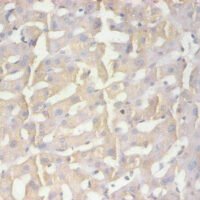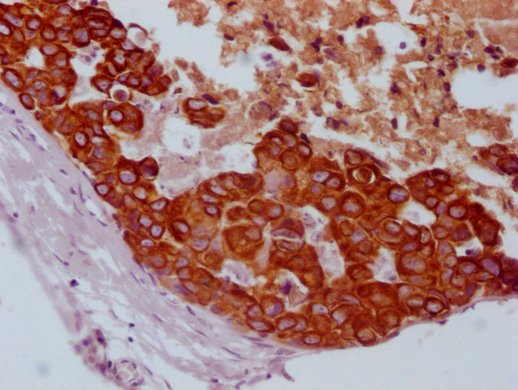
Mouse anti-Human KRT14/KRT16/KRT5/KRT6A/KRT8 Monoclonal Antibody

Mouse anti-Human KRT14/KRT16/KRT5/KRT6A/KRT8 Monoclonal Antibody — Structural component of intermediate filaments in basal keratinocytes of stratified epithelia.

SKU: BCREC-000767MA Category:

Product Specifications

Uniprot No.P02533
Species ReactivityMouse
ImmunogenSynthesized peptide derived from human Cytokeratin Pan
Immunogen SpeciesHomo sapiens (Human)
ConjugateNon-conjugated
IsotypeIgG2b, Kappa
ClonalityMonoclonal
ApplicationsELISA, IHC
BufferPBS, 50% glycerol, 0.05% Proclin 300, 0.05%BSA
StorageUpon receipt, store at -20°C or -80°C. Avoid repeated freeze.

Function

Structural component of intermediate filaments in basal keratinocytes of stratified epithelia. Forms obligate heteropolymers with the type II keratin KRT5, contributing to the keratin intermediate filament network that confers mechanical strength and structural integrity to the basal layer of the epidermis and other stratified epithelial. The nonhelical tail domain is involved in promoting KRT5-KRT14 filaments to self-organize into large bundles and enhances the mechanical properties involved in resilience of keratin intermediate filaments in vitro.

Biological Context

Subcellular Location: Cytoplasm; Nucleus
Tissue Specificity: Expressed in the corneal epithelium (at protein level). Detected in the basal layer, lowered within the more apically located layers specifically in the stratum spinosum, stratum granulosum but is not detected in stratum corneum. Strongly expressed in the outer root sheath of anagen follicles but not in the germinative matrix, inner root sheath or hair. Found in keratinocytes surrounding the club hair during telogen
Disease Association: Epidermolysis bullosa simplex 1A, generalized severe (EBS1A) : A form of epidermolysis bullosa simplex, a group of skin fragility disorders characterized by skin blistering due to cleavage within the basal layer of keratinocytes, and erosions caused by minor mechanical trauma. There is a broad spectrum of clinical severity ranging from minor blistering on the feet, to subtypes with extracutaneous involvement and a lethal outcome. EBS1A is an autosomal dominant form characterized by generalized intraepidermal skin blistering that begins and is very prominent at birth. EBS1A may be life-threatening in the first year of life. Tendency to blistering diminishes in adolescence. [The disease is caused by variants affecting the gene represented in this entry] | Epidermolysis bullosa simplex 1C, localized (EBS1C) : A form of epidermolysis bullosa simplex, a group of skin fragility disorders characterized by skin blistering due to cleavage within the basal layer of keratinocytes, and erosions caused by minor mechanical trauma. There is a broad spectrum of clinical severity ranging from minor blistering on the feet, to subtypes with extracutaneous involvement and a lethal outcome. EBS1C is an autosomal dominant form with intraepidermal blistering mainly restricted to hands and feet beginning in infancy. Nails may be thick and dystrophic. [The disease is caused by variants affecting the gene represented in this entry] | Epidermolysis bullosa simplex 1B, generalized intermediate (EBS1B) : A form of epidermolysis bullosa simplex, a group of skin fragility disorders characterized by skin blistering due to cleavage within the basal layer of keratinocytes, and erosions caused by minor mechanical trauma. There is a broad spectrum of clinical severity ranging from minor blistering on the feet, to subtypes with extracutaneous involvement and a lethal outcome. EBS1B is an autosomal dominant form characterized by generalized intraepidermal blistering beginning at birth. The tendency to blistering diminishes in adolescence, when it may become localized to hands and feet. [The disease is caused by variants affecting the gene represented in this entry] | Epidermolysis bullosa simplex 1D, generalized, intermediate or severe, autosomal recessive (EBS1D) : A form of epidermolysis bullosa simplex, a group of skin fragility disorders characterized by skin blistering due to cleavage within the basal layer of keratinocytes, and erosions caused by minor mechanical trauma. There is a broad spectrum of clinical severity ranging from minor blistering on the feet, to subtypes with extracutaneous involvement and a lethal outcome. EBS1D is an autosomal recessive form characterized by blistering beginning at birth or early childhood. In some patients hands and feet are primarily affected, and in others blistering anywhere on the body may occur. In some patients the condition improves with age. [The disease is caused by variants affecting the gene represented in this entry] | Naegeli-Franceschetti-Jadassohn syndrome (NFJS) : A rare autosomal dominant form of ectodermal dysplasia. The cardinal features are absence of dermatoglyphics (fingerprints), reticular cutaneous hyperpigmentation (starting at about the age of 2 years without a preceding inflammatory stage), palmoplantar keratoderma, hypohidrosis with diminished sweat gland function and discomfort provoked by heat, nail dystrophy, and tooth enamel defects. [The disease is caused by variants affecting the gene represented in this entry] | Dermatopathia pigmentosa reticularis (DPR) : A rare ectodermal dysplasia characterized by lifelong persistent reticulate hyperpigmentation, non-cicatricial alopecia, and nail dystrophy. Variable features include adermatoglyphia, hypohidrosis or hyperhidrosis, and palmoplantar hyperkeratosis. [The disease is caused by variants affecting the gene represented in this entry]

Product Specifications

Mouse anti-Human KRT14/KRT16/KRT5/KRT6A/KRT8 Monoclonal Antibody is a recombinant protein. Suitable for ELISA and Western Blot applications.

SDS-PAGE: Single band at expected molecular weight confirming purity.

ELISA: Suitable as coating antigen or detection standard.

Western Blot: Compatible with standard Western Blot protocols.

Protein Interaction: Validated for SPR (Surface Plasmon Resonance) and BLI (Bio-Layer Interferometry) studies.

Shipping: Shipped at ambient temperature. Lyophilized protein is stable during transit.

Storage: Store lyophilized protein at -20°C to -80°C. Reconstituted protein should be aliquoted and stored at -80°C. Avoid repeated freeze-thaw cycles.

Shelf Life: 12 months from date of receipt when stored as recommended.

Shipping Time: Orders placed before 2 PM EST ship same day. International orders typically deliver within 5-10 business days.

Protein Biology

Function

Structural component of intermediate filaments in basal keratinocytes of stratified epithelia. Forms obligate heteropolymers with the type II keratin KRT5, contributing to the keratin intermediate filament network that confers mechanical strength and structural integrity to the basal layer of the epidermis and other stratified epithelial (PubMed:11724817, PubMed:1694855, PubMed:1720261). The nonhelical tail domain is involved in promoting KRT5-KRT14 filaments to self-organize into large bundles and enhances the mechanical properties involved in resilience of keratin intermediate filaments in vitro (PubMed:11724817)

Subcellular Location

Cytoplasm; Nucleus

Disease Association

Epidermolysis bullosa simplex 1A, generalized severe (EBS1A) : A form of epidermolysis bullosa simplex, a group of skin fragility disorders characterized by skin blistering due to cleavage within the basal layer of keratinocytes, and erosions caused by minor mechanical trauma. There is a broad spectrum of clinical severity ranging from minor blistering on the feet, to subtypes with extracutaneous involvement and a lethal outcome. EBS1A is an autosomal dominant form characterized by generalized intraepidermal skin blistering that begins and is very prominent at birth. EBS1A may be life-threatening in the first year of life. Tendency to blistering diminishes in adolescence. [The disease is caused by variants affecting the gene represented in this entry] | Epidermolysis bullosa simplex 1C, localized (EBS1C) : A form of epidermolysis bullosa simplex, a group of skin fragility disorders characterized by skin blistering due to cleavage within the basal layer of keratinocytes, and erosions caused by minor mechanical trauma. There is a broad spectrum of clinical severity ranging from minor blistering on the feet, to subtypes with extracutaneous involvement and a lethal outcome. EBS1C is an autosomal dominant form with intraepidermal blistering mainly restricted to hands and feet beginning in infancy. Nails may be thick and dystrophic. [The disease is caused by variants affecting the gene represented in this entry] | Epidermolysis bullosa simplex 1B, generalized intermediate (EBS1B) : A form of epidermolysis bullosa simplex, a group of skin fragility disorders characterized by skin blistering due to cleavage within the basal layer of keratinocytes, and erosions caused by minor mechanical trauma. There is a broad spectrum of clinical severity ranging from minor blistering on the feet, to subtypes with extracutaneous involvement and a lethal outcome. EBS1B is an autosomal dominant form characterized by generalized intraepidermal blistering beginning at birth. The tendency to blistering diminishes in adolescence, when it may become localized to hands and feet. [The disease is caused by variants affecting the gene represented in this entry] | Epidermolysis bullosa simplex 1D, generalized, intermediate or severe, autosomal recessive (EBS1D) : A form of epidermolysis bullosa simplex, a group of skin fragility disorders characterized by skin blistering due to cleavage within the basal layer of keratinocytes, and erosions caused by minor mechanical trauma. There is a broad spectrum of clinical severity ranging from minor blistering on the feet, to subtypes with extracutaneous involvement and a lethal outcome. EBS1D is an autosomal recessive form characterized by blistering beginning at birth or early childhood. In some patients hands and feet are primarily affected, and in others blistering anywhere on the body may occur. In some patients the condition improves with age. [The disease is caused by variants affecting the gene represented in this entry] | Naegeli-Franceschetti-Jadassohn syndrome (NFJS) : A rare autosomal dominant form of ectodermal dysplasia. The cardinal features are absence of dermatoglyphics (fingerprints), reticular cutaneous hyperpigmentation (starting at about the age of 2 years without a preceding inflammatory stage), palmoplantar keratoderma, hypohidrosis with diminished sweat gland function and discomfort provoked by heat, nail dystrophy, and tooth enamel defects. [The disease is caused by variants affecting the gene represented in this entry] | Dermatopathia pigmentosa reticularis (DPR) : A rare ectodermal dysplasia characterized by lifelong persistent reticulate hyperpigmentation, non-cicatricial alopecia, and nail dystrophy. Variable features include adermatoglyphia, hypohidrosis or hyperhidrosis, and palmoplantar hyperkeratosis. [The disease is caused by variants affecting the gene represented in this entry]

Tissue Specificity

Expressed in the corneal epithelium (at protein level) (PubMed:26758872). Detected in the basal layer, lowered within the more apically located layers specifically in the stratum spinosum, stratum granulosum but is not detected in stratum corneum. Strongly expressed in the outer root sheath of anagen follicles but not in the germinative matrix, inner root sheath or hair (PubMed:9457912). Found in keratinocytes surrounding the club hair during telogen (PubMed:9457912)

Subunit

Heterodimers composed of type I and type II keratin; forms parallel coiled-coil heterodimers (PubMed:11724817, PubMed:1694855, PubMed:22705788, PubMed:24940650). Two heterodimers associate in an antiparallel manner to form heterotetramers, which further assemble into higher-order intermediate filaments (PubMed:1694855). Forms a disulfide-linked heterodimer (via 2B domains) with KRT5 (via 2B domains) (PubMed:1694855, PubMed:22705788, PubMed:24940650). Forms a heterodimer with KRT1; the interaction is more abundant in the absence of KRT5 (By similarity). Interacts with PLEC isoform 1C, when in a heterodimer with KRT5 (PubMed:24940650). Interacts with TRADD and with keratin filaments (PubMed:11684708). Interacts with EPPK1 (By similarity). Interacts with KLHL24 (PubMed:27798626). Interacts with PKP1 (via N-terminus) and PKP2 (PubMed:10852826)

Gene: KRT14  |  Organism: Homo sapiens  |  Synonyms: Cytokeratin-14; Keratin-14
Key Publications

Frequently Asked Questions

How do I order or inquire about this product?

Fill out the Online Inquiry form with your required quantity and specifications. You can also email sales@biocrestsci.com. Our team typically responds within 4 business hours with a quote and availability confirmation.

What is the shipping and delivery time?

Orders placed before 2 PM EST ship the same day. Domestic (US) delivery typically takes 2-3 business days. International orders deliver within 5-10 business days. All products are shipped at ambient temperature with appropriate packaging to ensure stability.

How should I store this recombinant protein?

Lyophilized proteins should be stored at -20°C to -80°C upon receipt. After reconstitution, aliquot and store at -80°C. Avoid repeated freeze-thaw cycles. Shelf life is 12 months from date of receipt when stored as recommended.

What quality controls are performed on your products?

Each product undergoes SDS-PAGE purity analysis (typically >85-95%), endotoxin testing, and bioactivity validation. Products are validated for ELISA, Western Blot, and SPR/BLI applications as specified on this product page. A Certificate of Analysis (CoA) is available upon request.

Shopping Cart
Scroll to Top