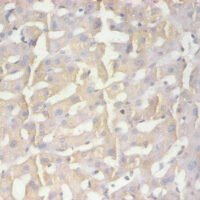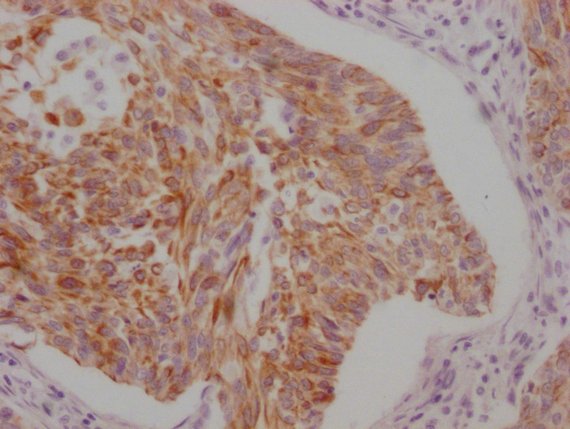
Mouse anti-Human KRT5/KRT6A Monoclonal Antibody

Mouse anti-Human KRT5/KRT6A Monoclonal Antibody — Structural component of intermediate filaments in basal keratinocytes of stratified epithelia.

SKU: BCREC-000825MA Category:

Product Specifications

Uniprot No.P13647
Species ReactivityMouse
ImmunogenSynthesized peptide derived from human Cytokeratin 5/6
Immunogen SpeciesHomo sapiens (Human)
ConjugateNon-conjugated
IsotypeIgG1, Kappa
ClonalityMonoclonal
ApplicationsELISA, IHC
BufferPBS, 50% glycerol, 0.05% Proclin 300, 0.05%BSA
StorageUpon receipt, store at -20°C or -80°C. Avoid repeated freeze.

Function

Structural component of intermediate filaments in basal keratinocytes of stratified epithelia. Together with its obligate type I partner KRT14, contributes to the formation of the keratin intermediate filament network that provides mechanical stability and resilience to the basal layer of the epidermis. Regulates the recruitment of Langerhans cells to the epidermis, potentially by modulation of the abundance of macrophage chemotactic cytokines, macrophage inflammatory cytokines and CTNND1 localization in keratinocytes.

Biological Context

Subcellular Location: Cytoplasm
Tissue Specificity: Expressed in corneal epithelium (at protein level). Expressed in keratinocytes (at protein level)
Disease Association: Epidermolysis bullosa simplex 2A, generalized severe (EBS2A) : A form of epidermolysis bullosa simplex, a group of skin fragility disorders characterized by skin blistering due to cleavage within the basal layer of keratinocytes, and erosions caused by minor mechanical trauma. There is a broad spectrum of clinical severity ranging from minor blistering on the feet, to subtypes with extracutaneous involvement and a lethal outcome. EBS2A is an autosomal dominant, severe form characterized by extensive intraepidermal blistering from the time of birth with herpetiform marginal spreading and central healing. Oral mucosal involvement, nail dystrophy, onychogryposis, formation of milia, and palmoplantar hyperkeratosis are common features. [The disease is caused by variants affecting the gene represented in this entry] | Epidermolysis bullosa simplex 2B, generalized intermediate (EBS2B) : A form of epidermolysis bullosa simplex, a group of skin fragility disorders characterized by skin blistering due to cleavage within the basal layer of keratinocytes, and erosions caused by minor mechanical trauma. There is a broad spectrum of clinical severity ranging from minor blistering on the feet, to subtypes with extracutaneous involvement and a lethal outcome. EBS2B is an autosomal dominant form characterized by generalized blistering manifesting at birth. The tendency to blistering diminishes in adolescence, when it may become localized to hands and feet. [The disease is caused by variants affecting the gene represented in this entry] | Epidermolysis bullosa simplex 2C, localized (EBS2C) : A form of epidermolysis bullosa simplex, a group of skin fragility disorders characterized by skin blistering due to cleavage within the basal layer of keratinocytes, and erosions caused by minor mechanical trauma. There is a broad spectrum of clinical severity ranging from minor blistering on the feet, to subtypes with extracutaneous involvement and a lethal outcome. EBS2C is an autosomal dominant form with intraepidermal blistering mainly restricted to hands and feet beginning in infancy. Nails may be thick and dystrophic. [The disease is caused by variants affecting the gene represented in this entry] | Epidermolysis bullosa simplex 2D, generalized, intermediate or severe, autosomal recessive (EBS2D) : A form of epidermolysis bullosa simplex, a group of skin fragility disorders characterized by skin blistering due to cleavage within the basal layer of keratinocytes, and erosions caused by minor mechanical trauma. There is a broad spectrum of clinical severity ranging from minor blistering on the feet, to subtypes with extracutaneous involvement and a lethal outcome. EBS2D is an autosomal recessive form characterized by widespread intraepidermal skin blistering and erosions from birth. Death may occur in the neonatal period. [The disease is caused by variants affecting the gene represented in this entry] | Epidermolysis bullosa simplex 2E, with migratory circinate erythema (EBS2E) : A form of epidermolysis bullosa simplex, a group of skin fragility disorders characterized by skin blistering due to cleavage within the basal layer of keratinocytes, and erosions caused by minor mechanical trauma. There is a broad spectrum of clinical severity ranging from minor blistering on the feet, to subtypes with extracutaneous involvement and a lethal outcome. EBS2E is an autosomal dominant form in which multiple vesicles are present from birth onward and acquire over time a typical migratory circinate pattern on an erythematous background. Postinflammatory hyperpigmentation develops gradually and may have a mottled pattern. [The disease is caused by variants affecting the gene represented in this entry] | Epidermolysis bullosa simplex 2F, with mottled pigmentation (EBS2F) : A form of epidermolysis bullosa simplex, a group of skin fragility disorders characterized by skin blistering due to cleavage within the basal layer of keratinocytes, and erosions caused by minor mechanical trauma. There is a broad spectrum of clinical severity ranging from minor blistering on the feet, to subtypes with extracutaneous involvement and a lethal outcome. EBS2F is an autosomal dominant form characterized by generalized skin blistering of intermediate severity beginning at birth, with mottled or reticulate pigmentation developing gradually. Focal keratoses of palms and soles and dystrophic, thickened nails develop over time. [The disease is caused by variants affecting the gene represented in this entry] | Dowling-Degos disease 1 (DDD1) : An autosomal dominant genodermatosis. Affected individuals develop a postpubertal reticulate hyperpigmentation that is progressive and disfiguring, and small hyperkeratotic dark brown papules that affect mainly the flexures and great skin folds. Patients usually show no abnormalities of the hair or nails. [The disease is caused by variants affecting the gene represented in this entry]

Product Specifications

Mouse anti-Human KRT5/KRT6A Monoclonal Antibody is a recombinant protein. Suitable for ELISA and Western Blot applications.

Applications: ELISA, IHC

Biological Activity: Not implied unless activity data are explicitly listed on this product page, the datasheet, or the CoA.

Storage: Upon receipt, store at -20°C or -80°C. Avoid repeated freeze.

Shipping & Lead Time: Availability, shipping conditions, and estimated lead time are confirmed in the formal quotation or order confirmation based on the product format, destination, and order requirements.

Protein Biology

Function

Structural component of intermediate filaments in basal keratinocytes of stratified epithelia. Together with its obligate type I partner KRT14, contributes to the formation of the keratin intermediate filament network that provides mechanical stability and resilience to the basal layer of the epidermis (PubMed:1372711, PubMed:1694855). Regulates the recruitment of Langerhans cells to the epidermis, potentially by modulation of the abundance of macrophage chemotactic cytokines, macrophage inflammatory cytokines and CTNND1 localization in keratinocytes (By similarity)

Subcellular Location

Cytoplasm

Disease Association

Epidermolysis bullosa simplex 2A, generalized severe (EBS2A) : A form of epidermolysis bullosa simplex, a group of skin fragility disorders characterized by skin blistering due to cleavage within the basal layer of keratinocytes, and erosions caused by minor mechanical trauma. There is a broad spectrum of clinical severity ranging from minor blistering on the feet, to subtypes with extracutaneous involvement and a lethal outcome. EBS2A is an autosomal dominant, severe form characterized by extensive intraepidermal blistering from the time of birth with herpetiform marginal spreading and central healing. Oral mucosal involvement, nail dystrophy, onychogryposis, formation of milia, and palmoplantar hyperkeratosis are common features. [The disease is caused by variants affecting the gene represented in this entry] | Epidermolysis bullosa simplex 2B, generalized intermediate (EBS2B) : A form of epidermolysis bullosa simplex, a group of skin fragility disorders characterized by skin blistering due to cleavage within the basal layer of keratinocytes, and erosions caused by minor mechanical trauma. There is a broad spectrum of clinical severity ranging from minor blistering on the feet, to subtypes with extracutaneous involvement and a lethal outcome. EBS2B is an autosomal dominant form characterized by generalized blistering manifesting at birth. The tendency to blistering diminishes in adolescence, when it may become localized to hands and feet. [The disease is caused by variants affecting the gene represented in this entry] | Epidermolysis bullosa simplex 2C, localized (EBS2C) : A form of epidermolysis bullosa simplex, a group of skin fragility disorders characterized by skin blistering due to cleavage within the basal layer of keratinocytes, and erosions caused by minor mechanical trauma. There is a broad spectrum of clinical severity ranging from minor blistering on the feet, to subtypes with extracutaneous involvement and a lethal outcome. EBS2C is an autosomal dominant form with intraepidermal blistering mainly restricted to hands and feet beginning in infancy. Nails may be thick and dystrophic. [The disease is caused by variants affecting the gene represented in this entry] | Epidermolysis bullosa simplex 2D, generalized, intermediate or severe, autosomal recessive (EBS2D) : A form of epidermolysis bullosa simplex, a group of skin fragility disorders characterized by skin blistering due to cleavage within the basal layer of keratinocytes, and erosions caused by minor mechanical trauma. There is a broad spectrum of clinical severity ranging from minor blistering on the feet, to subtypes with extracutaneous involvement and a lethal outcome. EBS2D is an autosomal recessive form characterized by widespread intraepidermal skin blistering and erosions from birth. Death may occur in the neonatal period. [The disease is caused by variants affecting the gene represented in this entry] | Epidermolysis bullosa simplex 2E, with migratory circinate erythema (EBS2E) : A form of epidermolysis bullosa simplex, a group of skin fragility disorders characterized by skin blistering due to cleavage within the basal layer of keratinocytes, and erosions caused by minor mechanical trauma. There is a broad spectrum of clinical severity ranging from minor blistering on the feet, to subtypes with extracutaneous involvement and a lethal outcome. EBS2E is an autosomal dominant form in which multiple vesicles are present from birth onward and acquire over time a typical migratory circinate pattern on an erythematous background. Postinflammatory hyperpigmentation develops gradually and may have a mottled pattern. [The disease is caused by variants affecting the gene represented in this entry] | Epidermolysis bullosa simplex 2F, with mottled pigmentation (EBS2F) : A form of epidermolysis bullosa simplex, a group of skin fragility disorders characterized by skin blistering due to cleavage within the basal layer of keratinocytes, and erosions caused by minor mechanical trauma. There is a broad spectrum of clinical severity ranging from minor blistering on the feet, to subtypes with extracutaneous involvement and a lethal outcome. EBS2F is an autosomal dominant form characterized by generalized skin blistering of intermediate severity beginning at birth, with mottled or reticulate pigmentation developing gradually. Focal keratoses of palms and soles and dystrophic, thickened nails develop over time. [The disease is caused by variants affecting the gene represented in this entry] | Dowling-Degos disease 1 (DDD1) : An autosomal dominant genodermatosis. Affected individuals develop a postpubertal reticulate hyperpigmentation that is progressive and disfiguring, and small hyperkeratotic dark brown papules that affect mainly the flexures and great skin folds. Patients usually show no abnormalities of the hair or nails. [The disease is caused by variants affecting the gene represented in this entry]

Tissue Specificity

Expressed in corneal epithelium (at protein level) (PubMed:26758872). Expressed in keratinocytes (at protein level) (PubMed:20128788, PubMed:31302245)

Subunit

Heterodimers composed of type I and type II keratin; forms parallel coiled-coil heterodimers (PubMed:1694855, PubMed:22705788, PubMed:24940650, PubMed:31995743). Two heterodimers associate in an antiparallel manner to form heterotetramers, which further assemble into higher-order intermediate filaments (PubMed:1694855). Forms a heterodimer (via 2B domains) with KRT14 (via 2B domains) (PubMed:22705788, PubMed:24940650, PubMed:31995743). Interacts with PLEC isoform 1C, when in a heterodimer with KRT14 (PubMed:24940650). May interact with KRT25 (PubMed:28899683). Interacts with TCHP (PubMed:15731013). Interacts with EPPK1 (By similarity). Interacts with AMELX (By similarity). Interacts with PKP1 (via N-terminus) and PKP2 (PubMed:10852826)

Gene: KRT5  |  Organism: Homo sapiens  |  Synonyms: 58 kDa cytokeratin; Cytokeratin-5; Keratin-5; Type-II keratin Kb5
Key Publications

Frequently Asked Questions

How do I order or inquire about this product?

Submit the Online Inquiry form with your required quantity and specifications, or email sales@biocrestsci.com. Available sizes, pricing, stock status, documentation, and estimated lead time are confirmed in the formal quotation.

What is the shipping and delivery time?

Availability, dispatch timing, shipping conditions, and delivery estimates depend on the product format, destination, and order requirements. These details are confirmed in the formal quotation or order confirmation.

How should this product be stored?

Follow the storage and handling instructions in the product-specific datasheet and Certificate of Analysis (CoA). Requirements may vary by product form and formulation; contact BioCrest Sci if product-specific guidance is needed.

What quality controls are performed on your products?

Quality-control data such as identity, purity, endotoxin level, or biological activity are provided only when specified on this product page, the datasheet, or Certificate of Analysis (CoA). Biological activity is not implied unless explicitly stated.

Shopping Cart
Scroll to Top