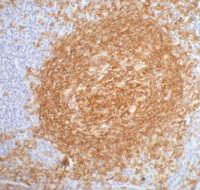
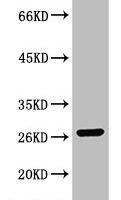
Mouse anti-Human/Mouse/Rat ACTA1 Monoclonal Antibody

Mouse anti-Human/Mouse/Rat ACTA1 Monoclonal Antibody — recombinant protein.

SKU: BCREC-000106MA Category:

Product Specifications

Uniprot No.P68133
Target NamesACTA1
Species ReactivityMouse
ImmunogenSynthetic Peptide
ConjugateNon-conjugated
IsotypeIgG
ClonalityMonoclonal
ApplicationsELISA,WB,IP
BufferPBS, 50% glycerol, 0.05% Proclin 300, 0.05%BSA
StorageUpon receipt, store at -20°C or -80°C. Avoid repeated freeze.

Function

Actins are highly conserved proteins that are involved in various types of cell motility and are ubiquitously expressed in all eukaryotic cells.

Biological Context

Subcellular Location: Cytoplasm, cytoskeleton
Disease Association: Congenital myopathy 2A, typical, autosomal dominant (CMYO2A) : A muscular disorder characterized by generalized muscle weakness, delayed motor milestones, hypotonia, and muscle fiber abnormalities on histologic examination. Histologic findings include abnormal thread- or rod-like structures (nemaline rods), intranuclear rods, clumped filaments, cores, or fiber-type disproportion. The spectrum of clinical phenotypes ranges from severe neonatal presentations to onset of a milder disorder in childhood. [The disease is caused by variants affecting the gene represented in this entry] | Congenital myopathy 2B, severe infantile, autosomal recessive (CMYO2B) : An autosomal recessive skeletal muscle disorder characterized by severe hypotonia with lack of spontaneous movements and respiratory insufficiency, usually leading to death in infancy or early childhood. Longer survival has been reported. [The disease is caused by variants affecting the gene represented in this entry] | Congenital myopathy 2C, severe infantile, autosomal dominant (CMYO2C) : An autosomal dominant skeletal muscle disorder characterized by severe congenital weakness usually resulting in death from respiratory failure in the first year or so of life. Patients present at birth with hypotonia, lack of antigravity movements, poor head control, and difficulties feeding or breathing, often requiring tube-feeding and mechanical ventilation. Decreased fetal movements may be observed in some cases. [The disease is caused by variants affecting the gene represented in this entry] | Myopathy, scapulohumeroperoneal (SHPM) : An autosomal dominant muscular disorder characterized by progressive muscle weakness with initial scapulo-humeral-peroneal and distal distribution. Over time, muscle weakness progresses to proximal muscle groups. Clinical characteristics include scapular winging, mild lower facial weakness, foot drop due to foot eversion and dorsiflexion weakness, and selective muscle atrophy. Age at onset and disease progression are variable. [The disease is caused by variants affecting the gene represented in this entry]

Product Specifications

Mouse anti-Human/Mouse/Rat ACTA1 Monoclonal Antibody is a recombinant protein. Suitable for ELISA and Western Blot applications.

Applications: ELISA,WB,IP

Biological Activity: Not implied unless activity data are explicitly listed on this product page, the datasheet, or the CoA.

Storage: Upon receipt, store at -20°C or -80°C. Avoid repeated freeze.

Shipping & Lead Time: Availability, shipping conditions, and estimated lead time are confirmed in the formal quotation or order confirmation based on the product format, destination, and order requirements.

Protein Biology

Function

Actins are highly conserved proteins that are involved in various types of cell motility and are ubiquitously expressed in all eukaryotic cells

Subcellular Location

Cytoplasm, cytoskeleton

Disease Association

Congenital myopathy 2A, typical, autosomal dominant (CMYO2A) : A muscular disorder characterized by generalized muscle weakness, delayed motor milestones, hypotonia, and muscle fiber abnormalities on histologic examination. Histologic findings include abnormal thread- or rod-like structures (nemaline rods), intranuclear rods, clumped filaments, cores, or fiber-type disproportion. The spectrum of clinical phenotypes ranges from severe neonatal presentations to onset of a milder disorder in childhood. [The disease is caused by variants affecting the gene represented in this entry] | Congenital myopathy 2B, severe infantile, autosomal recessive (CMYO2B) : An autosomal recessive skeletal muscle disorder characterized by severe hypotonia with lack of spontaneous movements and respiratory insufficiency, usually leading to death in infancy or early childhood. Longer survival has been reported. [The disease is caused by variants affecting the gene represented in this entry] | Congenital myopathy 2C, severe infantile, autosomal dominant (CMYO2C) : An autosomal dominant skeletal muscle disorder characterized by severe congenital weakness usually resulting in death from respiratory failure in the first year or so of life. Patients present at birth with hypotonia, lack of antigravity movements, poor head control, and difficulties feeding or breathing, often requiring tube-feeding and mechanical ventilation. Decreased fetal movements may be observed in some cases. [The disease is caused by variants affecting the gene represented in this entry] | Myopathy, scapulohumeroperoneal (SHPM) : An autosomal dominant muscular disorder characterized by progressive muscle weakness with initial scapulo-humeral-peroneal and distal distribution. Over time, muscle weakness progresses to proximal muscle groups. Clinical characteristics include scapular winging, mild lower facial weakness, foot drop due to foot eversion and dorsiflexion weakness, and selective muscle atrophy. Age at onset and disease progression are variable. [The disease is caused by variants affecting the gene represented in this entry]

Subunit

Polymerization of globular actin (G-actin) leads to a structural filament (F-actin) in the form of a two-stranded helix. Each actin can bind to 4 others. Interacts with alpha-actinin (By similarity). Identified in a complex composed of ACTA1, COBL, GSN AND TMSB4X (By similarity). Interacts with TTID (PubMed:10958653). Interacts (via its C-terminus) with USP25; the interaction occurs for all USP25 isoforms but is strongest for isoform USP25m in muscle differentiating cells (PubMed:16501887)

Gene: ACTA1  |  Organism: Homo sapiens  |  Synonyms: Alpha-actin-1
Key Publications

Frequently Asked Questions

How do I order or inquire about this product?

Submit the Online Inquiry form with your required quantity and specifications, or email sales@biocrestsci.com. Available sizes, pricing, stock status, documentation, and estimated lead time are confirmed in the formal quotation.

What is the shipping and delivery time?

Availability, dispatch timing, shipping conditions, and delivery estimates depend on the product format, destination, and order requirements. These details are confirmed in the formal quotation or order confirmation.

How should this product be stored?

Follow the storage and handling instructions in the product-specific datasheet and Certificate of Analysis (CoA). Requirements may vary by product form and formulation; contact BioCrest Sci if product-specific guidance is needed.

What quality controls are performed on your products?

Quality-control data such as identity, purity, endotoxin level, or biological activity are provided only when specified on this product page, the datasheet, or Certificate of Analysis (CoA). Biological activity is not implied unless explicitly stated.

Shopping Cart
Scroll to Top