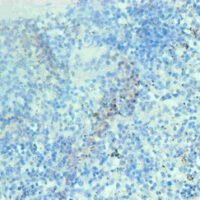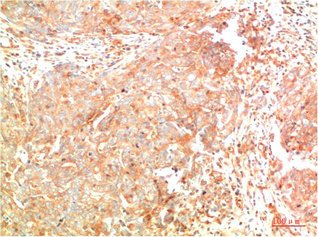
Mouse anti-Human/Mouse/Rat ATG7 Monoclonal Antibody

Mouse anti-Human/Mouse/Rat ATG7 Monoclonal Antibody — E1-like activating enzyme involved in the 2 ubiquitin-like systems required for cytoplasm to vacuole transport (Cvt) and autophagy.

SKU: BCREC-000717MA Category:

Product Specifications

Uniprot No.O95352
Target NamesATG7
Species ReactivityMouse
ImmunogenRecombinant Protein
Immunogen SpeciesHomo sapiens (Human)
ConjugateNon-conjugated
ClonalityMonoclonal
ApplicationsELISA,IHC
BufferPBS, 50% glycerol, 0.05% Proclin 300, 0.05%BSA
StorageUpon receipt, store at -20°C or -80°C. Avoid repeated freeze.

Function

E1-like activating enzyme involved in the 2 ubiquitin-like systems required for cytoplasm to vacuole transport (Cvt) and autophagy. Activates ATG12 for its conjugation with ATG5 as well as the ATG8 family proteins for their conjugation with phosphatidylethanolamine. Both systems are needed for the ATG8 association to Cvt vesicles and autophagosomes membranes.

Biological Context

Subcellular Location: Cytoplasm; Preautophagosomal structure
Tissue Specificity: Widely expressed, especially in kidney, liver, lymph nodes and bone marrow
Disease Association: Spinocerebellar ataxia, autosomal recessive, 31 (SCAR31) : A form of spinocerebellar ataxia, a clinically and genetically heterogeneous group of cerebellar disorders due to degeneration of the cerebellum with variable involvement of the brainstem and spinal cord. SCAR30 is characterized by global developmental delay, hypotonia, variably impaired intellectual and language development, ataxic gait, tremor, and dysarthria. Most affected individuals have optic atrophy. Additional features may include retinitis pigmentosa, sensorineural deafness, dysmorphic facial features, and possibly endocrine dysfunction. [The disease is caused by variants affecting the gene represented in this entry]

Product Specifications

Mouse anti-Human/Mouse/Rat ATG7 Monoclonal Antibody is a recombinant protein. Suitable for ELISA and Western Blot applications.

SDS-PAGE: Single band at expected molecular weight confirming purity.

ELISA: Suitable as coating antigen or detection standard.

Western Blot: Compatible with standard Western Blot protocols.

Protein Interaction: Validated for SPR (Surface Plasmon Resonance) and BLI (Bio-Layer Interferometry) studies.

Shipping: Shipped at ambient temperature. Lyophilized protein is stable during transit.

Storage: Store lyophilized protein at -20°C to -80°C. Reconstituted protein should be aliquoted and stored at -80°C. Avoid repeated freeze-thaw cycles.

Shelf Life: 12 months from date of receipt when stored as recommended.

Shipping Time: Orders placed before 2 PM EST ship same day. International orders typically deliver within 5-10 business days.

Protein Biology

Function

E1-like activating enzyme involved in the 2 ubiquitin-like systems required for cytoplasm to vacuole transport (Cvt) and autophagy. Activates ATG12 for its conjugation with ATG5 as well as the ATG8 family proteins for their conjugation with phosphatidylethanolamine. Both systems are needed for the ATG8 association to Cvt vesicles and autophagosomes membranes. Required for autophagic death induced by caspase-8 inhibition. Facilitates LC3-I lipidation with phosphatidylethanolamine to form LC3-II which is found on autophagosomal membranes (PubMed:34161705). Required for mitophagy which contributes to regulate mitochondrial quantity and quality by eliminating the mitochondria to a basal level to fulfill cellular energy requirements and preventing excess ROS production. Modulates p53/TP53 activity to regulate cell cycle and survival during metabolic stress. Also plays a key role in the maintenance of axonal homeostasis, the prevention of axonal degeneration, the maintenance of hematopoietic stem cells, the formation of Paneth cell granules, as well as in adipose differentiation. Plays a role in regulating the liver clock and glucose metabolism by mediating the autophagic degradation of CRY1 (clock repressor) in a time-dependent manner (By similarity)

Subcellular Location

Cytoplasm; Preautophagosomal structure

Disease Association

Spinocerebellar ataxia, autosomal recessive, 31 (SCAR31) : A form of spinocerebellar ataxia, a clinically and genetically heterogeneous group of cerebellar disorders due to degeneration of the cerebellum with variable involvement of the brainstem and spinal cord. SCAR30 is characterized by global developmental delay, hypotonia, variably impaired intellectual and language development, ataxic gait, tremor, and dysarthria. Most affected individuals have optic atrophy. Additional features may include retinitis pigmentosa, sensorineural deafness, dysmorphic facial features, and possibly endocrine dysfunction. [The disease is caused by variants affecting the gene represented in this entry]

Tissue Specificity

Widely expressed, especially in kidney, liver, lymph nodes and bone marrow

Subunit

Homodimer (PubMed:11096062). Interacts with ATG3; this interaction is essential for the transfer of ATG8-like proteins's thioester from ATG7 to ATG3 and plays a role in the conjugation of ATG12 to ATG5 (PubMed:11825910, PubMed:26043688). Interacts with ATG12 (PubMed:11096062, PubMed:11825910). Forms intermediate conjugates with GABARAPL1 (By similarity). Forms intermediate conjugates with ATG8-like proteins such as GABARAP, GABARAPL2 or MAP1LC3A (PubMed:11096062, PubMed:16303767). Interacts with EP300 acetyltransferase (PubMed:19124466). Interacts with FOXO1 (PubMed:20543840)

Gene: ATG7  |  Organism: Homo sapiens  |  Synonyms: ATG12-activating enzyme E1 ATG7; Autophagy-related protein 7; Ubiquitin-activating enzyme E1-like protein
Key Publications

Frequently Asked Questions

How do I order or inquire about this product?

Fill out the Online Inquiry form with your required quantity and specifications. You can also email sales@biocrestsci.com. Our team typically responds within 4 business hours with a quote and availability confirmation.

What is the shipping and delivery time?

Orders placed before 2 PM EST ship the same day. Domestic (US) delivery typically takes 2-3 business days. International orders deliver within 5-10 business days. All products are shipped at ambient temperature with appropriate packaging to ensure stability.

How should I store this recombinant protein?

Lyophilized proteins should be stored at -20°C to -80°C upon receipt. After reconstitution, aliquot and store at -80°C. Avoid repeated freeze-thaw cycles. Shelf life is 12 months from date of receipt when stored as recommended.

What quality controls are performed on your products?

Each product undergoes SDS-PAGE purity analysis (typically >85-95%), endotoxin testing, and bioactivity validation. Products are validated for ELISA, Western Blot, and SPR/BLI applications as specified on this product page. A Certificate of Analysis (CoA) is available upon request.

Shopping Cart
Scroll to Top