
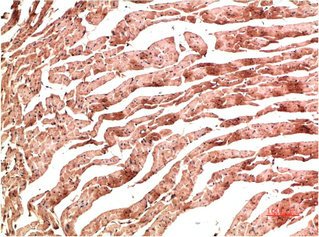
Mouse anti-Human/Mouse/Rat CDH5 Monoclonal Antibody

Mouse anti-Human/Mouse/Rat CDH5 Monoclonal Antibody — Cadherins are calcium-dependent cell adhesion proteins.

SKU: BCREC-000659MA Category:

Product Specifications

Uniprot No.P33151
Target NamesCDH5
Species ReactivityMouse
ImmunogenSynthetic Peptide of VE-Cadherin
Immunogen SpeciesHomo sapiens (Human)
ConjugateNon-conjugated
ClonalityMonoclonal
ApplicationsELISA,IHC
BufferPBS, 50% glycerol, 0.05% Proclin 300, 0.05%BSA
StorageUpon receipt, store at -20°C or -80°C. Avoid repeated freeze.

Function

Cadherins are calcium-dependent cell adhesion proteins. They preferentially interact with themselves in a homophilic manner in connecting cells; cadherins may thus contribute to the sorting of heterogeneous cell types. This cadherin may play a important role in endothelial cell biology through control of the cohesion and organization of the intercellular junctions.

Biological Context

Subcellular Location: Cell junction, adherens junction; Cell membrane (Single-pass type I membrane protein); Cytoplasm
Tissue Specificity: Expressed in endothelial cells (at protein level). Expressed in the brain

Product Specifications

Mouse anti-Human/Mouse/Rat CDH5 Monoclonal Antibody is a recombinant protein. Suitable for ELISA and Western Blot applications.

Catalog number: BCREC-000659MA.

Applications: ELISA,IHC

Biological Activity: Not implied unless activity data are explicitly listed on this product page, the datasheet, or the CoA.

Storage: Upon receipt, store at -20°C or -80°C. Avoid repeated freeze.

Shipping & Lead Time: Availability, shipping conditions, and estimated lead time are confirmed in the formal quotation or order confirmation based on the product format, destination, and order requirements.

Protein Biology

Function

Cadherins are calcium-dependent cell adhesion proteins (By similarity). They preferentially interact with themselves in a homophilic manner in connecting cells; cadherins may thus contribute to the sorting of heterogeneous cell types (PubMed:21269602). This cadherin may play a important role in endothelial cell biology through control of the cohesion and organization of the intercellular junctions (By similarity). It associates with alpha-catenin forming a link to the cytoskeleton (PubMed:10861224). Plays a role in coupling actin fibers to cell junctions in endothelial cells, via acting as a cell junctional complex anchor for AMOTL2 and MAGI1 (By similarity). Acts in concert with KRIT1 and PALS1 to establish and maintain correct endothelial cell polarity and vascular lumen (By similarity). These effects are mediated by recruitment and activation of the Par polarity complex and RAP1B (PubMed:20332120). Positively regulates reorientation of actin stress fibers and endothelial cell reorientation in response to cellular mechantransduction (PubMed:25795300). Required for activation of PRKCZ and for the localization of phosphorylated PRKCZ, PARD3, TIAM1 and RAP1B to the cell junction (PubMed:20332120). Associates with CTNND1/p120-catenin to control CADH5 endocytosis (By similarity)

Subcellular Location

Cell junction, adherens junction; Cell membrane (Single-pass type I membrane protein); Cytoplasm

Tissue Specificity

Expressed in endothelial cells (at protein level) (PubMed:27338829). Expressed in the brain (PubMed:2059658)

Subunit

Part of a complex composed of AMOTL2, MAGI1 and CDH5, within the complex AMOTL2 acts as a scaffold protein for the interaction of MAGI1 with CDH5 (By similarity). The complex is required for coupling actin fibers to cell junctions in endothelial cells (By similarity). Within the complex AMOTL2 (via its N-terminus) interacts with CDH5 (By similarity). Interacts (via cadherin 5 domain) with PTPRB (By similarity). Interacts with TRPC4 (PubMed:19996314). Interacts with KRIT1 (PubMed:20332120). Interacts with PARD3 (By similarity). Interacts with RTN4 (isoform B) (PubMed:21183689). Interacts with PALS1; the interaction promotes PALS1 localization to cell junctions and is required for CDH5-mediated vascular lumen formation and endothelial cell (PubMed:27466317). Interacts with CTNND1/p120-catenin; the interaction controls CADH5 endocytosis (By similarity)

Gene: CDH5  |  Organism: Homo sapiens  |  Synonyms: 7B4 antigen; Vascular endothelial cadherin
Key Publications

Frequently Asked Questions

How do I order or inquire about this product?

Submit the Online Inquiry form with your required quantity and specifications, or email sales@biocrestsci.com. Available sizes, pricing, stock status, documentation, and estimated lead time are confirmed in the formal quotation.

What is the shipping and delivery time?

Availability, dispatch timing, shipping conditions, and delivery estimates depend on the product format, destination, and order requirements. These details are confirmed in the formal quotation or order confirmation.

How should this product be stored?

Follow the storage and handling instructions in the product-specific datasheet and Certificate of Analysis (CoA). Requirements may vary by product form and formulation; contact BioCrest Sci if product-specific guidance is needed.

What quality controls are performed on your products?

Quality-control data such as identity, purity, endotoxin level, or biological activity are provided only when specified on this product page, the datasheet, or Certificate of Analysis (CoA). Biological activity is not implied unless explicitly stated.

Shopping Cart
Scroll to Top