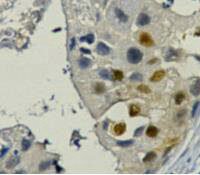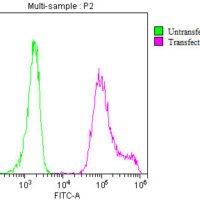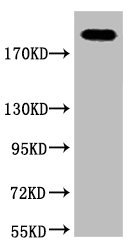
Mouse anti-Human/Mouse/Rat FN1 Monoclonal Antibody

Mouse anti-Human/Mouse/Rat FN1 Monoclonal Antibody — recombinant protein.

SKU: BCREC-000100MA Category:

Product Specifications

Uniprot No.P02751
Target NamesFN1
Species ReactivityMouse
ImmunogenSynthetic Peptide
ConjugateNon-conjugated
IsotypeIgG
ClonalityMonoclonal
ApplicationsELISA,WB
BufferPBS, 50% glycerol, 0.05% Proclin 300, 0.05%BSA
StorageUpon receipt, store at -20°C or -80°C. Avoid repeated freeze.

Function

Secreted by contracting muscle, induces liver autophagy, a degradative pathway for nutrient mobilization and damage removal, and systemic insulin sensitization via hepatic ITGA5:ITGB1 integrin receptor signaling.

Biological Context

Subcellular Location: Secreted, extracellular space, extracellular matrix; Secreted
Tissue Specificity: Expressed in the inner limiting membrane and around blood vessels in the retina (at protein level). Plasma FN (soluble dimeric form) is secreted by hepatocytes. Cellular FN (dimeric or cross-linked multimeric forms), made by fibroblasts, epithelial and other cell types, is deposited as fibrils in the extracellular matrix. Ugl-Y1, Ugl-Y2 and Ugl-Y3 are found in urine
Disease Association: Glomerulopathy with fibronectin deposits 2 (GFND2) : Genetically heterogeneous autosomal dominant disorder characterized clinically by proteinuria, microscopic hematuria, and hypertension that leads to end-stage renal failure in the second to fifth decade of life. [The disease is caused by variants affecting the gene represented in this entry] | Spondylometaphyseal dysplasia, corner fracture type (SMDCF) : An autosomal dominant form of spondylometaphyseal dysplasia, a group of short stature disorders distinguished by abnormalities in the vertebrae and the metaphyses of the tubular bones. SMDCF is characterized by flake-like, triangular, or curvilinear ossification centers at the edges of irregular metaphyses that simulate fractures. These corner fractures involve the distal tibia, the ulnar aspect of the distal radius, the proximal humerus, and the proximal femur. They represent irregular ossification at the growth plates and secondary ossification centers. [The disease is caused by variants affecting the gene represented in this entry]

Product Specifications

Mouse anti-Human/Mouse/Rat FN1 Monoclonal Antibody is a recombinant protein. Suitable for ELISA and Western Blot applications.

Applications: ELISA,WB

Biological Activity: Not implied unless activity data are explicitly listed on this product page, the datasheet, or the CoA.

Storage: Upon receipt, store at -20°C or -80°C. Avoid repeated freeze.

Shipping & Lead Time: Availability, shipping conditions, and estimated lead time are confirmed in the formal quotation or order confirmation based on the product format, destination, and order requirements.

Protein Biology

Function

Secreted by contracting muscle, induces liver autophagy, a degradative pathway for nutrient mobilization and damage removal, and systemic insulin sensitization via hepatic ITGA5:ITGB1 integrin receptor signaling

Subcellular Location

Secreted, extracellular space, extracellular matrix; Secreted

Disease Association

Glomerulopathy with fibronectin deposits 2 (GFND2) : Genetically heterogeneous autosomal dominant disorder characterized clinically by proteinuria, microscopic hematuria, and hypertension that leads to end-stage renal failure in the second to fifth decade of life. [The disease is caused by variants affecting the gene represented in this entry] | Spondylometaphyseal dysplasia, corner fracture type (SMDCF) : An autosomal dominant form of spondylometaphyseal dysplasia, a group of short stature disorders distinguished by abnormalities in the vertebrae and the metaphyses of the tubular bones. SMDCF is characterized by flake-like, triangular, or curvilinear ossification centers at the edges of irregular metaphyses that simulate fractures. These corner fractures involve the distal tibia, the ulnar aspect of the distal radius, the proximal humerus, and the proximal femur. They represent irregular ossification at the growth plates and secondary ossification centers. [The disease is caused by variants affecting the gene represented in this entry]

Tissue Specificity

Expressed in the inner limiting membrane and around blood vessels in the retina (at protein level) (PubMed:29777959). Plasma FN (soluble dimeric form) is secreted by hepatocytes. Cellular FN (dimeric or cross-linked multimeric forms), made by fibroblasts, epithelial and other cell types, is deposited as fibrils in the extracellular matrix. Ugl-Y1, Ugl-Y2 and Ugl-Y3 are found in urine (PubMed:17614963)

Subunit

(Microbial infection) Interacts with fibronectin-binding proteins from other Mycobacteria

Gene: FN1  |  Organism: Homo sapiens  |  Synonyms: Cold-insoluble globulin
Key Publications

Frequently Asked Questions

How do I order or inquire about this product?

Submit the Online Inquiry form with your required quantity and specifications, or email sales@biocrestsci.com. Available sizes, pricing, stock status, documentation, and estimated lead time are confirmed in the formal quotation.

What is the shipping and delivery time?

Availability, dispatch timing, shipping conditions, and delivery estimates depend on the product format, destination, and order requirements. These details are confirmed in the formal quotation or order confirmation.

How should this product be stored?

Follow the storage and handling instructions in the product-specific datasheet and Certificate of Analysis (CoA). Requirements may vary by product form and formulation; contact BioCrest Sci if product-specific guidance is needed.

What quality controls are performed on your products?

Quality-control data such as identity, purity, endotoxin level, or biological activity are provided only when specified on this product page, the datasheet, or Certificate of Analysis (CoA). Biological activity is not implied unless explicitly stated.

Shopping Cart
Scroll to Top