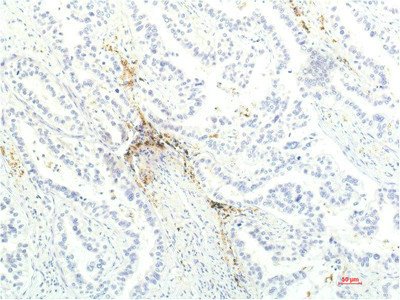
Mouse anti-Human/Mouse/Rat JAK1 Monoclonal Antibody

Mouse anti-Human/Mouse/Rat JAK1 Monoclonal Antibody — Non-membrane spanning protein tyrosine kinase that phosphorylates signal-transducing subunits of cytokine receptor complexes like IL2RB, IL10RA, IFNAR2, IL6ST, LIFR, OSMR and IL31RA.

SKU: BCREC-000858MA Category:

Product Specifications

Uniprot No.P23458
Target NamesJAK1
Species ReactivityMouse
ImmunogenSynthetic Peptide of JAK1 at AA range of 960-1040
Immunogen SpeciesHomo sapiens (Human)
ConjugateNon-conjugated
ClonalityMonoclonal
ApplicationsELISA,IHC
BufferPBS, 50% glycerol, 0.05% Proclin 300, 0.05%BSA
StorageUpon receipt, store at -20°C or -80°C. Avoid repeated freeze.

Function

Non-membrane spanning protein tyrosine kinase that phosphorylates signal-transducing subunits of cytokine receptor complexes like IL2RB, IL10RA, IFNAR2, IL6ST, LIFR, OSMR and IL31RA. Functionnally, is involved in the IFN-alpha/beta/gamma signal pathway. Mechanistically, in response to interferon-binding to IFNAR1-IFNAR2 heterodimer, phosphorylates and activates its binding partner IFNAR2, creating docking sites for STAT proteins.

Biological Context

Subcellular Location: Endomembrane system (Peripheral membrane protein)
Tissue Specificity: Expressed at higher levels in primary colon tumors than in normal colon tissue. The expression level in metastatic colon tumors is comparable to the expression level in normal colon tissue
Disease Association: Autoinflammation, immune dysregulation, and eosinophilia (AIIDE) : An autosomal dominant disorder characterized by immune dysregulation, severe atopic dermatitis, and chronic gastrointestinal inflammation. Additional features include asthma, food or environmental allergies, as well as poor overall growth with short stature. [The disease is caused by variants affecting the gene represented in this entry]

Product Specifications

Mouse anti-Human/Mouse/Rat JAK1 Monoclonal Antibody is a recombinant protein. Suitable for ELISA and Western Blot applications.

Applications: ELISA,IHC

Biological Activity: Not implied unless activity data are explicitly listed on this product page, the datasheet, or the CoA.

Storage: Upon receipt, store at -20°C or -80°C. Avoid repeated freeze.

Shipping & Lead Time: Availability, shipping conditions, and estimated lead time are confirmed in the formal quotation or order confirmation based on the product format, destination, and order requirements.

Protein Biology

Function

Non-membrane spanning protein tyrosine kinase that phosphorylates signal-transducing subunits of cytokine receptor complexes like IL2RB, IL10RA, IFNAR2, IL6ST, LIFR, OSMR and IL31RA (PubMed:11909529, PubMed:12133952, PubMed:15194700, PubMed:16239216, PubMed:28111307, PubMed:32750333, PubMed:7615558, PubMed:8232552, PubMed:9188471). Functionnally, is involved in the IFN-alpha/beta/gamma signal pathway (PubMed:16239216, PubMed:28111307, PubMed:32750333, PubMed:7615558, PubMed:8232552). Mechanistically, in response to interferon-binding to IFNAR1-IFNAR2 heterodimer, phosphorylates and activates its binding partner IFNAR2, creating docking sites for STAT proteins (PubMed:7759950). Directly phosphorylates STAT proteins but also activates STAT signaling through the transactivation of other JAK kinases associated with signaling receptors (PubMed:16239216, PubMed:32750333, PubMed:8232552). Involved in the MT-RNR2/humanin-mediated signaling pathway leading to STAT3 phosphorylation (PubMed:27384491). Binding of CNTF or the CLCF1/CLF heterodimer to CNTFR leads to IL6ST/gp130-LIFR dimerization followed by activation of JAK1 and JAK2 which in turns phosphorylate IL6ST/gp130 and LIFR (PubMed:11294841). The tyrosine phosphorylated signaling receptors serve in turn as docking proteins for STAT3 (PubMed:11294841). Involved in the oncostatin-M-mediated signaling pathway through both type I OSM receptor complex (heterodimers composed of LIFR and IL6ST) and type II OSM receptor complex (heterodimers composed of OSMR and IL6ST) (PubMed:9188471). Involved in the oncostatin-M-mediated signaling pathway through both type I OSM receptor complex (heterodimers composed of LIFR and IL6ST) and type II OSM receptor complex (heterodimers composed of OSMR and IL6ST) (PubMed:9188471). Involved in the Interleukin-31-mediated signaling pathway through the IL31 receptor complex (heterodimers composed of OSMR and IL31RA) (PubMed:15194700)

Subcellular Location

Endomembrane system (Peripheral membrane protein)

Disease Association

Autoinflammation, immune dysregulation, and eosinophilia (AIIDE) : An autosomal dominant disorder characterized by immune dysregulation, severe atopic dermatitis, and chronic gastrointestinal inflammation. Additional features include asthma, food or environmental allergies, as well as poor overall growth with short stature. [The disease is caused by variants affecting the gene represented in this entry]

Tissue Specificity

Expressed at higher levels in primary colon tumors than in normal colon tissue. The expression level in metastatic colon tumors is comparable to the expression level in normal colon tissue

Subunit

Interacts with IFNGR1 (PubMed:7615558). Interacts with JAKMIP1 (PubMed:15277531). Interacts with SHB (PubMed:12200137). Interacts (via N-terminus) with IL2RB and IL10RA (via its cytoplasmic domain) (PubMed:12133952). Interacts with FER (By similarity)

Gene: JAK1  |  Organism: Homo sapiens  |  Synonyms: Janus kinase 1
Key Publications

Frequently Asked Questions

How do I order or inquire about this product?

Submit the Online Inquiry form with your required quantity and specifications, or email sales@biocrestsci.com. Available sizes, pricing, stock status, documentation, and estimated lead time are confirmed in the formal quotation.

What is the shipping and delivery time?

Availability, dispatch timing, shipping conditions, and delivery estimates depend on the product format, destination, and order requirements. These details are confirmed in the formal quotation or order confirmation.

How should this product be stored?

Follow the storage and handling instructions in the product-specific datasheet and Certificate of Analysis (CoA). Requirements may vary by product form and formulation; contact BioCrest Sci if product-specific guidance is needed.

What quality controls are performed on your products?

Quality-control data such as identity, purity, endotoxin level, or biological activity are provided only when specified on this product page, the datasheet, or Certificate of Analysis (CoA). Biological activity is not implied unless explicitly stated.

Shopping Cart
Scroll to Top