Mouse anti-Human/Mouse/Rat sapiens (Human) ATIC Monoclonal Antibody

Mouse anti-Human/Mouse/Rat sapiens (Human) ATIC Monoclonal Antibody — Bifunctional enzyme that catalyzes the last two steps of purine biosynthesis.

SKU: BCREC-000534MA Category:

Product Specifications

Uniprot No.P31939
Target NamesATIC
Species ReactivityMouse
ImmunogenRecombinant Human ATIC protein
Immunogen SpeciesHomo sapiens (Human)
ConjugateNon-conjugated
IsotypeMouse IgG1
ClonalityMonoclonal
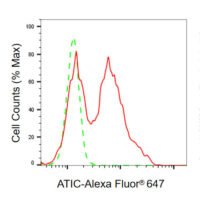
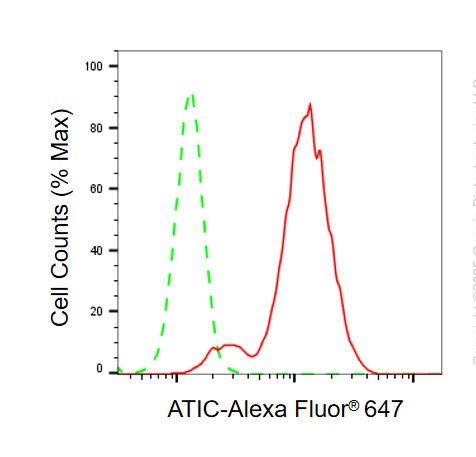
ApplicationsELISA, WB, FC
BufferPBS, 50% glycerol, 0.05% Proclin 300, 0.05%BSA
StorageUpon receipt, store at -20°C or -80°C. Avoid repeated freeze.

Function

Bifunctional enzyme that catalyzes the last two steps of purine biosynthesis. Acts as a transformylase that incorporates a formyl group to the AMP analog AICAR (5-amino-1-(5-phospho-beta-D-ribosyl)imidazole-4-carboxamide) to produce the intermediate formyl-AICAR (FAICAR). Can use both 10-formyldihydrofolate and 10-formyltetrahydrofolate as the formyl donor in this reaction.

Biological Context

Subcellular Location: Cytoplasm, cytosol
Tissue Specificity: Present in the heart, brain, placenta, lung, liver, skeletal muscle, kidney, pancreas
Disease Association: AICA-ribosuria due to ATIC deficiency (AICAR) : A neurologically devastating inborn error of purine biosynthesis. Patients excrete massive amounts of AICA-riboside in the urine and accumulate AICA-ribotide and its derivatives in erythrocytes and fibroblasts. Clinical features include profound intellectual disability, epilepsy, dysmorphic features and congenital blindness. AICAR inheritance is autosomal recessive. [The disease is caused by variants affecting the gene represented in this entry]
Pathway: Purine metabolism; IMP biosynthesis via de novo pathway; IMP from 5-formamido-1-(5-phospho-D-ribosyl)imidazole-4-carboxamide: step 1/1

Product Specifications

Mouse anti-Human/Mouse/Rat sapiens (Human) ATIC Monoclonal Antibody is a recombinant protein. Suitable for ELISA and Western Blot applications.

Applications: ELISA, WB, FC

Biological Activity: Not implied unless activity data are explicitly listed on this product page, the datasheet, or the CoA.

Storage: Upon receipt, store at -20°C or -80°C. Avoid repeated freeze.

Shipping & Lead Time: Availability, shipping conditions, and estimated lead time are confirmed in the formal quotation or order confirmation based on the product format, destination, and order requirements.

Protein Biology

Function

Bifunctional enzyme that catalyzes the last two steps of purine biosynthesis (PubMed:11948179, PubMed:14756554). Acts as a transformylase that incorporates a formyl group to the AMP analog AICAR (5-amino-1-(5-phospho-beta-D-ribosyl)imidazole-4-carboxamide) to produce the intermediate formyl-AICAR (FAICAR) (PubMed:10985775, PubMed:11948179, PubMed:9378707). Can use both 10-formyldihydrofolate and 10-formyltetrahydrofolate as the formyl donor in this reaction (PubMed:10985775). Also catalyzes the cyclization of FAICAR to inosine monophosphate (IMP) (PubMed:11948179, PubMed:14756554). Is able to convert thio-AICAR to 6-mercaptopurine ribonucleotide, an inhibitor of purine biosynthesis used in the treatment of human leukemias (PubMed:10985775). Promotes insulin receptor/INSR autophosphorylation and is involved in INSR internalization (PubMed:25687571)

Subcellular Location

Cytoplasm, cytosol

Disease Association

AICA-ribosuria due to ATIC deficiency (AICAR) : A neurologically devastating inborn error of purine biosynthesis. Patients excrete massive amounts of AICA-riboside in the urine and accumulate AICA-ribotide and its derivatives in erythrocytes and fibroblasts. Clinical features include profound intellectual disability, epilepsy, dysmorphic features and congenital blindness. AICAR inheritance is autosomal recessive. [The disease is caused by variants affecting the gene represented in this entry]

Tissue Specificity

Present in the heart, brain, placenta, lung, liver, skeletal muscle, kidney, pancreas

Subunit

Homodimer (PubMed:14756553, PubMed:14966129). Associates with internalized INSR complexes on Golgi/endosomal membranes (PubMed:25687571). Interacts with INSR; ATIC together with PRKAA2/AMPK2 and HACD3/PTPLAD1 is proposed to be part of a signaling network regulating INSR autophosphorylation and endocytosis (PubMed:25687571)

Pathway

Purine metabolism; IMP biosynthesis via de novo pathway; IMP from 5-formamido-1-(5-phospho-D-ribosyl)imidazole-4-carboxamide: step 1/1

Gene: ATIC  |  Organism: Homo sapiens  |  Synonyms: AICAR transformylase/inosine monophosphate cyclohydrolase
Key Publications

Frequently Asked Questions

How do I order or inquire about this product?

Submit the Online Inquiry form with your required quantity and specifications, or email sales@biocrestsci.com. Available sizes, pricing, stock status, documentation, and estimated lead time are confirmed in the formal quotation.

What is the shipping and delivery time?

Availability, dispatch timing, shipping conditions, and delivery estimates depend on the product format, destination, and order requirements. These details are confirmed in the formal quotation or order confirmation.

How should this product be stored?

Follow the storage and handling instructions in the product-specific datasheet and Certificate of Analysis (CoA). Requirements may vary by product form and formulation; contact BioCrest Sci if product-specific guidance is needed.

What quality controls are performed on your products?

Quality-control data such as identity, purity, endotoxin level, or biological activity are provided only when specified on this product page, the datasheet, or Certificate of Analysis (CoA). Biological activity is not implied unless explicitly stated.

Shopping Cart
Scroll to Top