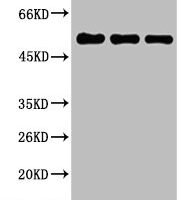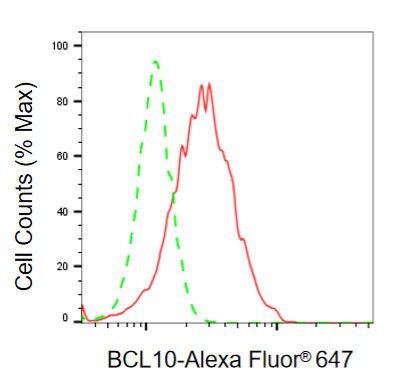
Mouse anti-Human/Mouse/Rat sapiens (Human) BCL10 Monoclonal Antibody

Mouse anti-Human/Mouse/Rat sapiens (Human) BCL10 Monoclonal Antibody — Plays a key role in both adaptive and innate immune signaling by bridging CARD domain-containing proteins to immune activation.

SKU: BCREC-000537MA Category:

Product Specifications

Uniprot No.O95999
Target NamesBCL10
Species ReactivityMouse
ImmunogenRecombinant Human BCL10 protein
Immunogen SpeciesHomo sapiens (Human)
ConjugateNon-conjugated
IsotypeMouse IgG1 kappa
ClonalityMonoclonal
ApplicationsELISA, WB, FC, ICC
BufferPBS, 50% glycerol, 0.05% Proclin 300, 0.05%BSA
StorageUpon receipt, store at -20°C or -80°C. Avoid repeated freeze.

Function

Plays a key role in both adaptive and innate immune signaling by bridging CARD domain-containing proteins to immune activation. Acts by channeling adaptive and innate immune signaling downstream of CARD domain-containing proteins CARD9, CARD11 and CARD14 to activate NF-kappa-B and MAP kinase p38 (MAPK11, MAPK12, MAPK13 and/or MAPK14) pathways which stimulate expression of genes encoding pro-inflammatory cytokines and chemokines. Recruited by activated CARD domain-containing proteins: homooligomerized CARD domain-containing proteins form a nucleating helical template that recruits BCL10 via CARD-CARD interaction, thereby promoting polymerization of BCL10, subsequent recruitment of MALT1 and formation of a CBM complex.

Biological Context

Subcellular Location: Cytoplasm, perinuclear region; Membrane raft
Tissue Specificity: Ubiquitous
Disease Association: [A chromosomal aberration involving BCL10 is recurrent in low-grade mucosa-associated lymphoid tissue (MALT lymphoma). Translocation t(1;14)(p22;q32). Although the BCL10/IgH translocation leaves the coding region of BCL10 intact, frequent BCL10 mutations could be attributed to the Ig somatic hypermutation mechanism resulting in nucleotide transitions] | Immunodeficiency 37 (IMD37) : A form of primary combined immunodeficiency, a group of disorders characterized by severe recurrent infections, with normal numbers or an absence of T and B lymphocytes, and impaired cellular and humoral immunity. IMD37 is characterized by hypogammaglobulinemia without lymphopenia, but with profoundly reduced memory B cells and memory T cells, and increased numbers of circulating naive lymphocytes. Inheritance is autosomal recessive. [The disease is caused by variants affecting the gene represented in this entry] | Lymphoma, mucosa-associated lymphoid type (MALTOMA) : A subtype of non-Hodgkin lymphoma, originating in mucosa-associated lymphoid tissue. MALT lymphomas occur most commonly in the gastro-intestinal tract but have been described in a variety of extranodal sites including the ocular adnexa, salivary gland, thyroid, lung, thymus, and breast. Histologically, they are characterized by an infiltrate of small to medium-sized lymphocytes with abundant cytoplasm and irregularly shaped nuclei. Scattered transformed blasts (large cells) also are present. Non-malignant reactive follicles are observed frequently. A pivotal feature is the presence of lymphoepithelial lesions, with invasion and partial destruction of mucosal glands and crypts by aggregates of tumor cells. [The disease is caused by variants affecting the gene represented in this entry]

Product Specifications

Mouse anti-Human/Mouse/Rat sapiens (Human) BCL10 Monoclonal Antibody is a recombinant protein. Suitable for ELISA and Western Blot applications.

Applications: ELISA, WB, FC, ICC

Biological Activity: Not implied unless activity data are explicitly listed on this product page, the datasheet, or the CoA.

Storage: Upon receipt, store at -20°C or -80°C. Avoid repeated freeze.

Shipping & Lead Time: Availability, shipping conditions, and estimated lead time are confirmed in the formal quotation or order confirmation based on the product format, destination, and order requirements.

Protein Biology

Function

Plays a key role in both adaptive and innate immune signaling by bridging CARD domain-containing proteins to immune activation (PubMed:10187770, PubMed:10364242, PubMed:10400625, PubMed:24074955, PubMed:25365219). Acts by channeling adaptive and innate immune signaling downstream of CARD domain-containing proteins CARD9, CARD11 and CARD14 to activate NF-kappa-B and MAP kinase p38 (MAPK11, MAPK12, MAPK13 and/or MAPK14) pathways which stimulate expression of genes encoding pro-inflammatory cytokines and chemokines (PubMed:24074955). Recruited by activated CARD domain-containing proteins: homooligomerized CARD domain-containing proteins form a nucleating helical template that recruits BCL10 via CARD-CARD interaction, thereby promoting polymerization of BCL10, subsequent recruitment of MALT1 and formation of a CBM complex (PubMed:24074955). This leads to activation of NF-kappa-B and MAP kinase p38 (MAPK11, MAPK12, MAPK13 and/or MAPK14) pathways which stimulate expression of genes encoding pro-inflammatory cytokines and chemokines (PubMed:18287044, PubMed:24074955, PubMed:27777308). Activated by CARD9 downstream of C-type lectin receptors; CARD9-mediated signals are essential for antifungal immunity (PubMed:26488816). Activated by CARD11 downstream of T-cell receptor (TCR) and B-cell receptor (BCR) (PubMed:18264101, PubMed:18287044, PubMed:24074955, PubMed:27777308). Promotes apoptosis, pro-caspase-9 maturation and activation of NF-kappa-B via NIK and IKK (PubMed:10187815)

Subcellular Location

Cytoplasm, perinuclear region; Membrane raft

Disease Association

[A chromosomal aberration involving BCL10 is recurrent in low-grade mucosa-associated lymphoid tissue (MALT lymphoma). Translocation t(1;14)(p22;q32). Although the BCL10/IgH translocation leaves the coding region of BCL10 intact, frequent BCL10 mutations could be attributed to the Ig somatic hypermutation mechanism resulting in nucleotide transitions] | Immunodeficiency 37 (IMD37) : A form of primary combined immunodeficiency, a group of disorders characterized by severe recurrent infections, with normal numbers or an absence of T and B lymphocytes, and impaired cellular and humoral immunity. IMD37 is characterized by hypogammaglobulinemia without lymphopenia, but with profoundly reduced memory B cells and memory T cells, and increased numbers of circulating naive lymphocytes. Inheritance is autosomal recessive. [The disease is caused by variants affecting the gene represented in this entry] | Lymphoma, mucosa-associated lymphoid type (MALTOMA) : A subtype of non-Hodgkin lymphoma, originating in mucosa-associated lymphoid tissue. MALT lymphomas occur most commonly in the gastro-intestinal tract but have been described in a variety of extranodal sites including the ocular adnexa, salivary gland, thyroid, lung, thymus, and breast. Histologically, they are characterized by an infiltrate of small to medium-sized lymphocytes with abundant cytoplasm and irregularly shaped nuclei. Scattered transformed blasts (large cells) also are present. Non-malignant reactive follicles are observed frequently. A pivotal feature is the presence of lymphoepithelial lesions, with invasion and partial destruction of mucosal glands and crypts by aggregates of tumor cells. [The disease is caused by variants affecting the gene represented in this entry]

Tissue Specificity

Ubiquitous

Subunit

Homomultimer; homooligomerized following recruitment by CARD domain-containing proteins that form a nucleating helical template that recruits BCL10 via CARD-CARD interaction (PubMed:24074955). Self-associates by CARD-CARD interaction and interacts with other CARD-proteins such as CARD9, CARD10, CARD11 and CARD14 (PubMed:24074955, PubMed:26488816, PubMed:27113748, PubMed:27777308, PubMed:28628108, PubMed:31296852). Forms a complex with CARD14 and MALT1; resulting in the formation of a CBM (CARD14-BCL10-MALT1) complex (PubMed:27113748). Forms a complex with CARD11 and MALT1; resulting in the formation of a CBM (CARD11-BCL10-MALT1) complex (PubMed:24074955, PubMed:28628108). Forms a complex with CARD9 and MALT1; resulting in the formation of a CBM (CARD9-BCL10-MALT1) complex (By similarity). Found in a membrane raft complex, at least composed of BCL10, CARD11, DPP4 and IKBKB (PubMed:17287217). Binds caspase-9 with its C-terminal domain (PubMed:10187815). Interacts with TRAF2 and BIRC2/c-IAP2 (PubMed:11466612). Interacts with PELI2 and SOCS3; these interactions may be mutually exclusive (By similarity)

Gene: BCL10  |  Organism: Homo sapiens  |  Synonyms: B-cell CLL/lymphoma 10; CARD-containing molecule enhancing NF-kappa-B; CARD-like apoptotic protein; CED-3/ICH-1 prodomain homologous E10-like regulator; Cellular homolog of vCARMEN; Cellular-E10; Mammalian CARD-containing adapter molecule E10
Key Publications

Frequently Asked Questions

How do I order or inquire about this product?

Submit the Online Inquiry form with your required quantity and specifications, or email sales@biocrestsci.com. Available sizes, pricing, stock status, documentation, and estimated lead time are confirmed in the formal quotation.

What is the shipping and delivery time?

Availability, dispatch timing, shipping conditions, and delivery estimates depend on the product format, destination, and order requirements. These details are confirmed in the formal quotation or order confirmation.

How should this product be stored?

Follow the storage and handling instructions in the product-specific datasheet and Certificate of Analysis (CoA). Requirements may vary by product form and formulation; contact BioCrest Sci if product-specific guidance is needed.

What quality controls are performed on your products?

Quality-control data such as identity, purity, endotoxin level, or biological activity are provided only when specified on this product page, the datasheet, or Certificate of Analysis (CoA). Biological activity is not implied unless explicitly stated.

Shopping Cart
Scroll to Top