
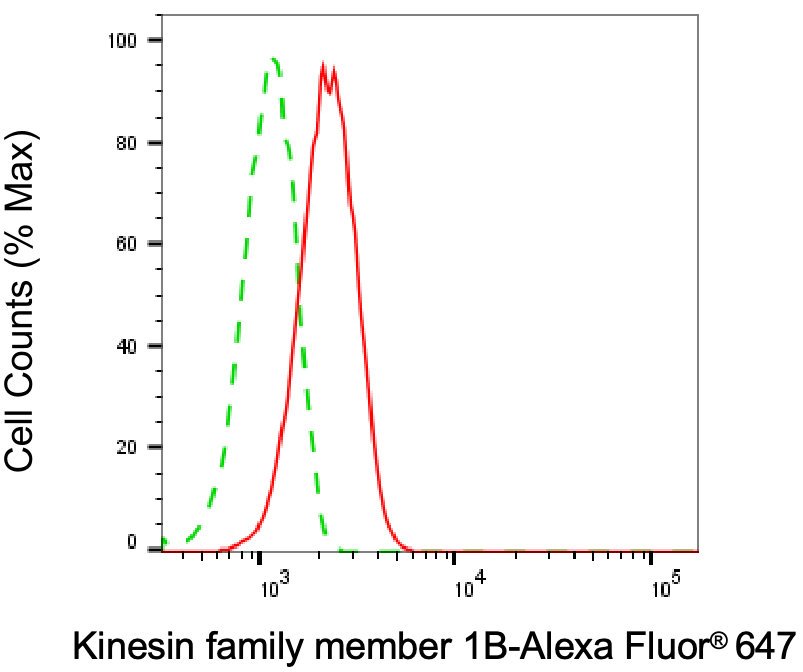
Mouse anti-Human/Mouse/Rat sapiens (Human) KIF1B Monoclonal Antibody

Mouse anti-Human/Mouse/Rat sapiens (Human) KIF1B Monoclonal Antibody — recombinant protein.

SKU: BCREC-000654MA Category:

Product Specifications

Uniprot No.O60333
Target NamesKIF1B
Species ReactivityMouse
ImmunogenRecombinant Human KIF1B protein
Immunogen SpeciesHomo sapiens (Human)
ConjugateNon-conjugated
IsotypeMouse IgG1 kappa
ClonalityMonoclonal
ApplicationsELISA, WB, FC, ICC
BufferPBS, 50% glycerol, 0.05% Proclin 300, 0.05%BSA
StorageUpon receipt, store at -20°C or -80°C. Avoid repeated freeze.

Function

Has a plus-end-directed microtubule motor activity and functions as a motor for anterograde transport of mitochondria.

Biological Context

Subcellular Location: Mitochondrion
Tissue Specificity: Isoform 3 is abundant in the skeletal muscle. It is also expressed in fetal brain, lung and kidney, and adult heart, placenta, testis, ovary and small intestine. Isoform 2 is abundant in the brain and also expressed in fetal heart, lung, liver and kidney, and adult skeletal muscle, placenta, liver, kidney, heart, spleen, thymus, prostate, testis, ovary, small intestine, colon and pancreas
Disease Association: Charcot-Marie-Tooth disease, axonal, type 2A1 (CMT2A1) : A dominant axonal form of Charcot-Marie-Tooth disease, a disorder of the peripheral nervous system, characterized by progressive weakness and atrophy, initially of the peroneal muscles and later of the distal muscles of the arms. Charcot-Marie-Tooth disease is classified in two main groups on the basis of electrophysiologic properties and histopathology: primary peripheral demyelinating neuropathies (designated CMT1 when they are dominantly inherited) and primary peripheral axonal neuropathies (CMT2). Neuropathies of the CMT2 group are characterized by signs of axonal degeneration in the absence of obvious myelin alterations, normal or slightly reduced nerve conduction velocities, and progressive distal muscle weakness and atrophy. [The disease may be caused by variants affecting the gene represented in this entry] | Neuroblastoma 1 (NBLST1) : A common neoplasm of early childhood arising from embryonic cells that form the primitive neural crest and give rise to the adrenal medulla and the sympathetic nervous system. [Disease susceptibility is associated with variants affecting the gene represented in this entry] | Pheochromocytoma (PCC) : A catecholamine-producing tumor of chromaffin tissue of the adrenal medulla or sympathetic paraganglia. The cardinal symptom, reflecting the increased secretion of epinephrine and norepinephrine, is hypertension, which may be persistent or intermittent. [Disease susceptibility is associated with variants affecting the gene represented in this entry]

Product Specifications

Mouse anti-Human/Mouse/Rat sapiens (Human) KIF1B Monoclonal Antibody is a recombinant protein. Suitable for ELISA and Western Blot applications.

SDS-PAGE: Single band at expected molecular weight confirming purity.

ELISA: Suitable as coating antigen or detection standard.

Western Blot: Compatible with standard Western Blot protocols.

Protein Interaction: Validated for SPR (Surface Plasmon Resonance) and BLI (Bio-Layer Interferometry) studies.

Shipping: Shipped at ambient temperature. Lyophilized protein is stable during transit.

Storage: Store lyophilized protein at -20°C to -80°C. Reconstituted protein should be aliquoted and stored at -80°C. Avoid repeated freeze-thaw cycles.

Shelf Life: 12 months from date of receipt when stored as recommended.

Shipping Time: Orders placed before 2 PM EST ship same day. International orders typically deliver within 5-10 business days.

Protein Biology

Function

Has a plus-end-directed microtubule motor activity and functions as a motor for anterograde transport of mitochondria

Subcellular Location

Mitochondrion

Disease Association

Charcot-Marie-Tooth disease, axonal, type 2A1 (CMT2A1) : A dominant axonal form of Charcot-Marie-Tooth disease, a disorder of the peripheral nervous system, characterized by progressive weakness and atrophy, initially of the peroneal muscles and later of the distal muscles of the arms. Charcot-Marie-Tooth disease is classified in two main groups on the basis of electrophysiologic properties and histopathology: primary peripheral demyelinating neuropathies (designated CMT1 when they are dominantly inherited) and primary peripheral axonal neuropathies (CMT2). Neuropathies of the CMT2 group are characterized by signs of axonal degeneration in the absence of obvious myelin alterations, normal or slightly reduced nerve conduction velocities, and progressive distal muscle weakness and atrophy. [The disease may be caused by variants affecting the gene represented in this entry] | Neuroblastoma 1 (NBLST1) : A common neoplasm of early childhood arising from embryonic cells that form the primitive neural crest and give rise to the adrenal medulla and the sympathetic nervous system. [Disease susceptibility is associated with variants affecting the gene represented in this entry] | Pheochromocytoma (PCC) : A catecholamine-producing tumor of chromaffin tissue of the adrenal medulla or sympathetic paraganglia. The cardinal symptom, reflecting the increased secretion of epinephrine and norepinephrine, is hypertension, which may be persistent or intermittent. [Disease susceptibility is associated with variants affecting the gene represented in this entry]

Tissue Specificity

Isoform 3 is abundant in the skeletal muscle. It is also expressed in fetal brain, lung and kidney, and adult heart, placenta, testis, ovary and small intestine. Isoform 2 is abundant in the brain and also expressed in fetal heart, lung, liver and kidney, and adult skeletal muscle, placenta, liver, kidney, heart, spleen, thymus, prostate, testis, ovary, small intestine, colon and pancreas

Subunit

Interacts with MADD (via death domain); links this isoform to Rab3-carrying vesicles in anterograde synaptic vesicle transport

Gene: KIF1B  |  Organism: Homo sapiens
Key Publications

Frequently Asked Questions

How do I order or inquire about this product?

Fill out the Online Inquiry form with your required quantity and specifications. You can also email sales@biocrestsci.com. Our team typically responds within 4 business hours with a quote and availability confirmation.

What is the shipping and delivery time?

Orders placed before 2 PM EST ship the same day. Domestic (US) delivery typically takes 2-3 business days. International orders deliver within 5-10 business days. All products are shipped at ambient temperature with appropriate packaging to ensure stability.

How should I store this recombinant protein?

Lyophilized proteins should be stored at -20°C to -80°C upon receipt. After reconstitution, aliquot and store at -80°C. Avoid repeated freeze-thaw cycles. Shelf life is 12 months from date of receipt when stored as recommended.

What quality controls are performed on your products?

Each product undergoes SDS-PAGE purity analysis (typically >85-95%), endotoxin testing, and bioactivity validation. Products are validated for ELISA, Western Blot, and SPR/BLI applications as specified on this product page. A Certificate of Analysis (CoA) is available upon request.

Shopping Cart
Scroll to Top