
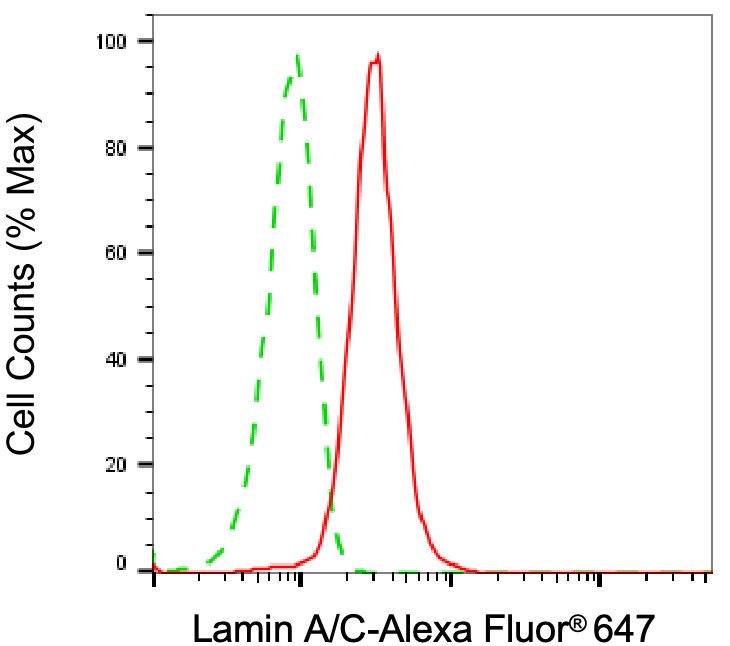
Mouse anti-Human/Mouse/Rat sapiens (Human) LMNA Monoclonal Antibody

Mouse anti-Human/Mouse/Rat sapiens (Human) LMNA Monoclonal Antibody — Prelamin-A/C can accelerate smooth muscle cell senescence.

SKU: BCREC-000949MA Category:

Product Specifications

Uniprot No.P02545
Target NamesLMNA
Species ReactivityMouse
ImmunogenRecombinant Human LMNA protein
Immunogen SpeciesHomo sapiens (Human)
ConjugateNon-conjugated
IsotypeMouse IgG1 kappa
ClonalityMonoclonal
ApplicationsELISA, WB, FC
BufferPBS, 50% glycerol, 0.05% Proclin 300, 0.05%BSA
StorageUpon receipt, store at -20°C or -80°C. Avoid repeated freeze.

Function

Prelamin-A/C can accelerate smooth muscle cell senescence. It acts to disrupt mitosis and induce DNA damage in vascular smooth muscle cells (VSMCs), leading to mitotic failure, genomic instability, and premature senescence.

Biological Context

Subcellular Location: Nucleus speckle
Tissue Specificity: In the arteries, prelamin-A/C accumulation is not observed in young healthy vessels but is prevalent in medial vascular smooth muscle cells (VSMCs) from aged individuals and in atherosclerotic lesions, where it often colocalizes with senescent and degenerate VSMCs. Prelamin-A/C expression increases with age and disease. In normal aging, the accumulation of prelamin-A/C is caused in part by the down-regulation of ZMPSTE24/FACE1 in response to oxidative stress
Disease Association: Emery-Dreifuss muscular dystrophy 2, autosomal dominant (EDMD2) : A form of Emery-Dreifuss muscular dystrophy, a degenerative myopathy characterized by weakness and atrophy of muscle without involvement of the nervous system, early contractures of the elbows, Achilles tendons and spine, and cardiomyopathy associated with cardiac conduction defects. [The disease is caused by variants affecting the gene represented in this entry] | Emery-Dreifuss muscular dystrophy 3, autosomal recessive (EDMD3) : A form of Emery-Dreifuss muscular dystrophy, a degenerative myopathy characterized by weakness and atrophy of muscle without involvement of the nervous system, early contractures of the elbows, Achilles tendons and spine, and cardiomyopathy associated with cardiac conduction defects. [The disease is caused by variants affecting the gene represented in this entry] | Cardiomyopathy, dilated, 1A (CMD1A) : A disorder characterized by ventricular dilation and impaired systolic function, resulting in congestive heart failure and arrhythmia. Patients are at risk of premature death. [The disease is caused by variants affecting the gene represented in this entry] | Lipodystrophy, familial partial, 2 (FPLD2) : An autosomal dominant disorder characterized by the loss of subcutaneous adipose tissue in the lower parts of the body (limbs, buttocks, trunk). It is accompanied by an accumulation of adipose tissue in the face and neck causing a double chin, fat neck, or cushingoid appearance. Adipose tissue may also accumulate in the axillae, back, labia majora, and intraabdominal region. Affected patients are insulin-resistant and may develop glucose intolerance and diabetes mellitus after age 20 years, hypertriglyceridemia, and low levels of high density lipoprotein cholesterol. [The disease is caused by variants affecting the gene represented in this entry] | Charcot-Marie-Tooth disease, axonal, type 2B1 (CMT2B1) : A recessive axonal form of Charcot-Marie-Tooth disease, a disorder of the peripheral nervous system, characterized by progressive weakness and atrophy, initially of the peroneal muscles and later of the distal muscles of the arms. Charcot-Marie-Tooth disease is classified in two main groups on the basis of electrophysiologic properties and histopathology: primary peripheral demyelinating neuropathies (designated CMT1 when they are dominantly inherited) and primary peripheral axonal neuropathies (CMT2). Neuropathies of the CMT2 group are characterized by signs of axonal degeneration in the absence of obvious myelin alterations, normal or slightly reduced nerve conduction velocities, and progressive distal muscle weakness and atrophy. [The disease is caused by variants affecting the gene represented in this entry] | Hutchinson-Gilford progeria syndrome (HGPS) : Rare genetic disorder characterized by features reminiscent of marked premature aging. [The disease is caused by variants affecting the gene represented in this entry. HGPS is caused by the toxic accumulation of a truncated form of lamin-A/C. This mutant protein, called progerin (isoform 6), acts to deregulate mitosis and DNA damage signaling, leading to premature cell death and senescence. The mutant form is mainly generated by a silent or missense mutation at codon 608 of prelamin A that causes activation of a cryptic splice donor site, resulting in production of isoform 6 with a deletion of 50 amino acids near the C terminus. Progerin lacks the conserved ZMPSTE24/FACE1 cleavage site and therefore remains permanently farnesylated. Thus, although it can enter the nucleus and associate with the nuclear envelope, it cannot incorporate normally into the nuclear lamina ] | Cardiomyopathy, dilated, with hypergonadotropic hypogonadism (CMDHH) : A disorder characterized by the association of genital anomalies, hypergonadotropic hypogonadism and dilated cardiomyopathy. Patients can present other variable clinical manifestations including intellectual disability, skeletal anomalies, scleroderma-like skin, graying and thinning of hair, osteoporosis. Dilated cardiomyopathy is characterized by ventricular dilation and impaired systolic function, resulting in congestive heart failure and arrhythmia. [The disease is caused by variants affecting the gene represented in this entry] | Mandibuloacral dysplasia with type A lipodystrophy (MADA) : A form of mandibuloacral dysplasia, a rare progeroid disorder with clinical and genetic heterogeneity, characterized by growth retardation, craniofacial dysmorphic features due to distal bone resorption, musculoskeletal and skin abnormalities associated with lipodystrophy. MADA is an autosomal recessive disease characterized by mandibular and clavicular hypoplasia, acroosteolysis, delayed closure of the cranial suture, progeroid appearance, partial alopecia, soft tissue calcinosis, joint contractures, and partial lipodystrophy with loss of subcutaneous fat from the extremities. Adipose tissue in the face, neck and trunk is normal or increased. [The disease is caused by variants affecting the gene represented in this entry] | Restrictive dermopathy 2 (RSDM2) : An autosomal dominant form of restrictive dermopathy, a genodermatosis mainly characterized by intrauterine growth retardation, tight and rigid skin with erosions, prominent superficial vasculature and epidermal hyperkeratosis, facial dysmorphism, sparse/absent eyelashes and eyebrows, mineralization defects of the skull, thin dysplastic clavicles, pulmonary hypoplasia, multiple joint contractures and an early neonatal lethal course. Liveborn children usually die within the first week of life. [The disease is caused by variants affecting the gene represented in this entry] | Heart-hand syndrome Slovenian type (HHS-Slovenian) : Heart-hand syndrome (HHS) is a clinically and genetically heterogeneous disorder characterized by the co-occurrence of a congenital cardiac disease and limb malformations. [The disease is caused by variants affecting the gene represented in this entry] | Muscular dystrophy congenital LMNA-related (MDCL) : A form of congenital muscular dystrophy. Patients present at birth, or within the first few months of life, with hypotonia, muscle weakness and often with joint contractures. [The disease is caused by variants affecting the gene represented in this entry] | [Defects in LMNA may cause a late-onset cardiocutaneous progeria syndrome characterized by cutaneous manifestations of aging appearing in the third decade of life, cardiac valve calcification and dysfunction, prominent atherosclerosis, and cardiomyopathy, leading to death on average in the fourth decade]

Product Specifications

Mouse anti-Human/Mouse/Rat sapiens (Human) LMNA Monoclonal Antibody is a recombinant protein. Suitable for ELISA and Western Blot applications.

SDS-PAGE: Single band at expected molecular weight confirming purity.

ELISA: Suitable as coating antigen or detection standard.

Western Blot: Compatible with standard Western Blot protocols.

Protein Interaction: Validated for SPR (Surface Plasmon Resonance) and BLI (Bio-Layer Interferometry) studies.

Shipping: Shipped at ambient temperature. Lyophilized protein is stable during transit.

Storage: Store lyophilized protein at -20°C to -80°C. Reconstituted protein should be aliquoted and stored at -80°C. Avoid repeated freeze-thaw cycles.

Shelf Life: 12 months from date of receipt when stored as recommended.

Shipping Time: Orders placed before 2 PM EST ship same day. International orders typically deliver within 5-10 business days.

Protein Biology

Function

Prelamin-A/C can accelerate smooth muscle cell senescence (PubMed:20458013). It acts to disrupt mitosis and induce DNA damage in vascular smooth muscle cells (VSMCs), leading to mitotic failure, genomic instability, and premature senescence (PubMed:20458013)

Subcellular Location

Nucleus speckle

Disease Association

Emery-Dreifuss muscular dystrophy 2, autosomal dominant (EDMD2) : A form of Emery-Dreifuss muscular dystrophy, a degenerative myopathy characterized by weakness and atrophy of muscle without involvement of the nervous system, early contractures of the elbows, Achilles tendons and spine, and cardiomyopathy associated with cardiac conduction defects. [The disease is caused by variants affecting the gene represented in this entry] | Emery-Dreifuss muscular dystrophy 3, autosomal recessive (EDMD3) : A form of Emery-Dreifuss muscular dystrophy, a degenerative myopathy characterized by weakness and atrophy of muscle without involvement of the nervous system, early contractures of the elbows, Achilles tendons and spine, and cardiomyopathy associated with cardiac conduction defects. [The disease is caused by variants affecting the gene represented in this entry] | Cardiomyopathy, dilated, 1A (CMD1A) : A disorder characterized by ventricular dilation and impaired systolic function, resulting in congestive heart failure and arrhythmia. Patients are at risk of premature death. [The disease is caused by variants affecting the gene represented in this entry] | Lipodystrophy, familial partial, 2 (FPLD2) : An autosomal dominant disorder characterized by the loss of subcutaneous adipose tissue in the lower parts of the body (limbs, buttocks, trunk). It is accompanied by an accumulation of adipose tissue in the face and neck causing a double chin, fat neck, or cushingoid appearance. Adipose tissue may also accumulate in the axillae, back, labia majora, and intraabdominal region. Affected patients are insulin-resistant and may develop glucose intolerance and diabetes mellitus after age 20 years, hypertriglyceridemia, and low levels of high density lipoprotein cholesterol. [The disease is caused by variants affecting the gene represented in this entry] | Charcot-Marie-Tooth disease, axonal, type 2B1 (CMT2B1) : A recessive axonal form of Charcot-Marie-Tooth disease, a disorder of the peripheral nervous system, characterized by progressive weakness and atrophy, initially of the peroneal muscles and later of the distal muscles of the arms. Charcot-Marie-Tooth disease is classified in two main groups on the basis of electrophysiologic properties and histopathology: primary peripheral demyelinating neuropathies (designated CMT1 when they are dominantly inherited) and primary peripheral axonal neuropathies (CMT2). Neuropathies of the CMT2 group are characterized by signs of axonal degeneration in the absence of obvious myelin alterations, normal or slightly reduced nerve conduction velocities, and progressive distal muscle weakness and atrophy. [The disease is caused by variants affecting the gene represented in this entry] | Hutchinson-Gilford progeria syndrome (HGPS) : Rare genetic disorder characterized by features reminiscent of marked premature aging. [The disease is caused by variants affecting the gene represented in this entry. HGPS is caused by the toxic accumulation of a truncated form of lamin-A/C. This mutant protein, called progerin (isoform 6), acts to deregulate mitosis and DNA damage signaling, leading to premature cell death and senescence. The mutant form is mainly generated by a silent or missense mutation at codon 608 of prelamin A that causes activation of a cryptic splice donor site, resulting in production of isoform 6 with a deletion of 50 amino acids near the C terminus. Progerin lacks the conserved ZMPSTE24/FACE1 cleavage site and therefore remains permanently farnesylated. Thus, although it can enter the nucleus and associate with the nuclear envelope, it cannot incorporate normally into the nuclear lamina (PubMed:12714972)] | Cardiomyopathy, dilated, with hypergonadotropic hypogonadism (CMDHH) : A disorder characterized by the association of genital anomalies, hypergonadotropic hypogonadism and dilated cardiomyopathy. Patients can present other variable clinical manifestations including intellectual disability, skeletal anomalies, scleroderma-like skin, graying and thinning of hair, osteoporosis. Dilated cardiomyopathy is characterized by ventricular dilation and impaired systolic function, resulting in congestive heart failure and arrhythmia. [The disease is caused by variants affecting the gene represented in this entry] | Mandibuloacral dysplasia with type A lipodystrophy (MADA) : A form of mandibuloacral dysplasia, a rare progeroid disorder with clinical and genetic heterogeneity, characterized by growth retardation, craniofacial dysmorphic features due to distal bone resorption, musculoskeletal and skin abnormalities associated with lipodystrophy. MADA is an autosomal recessive disease characterized by mandibular and clavicular hypoplasia, acroosteolysis, delayed closure of the cranial suture, progeroid appearance, partial alopecia, soft tissue calcinosis, joint contractures, and partial lipodystrophy with loss of subcutaneous fat from the extremities. Adipose tissue in the face, neck and trunk is normal or increased. [The disease is caused by variants affecting the gene represented in this entry] | Restrictive dermopathy 2 (RSDM2) : An autosomal dominant form of restrictive dermopathy, a genodermatosis mainly characterized by intrauterine growth retardation, tight and rigid skin with erosions, prominent superficial vasculature and epidermal hyperkeratosis, facial dysmorphism, sparse/absent eyelashes and eyebrows, mineralization defects of the skull, thin dysplastic clavicles, pulmonary hypoplasia, multiple joint contractures and an early neonatal lethal course. Liveborn children usually die within the first week of life. [The disease is caused by variants affecting the gene represented in this entry] | Heart-hand syndrome Slovenian type (HHS-Slovenian) : Heart-hand syndrome (HHS) is a clinically and genetically heterogeneous disorder characterized by the co-occurrence of a congenital cardiac disease and limb malformations. [The disease is caused by variants affecting the gene represented in this entry] | Muscular dystrophy congenital LMNA-related (MDCL) : A form of congenital muscular dystrophy. Patients present at birth, or within the first few months of life, with hypotonia, muscle weakness and often with joint contractures. [The disease is caused by variants affecting the gene represented in this entry] | [Defects in LMNA may cause a late-onset cardiocutaneous progeria syndrome characterized by cutaneous manifestations of aging appearing in the third decade of life, cardiac valve calcification and dysfunction, prominent atherosclerosis, and cardiomyopathy, leading to death on average in the fourth decade]

Tissue Specificity

In the arteries, prelamin-A/C accumulation is not observed in young healthy vessels but is prevalent in medial vascular smooth muscle cells (VSMCs) from aged individuals and in atherosclerotic lesions, where it often colocalizes with senescent and degenerate VSMCs. Prelamin-A/C expression increases with age and disease. In normal aging, the accumulation of prelamin-A/C is caused in part by the down-regulation of ZMPSTE24/FACE1 in response to oxidative stress

Subunit

Interacts (via C-terminus) with LEMD2 (via N-terminus) (in vitro)

Gene: LMNA  |  Organism: Homo sapiens
Key Publications

Frequently Asked Questions

How do I order or inquire about this product?

Fill out the Online Inquiry form with your required quantity and specifications. You can also email sales@biocrestsci.com. Our team typically responds within 4 business hours with a quote and availability confirmation.

What is the shipping and delivery time?

Orders placed before 2 PM EST ship the same day. Domestic (US) delivery typically takes 2-3 business days. International orders deliver within 5-10 business days. All products are shipped at ambient temperature with appropriate packaging to ensure stability.

How should I store this recombinant protein?

Lyophilized proteins should be stored at -20°C to -80°C upon receipt. After reconstitution, aliquot and store at -80°C. Avoid repeated freeze-thaw cycles. Shelf life is 12 months from date of receipt when stored as recommended.

What quality controls are performed on your products?

Each product undergoes SDS-PAGE purity analysis (typically >85-95%), endotoxin testing, and bioactivity validation. Products are validated for ELISA, Western Blot, and SPR/BLI applications as specified on this product page. A Certificate of Analysis (CoA) is available upon request.

Shopping Cart
Scroll to Top