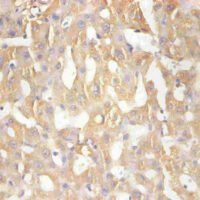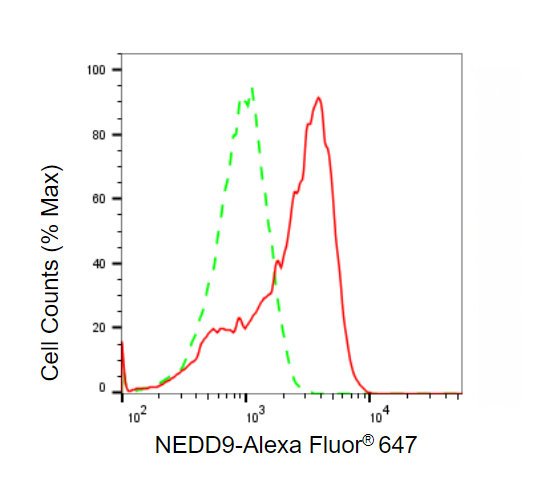
Mouse anti-Human/Mouse/Rat sapiens (Human) NEDD9 Monoclonal Antibody

Mouse anti-Human/Mouse/Rat sapiens (Human) NEDD9 Monoclonal Antibody — Scaffolding protein which plays a central coordinating role for tyrosine-kinase-based signaling related to cell adhesion.

SKU: BCREC-000775MA Category:

Product Specifications

Uniprot No.Q14511
Target NamesNEDD9
Species ReactivityMouse
ImmunogenRecombinant Human NEDD9 protein
Immunogen SpeciesHomo sapiens (Human)
ConjugateNon-conjugated
IsotypeMouse IgG2a
ClonalityMonoclonal
ApplicationsELISA, WB, FC
BufferPBS, 50% glycerol, 0.05% Proclin 300, 0.05%BSA
StorageUpon receipt, store at -20°C or -80°C. Avoid repeated freeze.

Function

Scaffolding protein which plays a central coordinating role for tyrosine-kinase-based signaling related to cell adhesion. As a focal adhesion protein, plays a role in embryonic fibroblast migration. May play an important role in integrin beta-1 or B cell antigen receptor (BCR) mediated signaling in B- and T-cells.

Biological Context

Subcellular Location: Cytoplasm, cytoskeleton, spindle
Tissue Specificity: Expressed in B-cells (at protein level). Expressed in the respiratory epithelium of the main bronchi to the bronchioles in the lungs (at protein level). High levels detected in kidney, lung, and placenta. Expressed in lymphocytes

Product Specifications

Mouse anti-Human/Mouse/Rat sapiens (Human) NEDD9 Monoclonal Antibody is a recombinant protein. Suitable for ELISA and Western Blot applications.

Applications: ELISA, WB, FC

Biological Activity: Not implied unless activity data are explicitly listed on this product page, the datasheet, or the CoA.

Storage: Upon receipt, store at -20°C or -80°C. Avoid repeated freeze.

Shipping & Lead Time: Availability, shipping conditions, and estimated lead time are confirmed in the formal quotation or order confirmation based on the product format, destination, and order requirements.

Protein Biology

Function

Scaffolding protein which plays a central coordinating role for tyrosine-kinase-based signaling related to cell adhesion (PubMed:24574519). As a focal adhesion protein, plays a role in embryonic fibroblast migration (By similarity). May play an important role in integrin beta-1 or B cell antigen receptor (BCR) mediated signaling in B- and T-cells. Integrin beta-1 stimulation leads to recruitment of various proteins including CRKL and SHPTP2 to the tyrosine phosphorylated form (PubMed:9020138). Promotes adhesion and migration of lymphocytes; as a result required for the correct migration of lymphocytes to the spleen and other secondary lymphoid organs (PubMed:17174122). Plays a role in the organization of T-cell F-actin cortical cytoskeleton and the centralization of T-cell receptor microclusters at the immunological synapse (By similarity). Negatively regulates cilia outgrowth in polarized cysts (By similarity). Modulates cilia disassembly via activation of AURKA-mediated phosphorylation of HDAC6 and subsequent deacetylation of alpha-tubulin (PubMed:17604723). Positively regulates RANKL-induced osteoclastogenesis (By similarity). Required for the maintenance of hippocampal dendritic spines in the dentate gyrus and CA1 regions, thereby involved in spatial learning and memory (By similarity)

Subcellular Location

Cytoplasm, cytoskeleton, spindle

Tissue Specificity

Expressed in B-cells (at protein level) (PubMed:9020138). Expressed in the respiratory epithelium of the main bronchi to the bronchioles in the lungs (at protein level) (PubMed:9584194). High levels detected in kidney, lung, and placenta (PubMed:9584194). Expressed in lymphocytes (PubMed:9497377)

Subunit

Homodimer (PubMed:10502414, PubMed:9584194). Forms heterodimers with BCAR1/p130cas (PubMed:10502414). Forms complexes with PTK2B/RAFTK, adapter protein CRKL and LYN kinase (PubMed:9020138). Part of a complex composed of NEDD9, AURKA and CTTN; within the complex NEDD9 acts as a scaffold protein and is required for complex formation (PubMed:24574519). Part of a ternary complex composed of SMAD3, ITCH/AIP4 and NEDD9/HEF1; within the complex NEDD9/HEF1 interacts (via N-terminus) with ITCH/AIP4 (via WW domains); the complex mediates ubiquitination and proteasomal degradation of NEDD9/HEF1 (PubMed:15051726). Interacts with SMAD3; the interaction promotes NEDD9 ubiquitination and proteasomal degradation (PubMed:24574519). Interacts with ID2 (PubMed:10502414). Interacts with CTTN (via N-terminus) (PubMed:24574519). Interacts with MICAL (PubMed:11827972). Interacts with TXNL4/DIM1 (PubMed:11054566). Interacts with BCAR3 (via Ras-GEF domain) (PubMed:19103205). Interacts with SH2D3C isoform 1 and isoform 2 (By similarity). Interacts with ECT2 (PubMed:16394104). Interacts with PTPN11/SHP-2 (via SH2 domains); the interaction is enhanced when NEDD9/CAS-L is tyrosine phosphorylated (PubMed:19275884). Interacts (via C-terminus) with PLK1 (via polo box domains) (PubMed:29191835). Interacts with NKX2-5 (PubMed:29899023). Interacts with SMAD3; the interaction is inhibited by oxidation of NEDD9 (PubMed:15051726, PubMed:29899023). Interacts with NEDD9/HEF1; interaction is induced by CXCL12 promotion of ABL-mediated phosphorylation of NEDD9/HEF1 (PubMed:22810897). Interacts (via SH3 domain) with PTK2/FAK (PubMed:8668148, PubMed:8879209, PubMed:9360983). Interacts with FYN; in the presence of PTK2 (PubMed:9360983). Interacts with INPPL1/SHIP2 (By similarity)

Gene: NEDD9  |  Organism: Homo sapiens  |  Synonyms: CRK-associated substrate-related protein; Cas scaffolding protein family member 2; Neural precursor cell expressed developmentally down-regulated protein 9; Renal carcinoma antigen NY-REN-12; p105
Key Publications

Frequently Asked Questions

How do I order or inquire about this product?

Submit the Online Inquiry form with your required quantity and specifications, or email sales@biocrestsci.com. Available sizes, pricing, stock status, documentation, and estimated lead time are confirmed in the formal quotation.

What is the shipping and delivery time?

Availability, dispatch timing, shipping conditions, and delivery estimates depend on the product format, destination, and order requirements. These details are confirmed in the formal quotation or order confirmation.

How should this product be stored?

Follow the storage and handling instructions in the product-specific datasheet and Certificate of Analysis (CoA). Requirements may vary by product form and formulation; contact BioCrest Sci if product-specific guidance is needed.

What quality controls are performed on your products?

Quality-control data such as identity, purity, endotoxin level, or biological activity are provided only when specified on this product page, the datasheet, or Certificate of Analysis (CoA). Biological activity is not implied unless explicitly stated.

Shopping Cart
Scroll to Top