
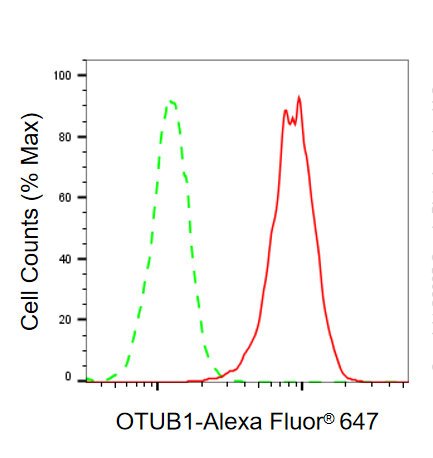
Mouse anti-Human/Mouse/Rat sapiens (Human) OTUB1 Monoclonal Antibody

Mouse anti-Human/Mouse/Rat sapiens (Human) OTUB1 Monoclonal Antibody — Plays a key non-catalytic role in DNA repair regulation by inhibiting activity of RNF168, an E3 ubiquitin-protein ligase that promotes accumulation of ‘Lys-63’-linked histone H2A and H2AX at DNA da…

SKU: BCREC-000396MA Category:

Product Specifications

Uniprot No.Q96FW1
Target NamesOTUB1
Species ReactivityMouse
ImmunogenRecombinant Human OTUB1 protein
Immunogen SpeciesHomo sapiens (Human)
ConjugateNon-conjugated
IsotypeMouse IgG2b
ClonalityMonoclonal
ApplicationsELISA, WB, FC
BufferPBS, 50% glycerol, 0.05% Proclin 300, 0.05%BSA
StorageUpon receipt, store at -20°C or -80°C. Avoid repeated freeze.

Function

Plays a key non-catalytic role in DNA repair regulation by inhibiting activity of RNF168, an E3 ubiquitin-protein ligase that promotes accumulation of 'Lys-63'-linked histone H2A and H2AX at DNA damage sites. Inhibits RNF168 independently of ubiquitin thioesterase activity by binding and inhibiting UBE2N/UBC13, the E2 partner of RNF168, thereby limiting spreading of 'Lys-63'-linked histone H2A and H2AX marks. Inhibition occurs by binding to free ubiquitin: free ubiquitin acts as an allosteric regulator that increases affinity for UBE2N/UBC13 and disrupts interaction with UBE2V1.

Biological Context

Subcellular Location: Cytoplasm
Tissue Specificity: Isoform 1 is ubiquitous. Isoform 2 is expressed only in lymphoid tissues such as tonsils, lymph nodes and spleen, as well as peripheral blood mononuclear cells

Product Specifications

Mouse anti-Human/Mouse/Rat sapiens (Human) OTUB1 Monoclonal Antibody is a recombinant protein. Suitable for ELISA and Western Blot applications.

Catalog number: BCREC-000396MA.

Applications: ELISA, WB, FC

Biological Activity: Not implied unless activity data are explicitly listed on this product page, the datasheet, or the CoA.

Storage: Upon receipt, store at -20°C or -80°C. Avoid repeated freeze.

Shipping & Lead Time: Availability, shipping conditions, and estimated lead time are confirmed in the formal quotation or order confirmation based on the product format, destination, and order requirements.

Protein Biology

Function

Plays a key non-catalytic role in DNA repair regulation by inhibiting activity of RNF168, an E3 ubiquitin-protein ligase that promotes accumulation of 'Lys-63'-linked histone H2A and H2AX at DNA damage sites (PubMed:20725033, PubMed:22325355). Inhibits RNF168 independently of ubiquitin thioesterase activity by binding and inhibiting UBE2N/UBC13, the E2 partner of RNF168, thereby limiting spreading of 'Lys-63'-linked histone H2A and H2AX marks (PubMed:20725033, PubMed:22325355). Inhibition occurs by binding to free ubiquitin: free ubiquitin acts as an allosteric regulator that increases affinity for UBE2N/UBC13 and disrupts interaction with UBE2V1 (PubMed:20725033, PubMed:22325355). The OTUB1-UBE2N/UBC13-free ubiquitin complex adopts a configuration that mimics a cleaved 'Lys48'-linked di-ubiquitin chain (PubMed:20725033, PubMed:22325355). Acts as a regulator of mTORC1 and mTORC2 complexes (PubMed:29382726, PubMed:35927303). When phosphorylated at Tyr-26, acts as an activator of the mTORC1 complex by mediating deubiquitination of RPTOR via a non-catalytic process: acts by binding and inhibiting the activity of the ubiquitin-conjugating enzyme E2 (UBE2D1/UBCH5A, UBE2W/UBC16 and UBE2N/UBC13), thereby preventing ubiquitination of RPTOR (PubMed:35927303). Can also act as an inhibitor of the mTORC1 and mTORC2 complexes in response to amino acids by mediating non-catalytic deubiquitination of DEPTOR (PubMed:29382726)

Subcellular Location

Cytoplasm

Tissue Specificity

Isoform 1 is ubiquitous. Isoform 2 is expressed only in lymphoid tissues such as tonsils, lymph nodes and spleen, as well as peripheral blood mononuclear cells

Subunit

Interacts with RNF128 (PubMed:14661020). Does not associate with USP8 (PubMed:14661020)

Gene: OTUB1  |  Organism: Homo sapiens  |  Synonyms: Deubiquitinating enzyme OTUB1; OTU domain-containing ubiquitin aldehyde-binding protein 1; Otubain-1; Ubiquitin-specific-processing protease OTUB1
Key Publications

Frequently Asked Questions

How do I order or inquire about this product?

Submit the Online Inquiry form with your required quantity and specifications, or email sales@biocrestsci.com. Available sizes, pricing, stock status, documentation, and estimated lead time are confirmed in the formal quotation.

What is the shipping and delivery time?

Availability, dispatch timing, shipping conditions, and delivery estimates depend on the product format, destination, and order requirements. These details are confirmed in the formal quotation or order confirmation.

How should this product be stored?

Follow the storage and handling instructions in the product-specific datasheet and Certificate of Analysis (CoA). Requirements may vary by product form and formulation; contact BioCrest Sci if product-specific guidance is needed.

What quality controls are performed on your products?

Quality-control data such as identity, purity, endotoxin level, or biological activity are provided only when specified on this product page, the datasheet, or Certificate of Analysis (CoA). Biological activity is not implied unless explicitly stated.

Shopping Cart
Scroll to Top