Mouse anti-Human/Mouse/Rat sapiens (Human) PGK1 Monoclonal Antibody

Mouse anti-Human/Mouse/Rat sapiens (Human) PGK1 Monoclonal Antibody — Catalyzes one of the two ATP producing reactions in the glycolytic pathway via the reversible conversion of 1,3-diphosphoglycerate to 3-phosphoglycerate.

SKU: BCREC-000407MA Category:

Product Specifications

Uniprot No.P00558
Target NamesPGK1
Species ReactivityMouse
ImmunogenRecombinant Human PGK1 protein
Immunogen SpeciesHomo sapiens (Human)
ConjugateNon-conjugated
IsotypeMouse IgG
ClonalityMonoclonal
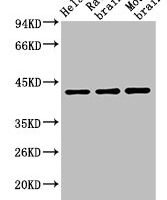
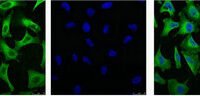
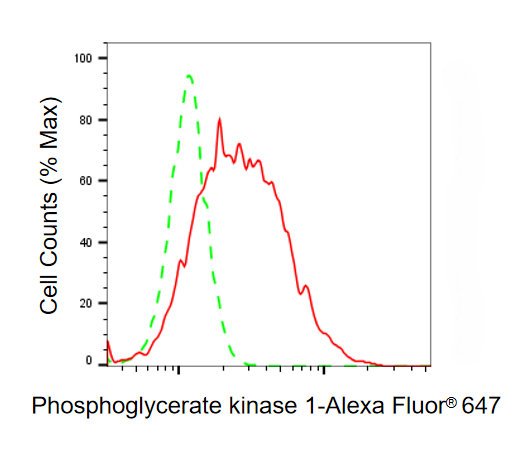
ApplicationsELISA, WB, FC, IHC
BufferPBS, 50% glycerol, 0.05% Proclin 300, 0.05%BSA
StorageUpon receipt, store at -20°C or -80°C. Avoid repeated freeze.

Function

Catalyzes one of the two ATP producing reactions in the glycolytic pathway via the reversible conversion of 1,3-diphosphoglycerate to 3-phosphoglycerate. Both L- and D- forms of purine and pyrimidine nucleotides can be used as substrates, but the activity is much lower on pyrimidines. In addition to its role as a glycolytic enzyme, it seems that PGK1 acts as a polymerase alpha cofactor protein (primer recognition protein).

Biological Context

Subcellular Location: Cytoplasm, cytosol; Mitochondrion matrix
Tissue Specificity: Mainly expressed in spermatogonia. Localized on the principle piece in the sperm (at protein level). Expression significantly decreased in the testis of elderly men
Disease Association: Phosphoglycerate kinase 1 deficiency (PGK1D) : A condition with a highly variable clinical phenotype that includes hemolytic anemia, rhabdomyolysis, myopathy and neurologic involvement. Patients can express one or more of these manifestations, and some affected individuals develop parkinsonian symptoms. [The disease is caused by variants affecting the gene represented in this entry]
Pathway: Carbohydrate degradation; glycolysis; pyruvate from D-glyceraldehyde 3-phosphate: step 2/5

Product Specifications

Mouse anti-Human/Mouse/Rat sapiens (Human) PGK1 Monoclonal Antibody is a recombinant protein. Suitable for ELISA and Western Blot applications.

Applications: ELISA, WB, FC, IHC

Biological Activity: Not implied unless activity data are explicitly listed on this product page, the datasheet, or the CoA.

Storage: Upon receipt, store at -20°C or -80°C. Avoid repeated freeze.

Shipping & Lead Time: Availability, shipping conditions, and estimated lead time are confirmed in the formal quotation or order confirmation based on the product format, destination, and order requirements.

Protein Biology

Function

Catalyzes one of the two ATP producing reactions in the glycolytic pathway via the reversible conversion of 1,3-diphosphoglycerate to 3-phosphoglycerate (PubMed:30323285, PubMed:7391028). Both L- and D- forms of purine and pyrimidine nucleotides can be used as substrates, but the activity is much lower on pyrimidines (PubMed:18463139). In addition to its role as a glycolytic enzyme, it seems that PGK1 acts as a polymerase alpha cofactor protein (primer recognition protein) (PubMed:2324090). Acts as a protein kinase when localized to the mitochondrion where it phosphorylates pyruvate dehydrogenase kinase PDK1 to inhibit pyruvate dehydrogenase complex activity and suppress the formation of acetyl-coenzyme A from pyruvate, and consequently inhibit oxidative phosphorylation and promote glycolysis (PubMed:26942675, PubMed:36849569). May play a role in sperm motility (PubMed:26677959)

Subcellular Location

Cytoplasm, cytosol; Mitochondrion matrix

Disease Association

Phosphoglycerate kinase 1 deficiency (PGK1D) : A condition with a highly variable clinical phenotype that includes hemolytic anemia, rhabdomyolysis, myopathy and neurologic involvement. Patients can express one or more of these manifestations, and some affected individuals develop parkinsonian symptoms. [The disease is caused by variants affecting the gene represented in this entry]

Tissue Specificity

Mainly expressed in spermatogonia. Localized on the principle piece in the sperm (at protein level). Expression significantly decreased in the testis of elderly men

Subunit

Monomer (PubMed:18463139). Interacts with kinase MAPK1/ERK2; the interaction is direct, occurs under hypoxic conditions, and promotes its interaction with PIN1 (PubMed:26942675). Interacts with peptidyl-prolyl cis-trans isomerase PIN1; the interaction is direct, occurs under hypoxic conditions, and targets the protein to the mitochondrion by promoting interactions with the TOM complex (PubMed:26942675). Interacts with mitochondrial circRNA mcPGK1 (via its 2nd stem-loop); the interaction is direct and targets the protein to the mitochondrion by promoting interactions with the TOM complex (PubMed:36849569). Interacts with pyruvate dehydrogenase kinase PDK1; the interaction is direct, occurs under hypoxic conditions and leads to PDK1-mediated inhibition of pyruvate dehydrogenase complex activity (PubMed:26942675)

Pathway

Carbohydrate degradation; glycolysis; pyruvate from D-glyceraldehyde 3-phosphate: step 2/5

Gene: PGK1  |  Organism: Homo sapiens  |  Synonyms: Cell migration-inducing gene 10 protein; Primer recognition protein 2
Key Publications

Frequently Asked Questions

How do I order or inquire about this product?

Submit the Online Inquiry form with your required quantity and specifications, or email sales@biocrestsci.com. Available sizes, pricing, stock status, documentation, and estimated lead time are confirmed in the formal quotation.

What is the shipping and delivery time?

Availability, dispatch timing, shipping conditions, and delivery estimates depend on the product format, destination, and order requirements. These details are confirmed in the formal quotation or order confirmation.

How should this product be stored?

Follow the storage and handling instructions in the product-specific datasheet and Certificate of Analysis (CoA). Requirements may vary by product form and formulation; contact BioCrest Sci if product-specific guidance is needed.

What quality controls are performed on your products?

Quality-control data such as identity, purity, endotoxin level, or biological activity are provided only when specified on this product page, the datasheet, or Certificate of Analysis (CoA). Biological activity is not implied unless explicitly stated.

Shopping Cart
Scroll to Top