Mouse anti-Human/Mouse/Rat sapiens (Human) PMVK Monoclonal Antibody

Mouse anti-Human/Mouse/Rat sapiens (Human) PMVK Monoclonal Antibody — recombinant protein.

SKU: BCREC-000762MA Category:

Product Specifications

Uniprot No.Q15126
Target NamesPMVK
Species ReactivityMouse
ImmunogenRecombinant Human PMVK protein
Immunogen SpeciesHomo sapiens (Human)
ConjugateNon-conjugated
IsotypeMouse IgG2b
ClonalityMonoclonal
ApplicationsELISA, WB
BufferPBS, 50% glycerol, 0.05% Proclin 300, 0.05%BSA
StorageUpon receipt, store at -20°C or -80°C. Avoid repeated freeze.

Function

Catalyzes the reversible ATP-dependent phosphorylation of mevalonate 5-phosphate to produce mevalonate diphosphate and ADP, a key step in the mevalonic acid mediated biosynthesis of isopentenyl diphosphate and other polyisoprenoid metabolites.

Biological Context

Subcellular Location: Cytoplasm, cytosol
Tissue Specificity: Heart, liver, skeletal muscle, kidney, and pancreas. Lower level in brain, placenta and lung
Disease Association: Porokeratosis 1, multiple types (POROK1) : A form of porokeratosis, a disorder of faulty keratinization characterized by one or more atrophic patches surrounded by a distinctive hyperkeratotic ridgelike border called the cornoid lamella. The keratotic lesions can progress to overt cutaneous neoplasms, typically squamous cell carcinomas. Multiple clinical variants of porokeratosis are recognized, including porokeratosis of Mibelli, linear porokeratosis, disseminated superficial actinic porokeratosis, palmoplantar porokeratosis, and punctate porokeratosis. Different clinical presentations can be observed among members of the same family. Individuals expressing more than one variant have also been reported. [The disease is caused by variants affecting the gene represented in this entry]
Pathway: Isoprenoid biosynthesis; isopentenyl diphosphate biosynthesis via mevalonate pathway; isopentenyl diphosphate from (R)-mevalonate: step 2/3

Product Specifications

Mouse anti-Human/Mouse/Rat sapiens (Human) PMVK Monoclonal Antibody is a recombinant protein. Suitable for ELISA and Western Blot applications.

SDS-PAGE: Single band at expected molecular weight confirming purity.

ELISA: Suitable as coating antigen or detection standard.

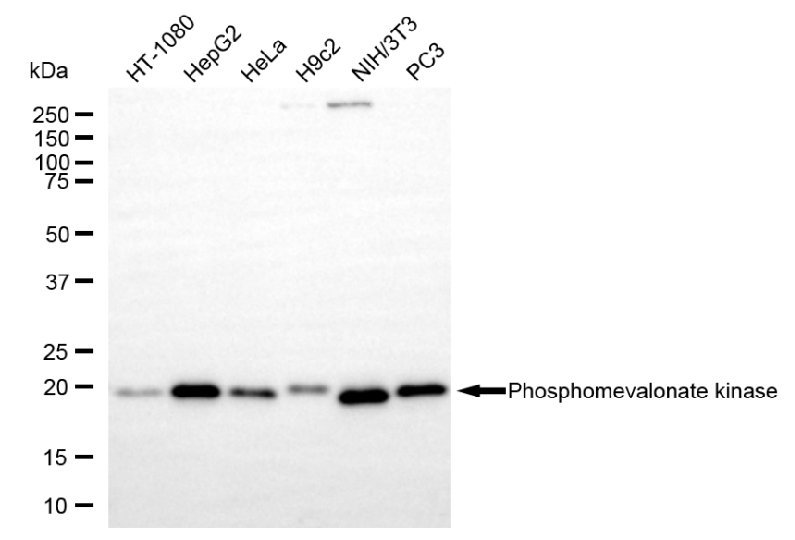
Western Blot: Compatible with standard Western Blot protocols.

Protein Interaction: Validated for SPR (Surface Plasmon Resonance) and BLI (Bio-Layer Interferometry) studies.

Shipping: Shipped at ambient temperature. Lyophilized protein is stable during transit.

Storage: Store lyophilized protein at -20°C to -80°C. Reconstituted protein should be aliquoted and stored at -80°C. Avoid repeated freeze-thaw cycles.

Shelf Life: 12 months from date of receipt when stored as recommended.

Shipping Time: Orders placed before 2 PM EST ship same day. International orders typically deliver within 5-10 business days.

Protein Biology

Function

Catalyzes the reversible ATP-dependent phosphorylation of mevalonate 5-phosphate to produce mevalonate diphosphate and ADP, a key step in the mevalonic acid mediated biosynthesis of isopentenyl diphosphate and other polyisoprenoid metabolites

Subcellular Location

Cytoplasm, cytosol

Disease Association

Porokeratosis 1, multiple types (POROK1) : A form of porokeratosis, a disorder of faulty keratinization characterized by one or more atrophic patches surrounded by a distinctive hyperkeratotic ridgelike border called the cornoid lamella. The keratotic lesions can progress to overt cutaneous neoplasms, typically squamous cell carcinomas. Multiple clinical variants of porokeratosis are recognized, including porokeratosis of Mibelli, linear porokeratosis, disseminated superficial actinic porokeratosis, palmoplantar porokeratosis, and punctate porokeratosis. Different clinical presentations can be observed among members of the same family. Individuals expressing more than one variant have also been reported. [The disease is caused by variants affecting the gene represented in this entry]

Tissue Specificity

Heart, liver, skeletal muscle, kidney, and pancreas. Lower level in brain, placenta and lung

Subunit

Monomer

Pathway

Isoprenoid biosynthesis; isopentenyl diphosphate biosynthesis via mevalonate pathway; isopentenyl diphosphate from (R)-mevalonate: step 2/3

Gene: PMVK  |  Organism: Homo sapiens
Key Publications

Frequently Asked Questions

How do I order or inquire about this product?

Fill out the Online Inquiry form with your required quantity and specifications. You can also email sales@biocrestsci.com. Our team typically responds within 4 business hours with a quote and availability confirmation.

What is the shipping and delivery time?

Orders placed before 2 PM EST ship the same day. Domestic (US) delivery typically takes 2-3 business days. International orders deliver within 5-10 business days. All products are shipped at ambient temperature with appropriate packaging to ensure stability.

How should I store this recombinant protein?

Lyophilized proteins should be stored at -20°C to -80°C upon receipt. After reconstitution, aliquot and store at -80°C. Avoid repeated freeze-thaw cycles. Shelf life is 12 months from date of receipt when stored as recommended.

What quality controls are performed on your products?

Each product undergoes SDS-PAGE purity analysis (typically >85-95%), endotoxin testing, and bioactivity validation. Products are validated for ELISA, Western Blot, and SPR/BLI applications as specified on this product page. A Certificate of Analysis (CoA) is available upon request.

Shopping Cart
Scroll to Top