Mouse anti-Human/Mouse/Rat sapiens (Human) RBX1 Monoclonal Antibody

Mouse anti-Human/Mouse/Rat sapiens (Human) RBX1 Monoclonal Antibody — E3 ubiquitin ligase component of multiple cullin-RING-based E3 ubiquitin-protein ligase (CRLs) complexes which mediate the ubiquitination and subsequent proteasomal degradation of target proteins, …

SKU: BCREC-000817MA Category:

Product Specifications

Uniprot No.P62877
Target NamesRBX1
Species ReactivityMouse
ImmunogenRecombinant Human RBX1 protein
Immunogen SpeciesHomo sapiens (Human)
ConjugateNon-conjugated
IsotypeMouse IgG1
ClonalityMonoclonal
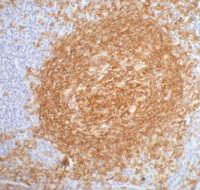
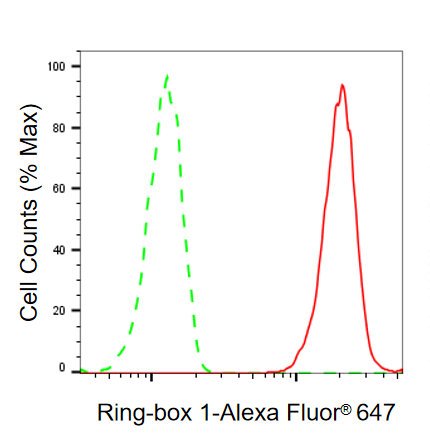
ApplicationsELISA, WB, FC, ICC
BufferPBS, 50% glycerol, 0.05% Proclin 300, 0.05%BSA
StorageUpon receipt, store at -20°C or -80°C. Avoid repeated freeze.

Function

E3 ubiquitin ligase component of multiple cullin-RING-based E3 ubiquitin-protein ligase (CRLs) complexes which mediate the ubiquitination and subsequent proteasomal degradation of target proteins, including proteins involved in cell cycle progression, signal transduction, transcription and transcription-coupled nucleotide excision repair. CRLs complexes and ARIH1 collaborate in tandem to mediate ubiquitination of target proteins, ARIH1 mediating addition of the first ubiquitin on CRLs targets. The functional specificity of the E3 ubiquitin-protein ligase complexes depends on the variable substrate recognition components.

Biological Context

Subcellular Location: Cytoplasm; Nucleus
Tissue Specificity: Widely expressed
Pathway: Protein modification; protein neddylation

Product Specifications

Mouse anti-Human/Mouse/Rat sapiens (Human) RBX1 Monoclonal Antibody is a recombinant protein. Suitable for ELISA and Western Blot applications.

Applications: ELISA, WB, FC, ICC

Biological Activity: Not implied unless activity data are explicitly listed on this product page, the datasheet, or the CoA.

Storage: Upon receipt, store at -20°C or -80°C. Avoid repeated freeze.

Shipping & Lead Time: Availability, shipping conditions, and estimated lead time are confirmed in the formal quotation or order confirmation based on the product format, destination, and order requirements.

Protein Biology

Function

E3 ubiquitin ligase component of multiple cullin-RING-based E3 ubiquitin-protein ligase (CRLs) complexes which mediate the ubiquitination and subsequent proteasomal degradation of target proteins, including proteins involved in cell cycle progression, signal transduction, transcription and transcription-coupled nucleotide excision repair (PubMed:10230407, PubMed:10579999, PubMed:11961546, PubMed:15983046, PubMed:16678110, PubMed:19112177, PubMed:19679664, PubMed:22748924, PubMed:23455478, PubMed:27565346, PubMed:29769719, PubMed:32355176, PubMed:33417871, PubMed:37844242, PubMed:38326650, PubMed:39504960, PubMed:39667934, PubMed:38316879). CRLs complexes and ARIH1 collaborate in tandem to mediate ubiquitination of target proteins, ARIH1 mediating addition of the first ubiquitin on CRLs targets (PubMed:27565346). The functional specificity of the E3 ubiquitin-protein ligase complexes depends on the variable substrate recognition components. As a component of the CSA complex mediates ubiquitination of Pol II subunit POLR2A at 'Lys-1268', a critical TC-NER checkpoint (PubMed:32355176, PubMed:34526721). Core component of the Cul7-RING(FBXW8) ubiquitin ligase complex, which mediates the ubiquitination and subsequent proteasomal degradation of target proteins (PubMed:35982156). Core component of a Cul9-RING ubiquitin ligase complex composed of CUL9 and RBX1, which mediates mono-ubiquitination of p53/TP53 (PubMed:38605244). Recruits the E2 ubiquitin-conjugating enzyme CDC34 to the complex and brings it into close proximity to the substrate. Probably also stimulates CDC34 autoubiquitination. May be required for histone H3 and histone H4 ubiquitination in response to ultraviolet and for subsequent DNA repair. Promotes the neddylation of CUL1, CUL2, CUL4 and CUL4 via its interaction with UBE2M. Involved in the ubiquitination of KEAP1, ENC1 and KLHL41. In concert with ATF2 and CUL3, promotes degradation of KAT5 thereby attenuating its ability to acetylate and activate ATM. As part of a multisubunit complex composed of elongin BC complex (ELOB and ELOC), elongin A/ELOA, RBX1 and CUL5; polyubiquitinates monoubiquitinated POLR2A (PubMed:19920177)

Subcellular Location

Cytoplasm; Nucleus

Tissue Specificity

Widely expressed

Subunit

(Microbial infection) Interacts with human adenovirus 5 protein E1A; this interaction inhibits RBX1-CUL1-dependent elongation reaction of ubiquitin chains by the SCF(FBW7) complex

Pathway

Protein modification; protein neddylation

Gene: RBX1  |  Organism: Homo sapiens  |  Synonyms: E3 ubiquitin-protein transferase RBX1; Protein ZYP; RING finger protein 75; RING-box protein 1; Regulator of cullins 1
Key Publications

Frequently Asked Questions

How do I order or inquire about this product?

Submit the Online Inquiry form with your required quantity and specifications, or email sales@biocrestsci.com. Available sizes, pricing, stock status, documentation, and estimated lead time are confirmed in the formal quotation.

What is the shipping and delivery time?

Availability, dispatch timing, shipping conditions, and delivery estimates depend on the product format, destination, and order requirements. These details are confirmed in the formal quotation or order confirmation.

How should this product be stored?

Follow the storage and handling instructions in the product-specific datasheet and Certificate of Analysis (CoA). Requirements may vary by product form and formulation; contact BioCrest Sci if product-specific guidance is needed.

What quality controls are performed on your products?

Quality-control data such as identity, purity, endotoxin level, or biological activity are provided only when specified on this product page, the datasheet, or Certificate of Analysis (CoA). Biological activity is not implied unless explicitly stated.

Shopping Cart
Scroll to Top