

Function
Fodrin, which seems to be involved in secretion, interacts with calmodulin in a calcium-dependent manner and is thus candidate for the calcium-dependent movement of the cytoskeleton at the membrane.
Biological Context
Subcellular Location: Cytoplasm, cytoskeleton; Cytoplasm, cell cortex
Disease Association: Developmental and epileptic encephalopathy 5 (DEE5) : A disorder characterized by seizures associated with hypsarrhythmia, profound intellectual disability with lack of visual attention and speech development, as well as spastic quadriplegia. [The disease is caused by variants affecting the gene represented in this entry] | Developmental delay with or without epilepsy (DEVEP) : An autosomal dominant neurodevelopmental disorder apparent from infancy or early childhood, and characterized by impaired intellectual development, speech delay, motor delay, and behavioral abnormalities. About half of patients develop various types of seizures. Some affected individuals have cerebellar atrophy and ataxia. [The disease is caused by variants affecting the gene represented in this entry] | Neuronopathy, distal hereditary motor, autosomal dominant 11 (HMND11) : A form of distal hereditary motor neuronopathy, a heterogeneous group of neuromuscular diseases caused by selective degeneration of motor neurons in the anterior horn of the spinal cord, without sensory deficit in the posterior horn. HMND11 is an autosomal dominant form with incomplete penetrance, characterized by juvenile or young-adult onset of distal limb muscle weakness and atrophy mainly affecting the lower limbs, resulting in gait instability and walking difficulties. Some affected individuals may have distal upper limb and hand involvement or mild distal sensory abnormalities, but motor symptoms dominate the clinical picture. [The disease is caused by variants affecting the gene represented in this entry] | Spastic paraplegia 91, autosomal dominant, with or without cerebellar ataxia (SPG91) : A form of spastic paraplegia, a neurodegenerative disorder characterized by a slow, gradual, progressive weakness and spasticity of the lower limbs. Rate of progression and the severity of symptoms are quite variable. Initial symptoms may include difficulty with balance, weakness and stiffness in the legs, muscle spasms, and dragging the toes when walking. In some forms of the disorder, bladder symptoms (such as incontinence) may appear, or the weakness and stiffness may spread to other parts of the body. SPG91 is an autosomal dominant form characterized by gait abnormalities, sometimes associated with cerebellar ataxia. Additional features may include sensory abnormalities, peripheral neuropathy, optic neuropathy, developmental delay, impaired intellectual development, and seizures. Most patients have symptoms onset in the first decade of life, although age at onset is highly variable and ranges from birth to young adulthood. [The disease is caused by variants affecting the gene represented in this entry]
Product Specifications
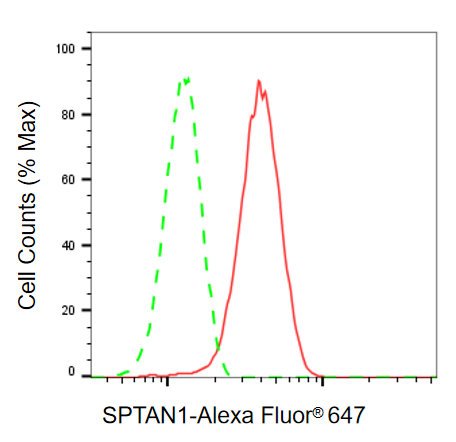
Mouse anti-Human/Mouse/Rat sapiens (Human) SPTAN1 Monoclonal Antibody is a recombinant protein. Suitable for ELISA and Western Blot applications. Explore more Antibody products →