
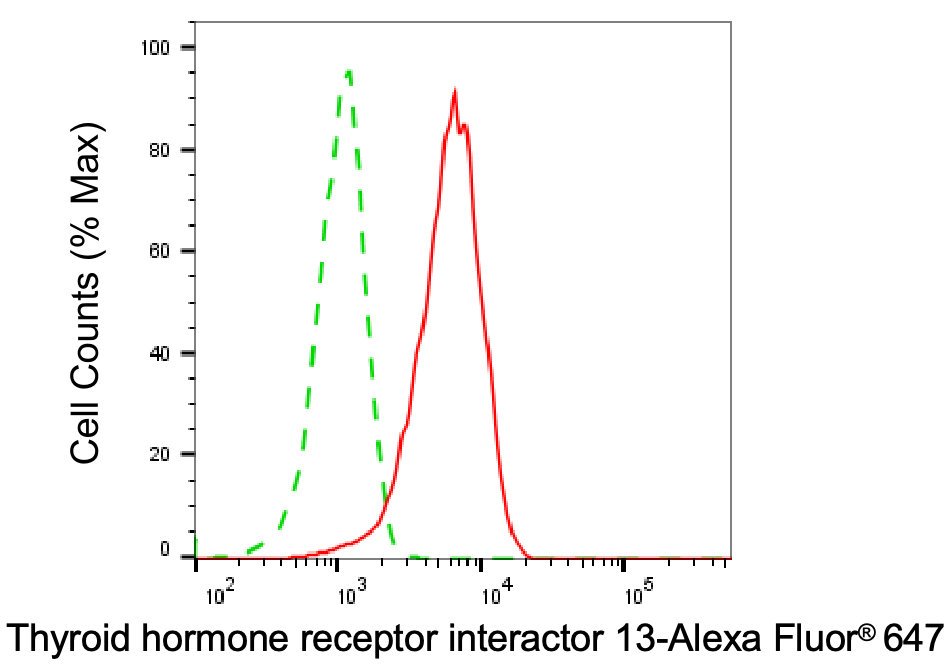
Mouse anti-Human/Mouse/Rat sapiens (Human) TRIP13 Monoclonal Antibody

Mouse anti-Human/Mouse/Rat sapiens (Human) TRIP13 Monoclonal Antibody — Plays a key role in chromosome recombination and chromosome structure development during meiosis.

SKU: BCREC-000319MA Category:

Product Specifications

Uniprot No.Q15645
Target NamesTRIP13
Species ReactivityMouse
ImmunogenRecombinant Human TRIP13 protein
Immunogen SpeciesHomo sapiens (Human)
ConjugateNon-conjugated
IsotypeMouse IgG1
ClonalityMonoclonal
ApplicationsELISA, WB, FC
BufferPBS, 50% glycerol, 0.05% Proclin 300, 0.05%BSA
StorageUpon receipt, store at -20°C or -80°C. Avoid repeated freeze.

Function

Plays a key role in chromosome recombination and chromosome structure development during meiosis. Required at early steps in meiotic recombination that leads to non-crossovers pathways. Also needed for efficient completion of homologous synapsis by influencing crossover distribution along the chromosomes affecting both crossovers and non-crossovers pathways.

Biological Context

Disease Association: Mosaic variegated aneuploidy syndrome 3 (MVA3) : A form of mosaic variegated aneuploidy syndrome, a severe disorder characterized by mosaic aneuploidies, predominantly trisomies and monosomies, involving multiple different chromosomes and tissues. Affected individuals typically present with severe intrauterine growth retardation and microcephaly. Eye anomalies, mild dysmorphism, variable developmental delay, and a broad spectrum of additional congenital abnormalities and medical conditions may also occur. The risk of malignancy is high, with rhabdomyosarcoma, Wilms tumor and leukemia reported in several cases. MVA3 inheritance is autosomal recessive. [The disease is caused by variants affecting the gene represented in this entry. MVA3 is caused by biallelic mutations in the TRIP13 gene] | Oocyte/zygote/embryo maturation arrest 9 (OZEMA9) : An autosomal recessive infertility disorder due to oocyte meiotic arrest at metaphase I. Abnormal zygotic cleavage has been observed in some patients. [The disease may be caused by variants affecting the gene represented in this entry]

Product Specifications

Mouse anti-Human/Mouse/Rat sapiens (Human) TRIP13 Monoclonal Antibody is a recombinant protein. Suitable for ELISA and Western Blot applications.

SDS-PAGE: Single band at expected molecular weight confirming purity.

ELISA: Suitable as coating antigen or detection standard.

Western Blot: Compatible with standard Western Blot protocols.

Protein Interaction: Validated for SPR (Surface Plasmon Resonance) and BLI (Bio-Layer Interferometry) studies.

Shipping: Shipped at ambient temperature. Lyophilized protein is stable during transit.

Storage: Store lyophilized protein at -20°C to -80°C. Reconstituted protein should be aliquoted and stored at -80°C. Avoid repeated freeze-thaw cycles.

Shelf Life: 12 months from date of receipt when stored as recommended.

Shipping Time: Orders placed before 2 PM EST ship same day. International orders typically deliver within 5-10 business days.

Protein Biology

Function

Plays a key role in chromosome recombination and chromosome structure development during meiosis. Required at early steps in meiotic recombination that leads to non-crossovers pathways. Also needed for efficient completion of homologous synapsis by influencing crossover distribution along the chromosomes affecting both crossovers and non-crossovers pathways. Also required for development of higher-order chromosome structures and is needed for synaptonemal-complex formation. In males, required for efficient synapsis of the sex chromosomes and for sex body formation. Promotes early steps of the DNA double-strand breaks (DSBs) repair process upstream of the assembly of RAD51 complexes. Required for depletion of HORMAD1 and HORMAD2 from synapsed chromosomes (By similarity). Plays a role in mitotic spindle assembly checkpoint (SAC) activation (PubMed:28553959)

Disease Association

Mosaic variegated aneuploidy syndrome 3 (MVA3) : A form of mosaic variegated aneuploidy syndrome, a severe disorder characterized by mosaic aneuploidies, predominantly trisomies and monosomies, involving multiple different chromosomes and tissues. Affected individuals typically present with severe intrauterine growth retardation and microcephaly. Eye anomalies, mild dysmorphism, variable developmental delay, and a broad spectrum of additional congenital abnormalities and medical conditions may also occur. The risk of malignancy is high, with rhabdomyosarcoma, Wilms tumor and leukemia reported in several cases. MVA3 inheritance is autosomal recessive. [The disease is caused by variants affecting the gene represented in this entry. MVA3 is caused by biallelic mutations in the TRIP13 gene] | Oocyte/zygote/embryo maturation arrest 9 (OZEMA9) : An autosomal recessive infertility disorder due to oocyte meiotic arrest at metaphase I. Abnormal zygotic cleavage has been observed in some patients. [The disease may be caused by variants affecting the gene represented in this entry]

Subunit

Specifically interacts with the ligand binding domain of the thyroid receptor (TR). This interaction does not require the presence of thyroid hormone for its interaction. Interacts with HPV16 E1. Interacts with proteasome subunit PSMA8; to participate in meiosis progression during spermatogenesis (By similarity)

Gene: TRIP13  |  Organism: Homo sapiens  |  Synonyms: Human papillomavirus type 16 E1 protein-binding protein; Thyroid hormone receptor interactor 13; Thyroid receptor-interacting protein 13
Key Publications

Frequently Asked Questions

How do I order or inquire about this product?

Fill out the Online Inquiry form with your required quantity and specifications. You can also email sales@biocrestsci.com. Our team typically responds within 4 business hours with a quote and availability confirmation.

What is the shipping and delivery time?

Orders placed before 2 PM EST ship the same day. Domestic (US) delivery typically takes 2-3 business days. International orders deliver within 5-10 business days. All products are shipped at ambient temperature with appropriate packaging to ensure stability.

How should I store this recombinant protein?

Lyophilized proteins should be stored at -20°C to -80°C upon receipt. After reconstitution, aliquot and store at -80°C. Avoid repeated freeze-thaw cycles. Shelf life is 12 months from date of receipt when stored as recommended.

What quality controls are performed on your products?

Each product undergoes SDS-PAGE purity analysis (typically >85-95%), endotoxin testing, and bioactivity validation. Products are validated for ELISA, Western Blot, and SPR/BLI applications as specified on this product page. A Certificate of Analysis (CoA) is available upon request.

Shopping Cart
Scroll to Top