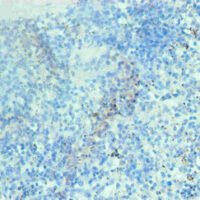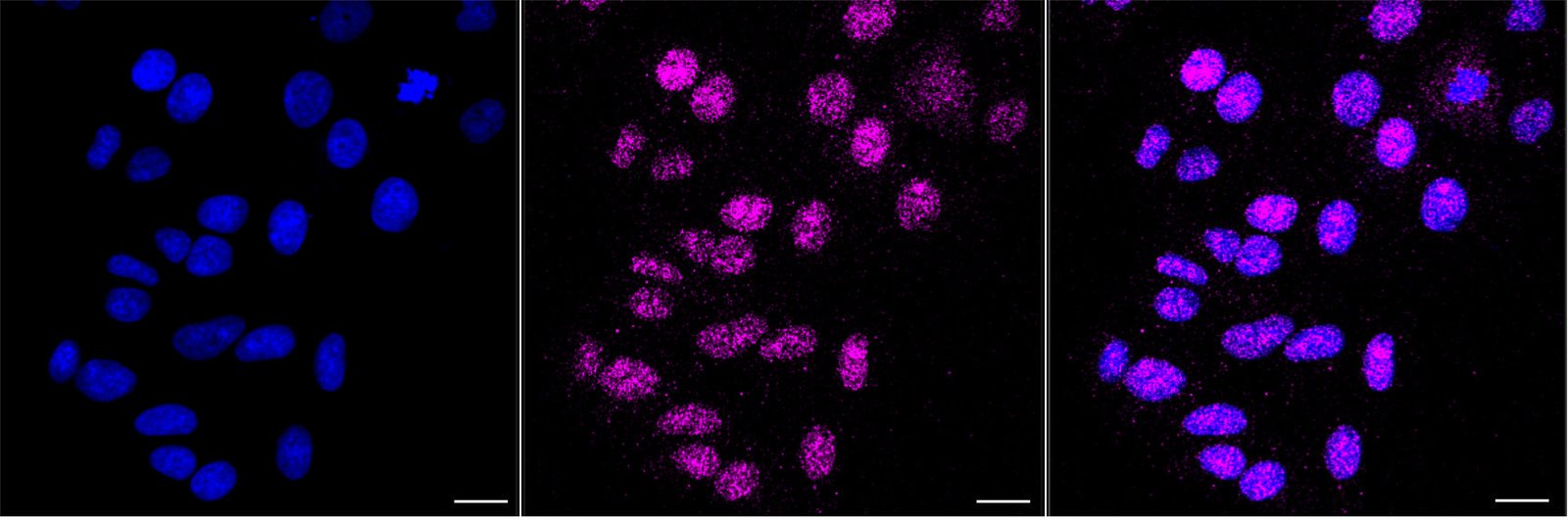
Mouse anti-Human/Mouse/Rat sapiens (Human) UHRF2 Monoclonal Antibody

Mouse anti-Human/Mouse/Rat sapiens (Human) UHRF2 Monoclonal Antibody — E3 ubiquitin ligase that plays important roles in DNA methylation, histone modifications, cell cycle and DNA repair.

SKU: BCREC-000495MA Category:

Product Specifications

Uniprot No.Q96PU4
Target NamesUHRF2
Species ReactivityMouse
ImmunogenRecombinant Human UHRF2 protein
Immunogen SpeciesHomo sapiens (Human)
ConjugateNon-conjugated
IsotypeMouse IgG1
ClonalityMonoclonal
ApplicationsELISA, WB, ICC
BufferPBS, 50% glycerol, 0.05% Proclin 300, 0.05%BSA
StorageUpon receipt, store at -20°C or -80°C. Avoid repeated freeze.

Function

E3 ubiquitin ligase that plays important roles in DNA methylation, histone modifications, cell cycle and DNA repair. Acts as a specific reader for 5-hydroxymethylcytosine (5hmC) and thereby recruits various substrates to these sites to ubiquitinate them. This activity also allows the maintenance of 5mC levels at specific genomic loci and regulates neuron-related gene expression.

Biological Context

Subcellular Location: Nucleus; Chromosome
Disease Association: [Associated with various cancers. DNA copy number loss is found in multiple kinds of malignancies originating from the brain, breast, stomach, kidney, hematopoietic tissue and lung]
Pathway: Protein modification; protein ubiquitination

Product Specifications

Mouse anti-Human/Mouse/Rat sapiens (Human) UHRF2 Monoclonal Antibody is a recombinant protein. Suitable for ELISA and Western Blot applications.

Applications: ELISA, WB, ICC

Biological Activity: Not implied unless activity data are explicitly listed on this product page, the datasheet, or the CoA.

Storage: Upon receipt, store at -20°C or -80°C. Avoid repeated freeze.

Shipping & Lead Time: Availability, shipping conditions, and estimated lead time are confirmed in the formal quotation or order confirmation based on the product format, destination, and order requirements.

Protein Biology

Function

E3 ubiquitin ligase that plays important roles in DNA methylation, histone modifications, cell cycle and DNA repair (PubMed:15178429, PubMed:23404503, PubMed:27743347, PubMed:29506131). Acts as a specific reader for 5-hydroxymethylcytosine (5hmC) and thereby recruits various substrates to these sites to ubiquitinate them (PubMed:24813944, PubMed:27129234). This activity also allows the maintenance of 5mC levels at specific genomic loci and regulates neuron-related gene expression (By similarity). Participates in cell cycle regulation by ubiquitinating cyclins CCND1 and CCNE1 and thereby inducing G1 arrest (PubMed:15178429, PubMed:15361834, PubMed:21952639). Also ubiquitinates PCNP leading to its degradation by the proteasome (PubMed:12176013, PubMed:14741369). Plays an active role in DNA damage repair by ubiquitinating p21/CDKN1A leading to its proteasomal degradation (PubMed:29923055). Also promotes DNA repair by acting as an interstrand cross-links (ICLs) sensor. Mechanistically, cooperates with UHRF1 to ensure recruitment of FANCD2 to ICLs, leading to FANCD2 monoubiquitination and subsequent activation (PubMed:30335751). Contributes to UV-induced DNA damage response by physically interacting with ATR in response to irradiation, thereby promoting ATR activation (PubMed:33848395)

Subcellular Location

Nucleus; Chromosome

Disease Association

[Associated with various cancers. DNA copy number loss is found in multiple kinds of malignancies originating from the brain, breast, stomach, kidney, hematopoietic tissue and lung]

Subunit

Homodimer; disulfide-linked. Binds methylated CpG containing oligonucleotides. Interacts with H3; the interaction has a preference for the 'Lys-9' trimethylated form of H3 (H3K9me3) (By similarity). Interacts with PCNP (PubMed:12176013, PubMed:14741369). Interacts with HDAC1 (PubMed:15361834). Interacts directly with CCNE1; the interaction ubiquitinates CCNE1 and appears independent of CCNE1 phosphorylation (PubMed:21952639). Interacts with CCND1; the interaction ubiquitinates CCND1 and appears independent of CCND1 phosphorylation (PubMed:21952639). Interacts with p53/TP53 and RB1 (PubMed:21952639). Interacts with UBE2I (PubMed:23404503). Interacts with ZNF618 (PubMed:27129234). Interacts with UHRF1 (PubMed:30335751). Interacts with FANCD2 (PubMed:30335751). Interacts with ATR (PubMed:33848395). Interacts with PCNA (PubMed:28951215)

Pathway

Protein modification; protein ubiquitination

Gene: UHRF2  |  Organism: Homo sapiens  |  Synonyms: Np95/ICBP90-like RING finger protein; Nuclear protein 97; Nuclear zinc finger protein Np97; RING finger protein 107; RING-type E3 ubiquitin transferase UHRF2; Ubiquitin-like PHD and RING finger domain-containing protein 2; Ubiquitin-like-containing PHD and RING finger domains protein 2
Key Publications

Frequently Asked Questions

How do I order or inquire about this product?

Submit the Online Inquiry form with your required quantity and specifications, or email sales@biocrestsci.com. Available sizes, pricing, stock status, documentation, and estimated lead time are confirmed in the formal quotation.

What is the shipping and delivery time?

Availability, dispatch timing, shipping conditions, and delivery estimates depend on the product format, destination, and order requirements. These details are confirmed in the formal quotation or order confirmation.

How should this product be stored?

Follow the storage and handling instructions in the product-specific datasheet and Certificate of Analysis (CoA). Requirements may vary by product form and formulation; contact BioCrest Sci if product-specific guidance is needed.

What quality controls are performed on your products?

Quality-control data such as identity, purity, endotoxin level, or biological activity are provided only when specified on this product page, the datasheet, or Certificate of Analysis (CoA). Biological activity is not implied unless explicitly stated.

Shopping Cart
Scroll to Top