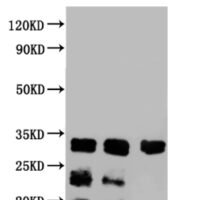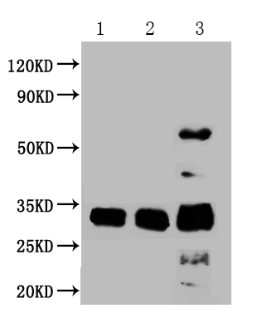
,

Mouse anti-Human/Rabbit sapiens (Human) CD63 Monoclonal Antibody

Mouse anti-Human/Rabbit sapiens (Human) CD63 Monoclonal Antibody — Functions as a cell surface receptor for TIMP1 and plays a role in the activation of cellular signaling cascades.

SKU: BCREC-000145MA Categories: ,

Product Specifications

Uniprot No.P08962
Target NamesCD63
Species ReactivityMouse
ImmunogenRecombinant Human CD63 antigen protein (103-203AA)
ConjugateNon-conjugated
IsotypeIgG1
ClonalityMonoclonal
ApplicationsELISA, WB, IHC, IF, FC
BufferPBS, 50% glycerol, 0.05% Proclin 300, 0.05%BSA
StorageUpon receipt, store at -20°C or -80°C. Avoid repeated freeze.

Function

Functions as a cell surface receptor for TIMP1 and plays a role in the activation of cellular signaling cascades. Plays a role in the activation of ITGB1 and integrin signaling, leading to the activation of AKT, FAK/PTK2 and MAP kinases. Promotes cell survival, reorganization of the actin cytoskeleton, cell adhesion, spreading and migration, via its role in the activation of AKT and FAK/PTK2.

Biological Context

Subcellular Location: Cell membrane (Multi-pass membrane protein); Lysosome membrane (Multi-pass membrane protein); Late endosome membrane (Multi-pass membrane protein); Endosome, multivesicular body; Melanosome; Secreted, extracellular exosome; Cell surface
Tissue Specificity: Detected in platelets (at protein level). Dysplastic nevi, radial growth phase primary melanomas, hematopoietic cells, tissue macrophages

Product Specifications

Mouse anti-Human/Rabbit sapiens (Human) CD63 Monoclonal Antibody is a recombinant protein. Suitable for ELISA and Western Blot applications.

SDS-PAGE: Single band at expected molecular weight confirming purity.

ELISA: Suitable as coating antigen or detection standard.

Western Blot: Compatible with standard Western Blot protocols.

Protein Interaction: Validated for SPR (Surface Plasmon Resonance) and BLI (Bio-Layer Interferometry) studies.

Shipping: Shipped at ambient temperature. Lyophilized protein is stable during transit.

Storage: Store lyophilized protein at -20°C to -80°C. Reconstituted protein should be aliquoted and stored at -80°C. Avoid repeated freeze-thaw cycles.

Shelf Life: 12 months from date of receipt when stored as recommended.

Shipping Time: Orders placed before 2 PM EST ship same day. International orders typically deliver within 5-10 business days.

Protein Biology

Function

Functions as a cell surface receptor for TIMP1 and plays a role in the activation of cellular signaling cascades. Plays a role in the activation of ITGB1 and integrin signaling, leading to the activation of AKT, FAK/PTK2 and MAP kinases. Promotes cell survival, reorganization of the actin cytoskeleton, cell adhesion, spreading and migration, via its role in the activation of AKT and FAK/PTK2. Plays a role in VEGFA signaling via its role in regulating the internalization of KDR/VEGFR2. Plays a role in intracellular vesicular transport processes, and is required for normal trafficking of the PMEL luminal domain that is essential for the development and maturation of melanocytes. Plays a role in the adhesion of leukocytes onto endothelial cells via its role in the regulation of SELP trafficking. May play a role in mast cell degranulation in response to Ms4a2/FceRI stimulation, but not in mast cell degranulation in response to other stimuli

Subcellular Location

Cell membrane (Multi-pass membrane protein); Lysosome membrane (Multi-pass membrane protein); Late endosome membrane (Multi-pass membrane protein); Endosome, multivesicular body; Melanosome; Secreted, extracellular exosome; Cell surface

Tissue Specificity

Detected in platelets (at protein level). Dysplastic nevi, radial growth phase primary melanomas, hematopoietic cells, tissue macrophages

Subunit

Interacts with TIMP1 and ITGB1 and recruits TIMP1 to ITGB1 (PubMed:16917503, PubMed:24635319). Interacts with CD9. Identified in a complex with CD9 and ITGB3 (PubMed:19640571). Interacts with PMEL (PubMed:21962903). Interacts with KDR/VEGFR2; identified in a complex with ITGB1 and KDR/VEGFR2 and is required to recruit KDR to ITGB1 complexes (PubMed:23632027). Interacts with SYT7 (By similarity)

Gene: CD63  |  Organism: Homo sapiens  |  Synonyms: Granulophysin; Lysosomal-associated membrane protein 3; Lysosome integral membrane protein 1; Melanoma-associated antigen ME491; OMA81H; Ocular melanoma-associated antigen; Tetraspanin-30
Key Publications

Frequently Asked Questions

How do I order or inquire about this product?

Fill out the Online Inquiry form with your required quantity and specifications. You can also email sales@biocrestsci.com. Our team typically responds within 4 business hours with a quote and availability confirmation.

What is the shipping and delivery time?

Orders placed before 2 PM EST ship the same day. Domestic (US) delivery typically takes 2-3 business days. International orders deliver within 5-10 business days. All products are shipped at ambient temperature with appropriate packaging to ensure stability.

How should I store this recombinant protein?

Lyophilized proteins should be stored at -20°C to -80°C upon receipt. After reconstitution, aliquot and store at -80°C. Avoid repeated freeze-thaw cycles. Shelf life is 12 months from date of receipt when stored as recommended.

What quality controls are performed on your products?

Each product undergoes SDS-PAGE purity analysis (typically >85-95%), endotoxin testing, and bioactivity validation. Products are validated for ELISA, Western Blot, and SPR/BLI applications as specified on this product page. A Certificate of Analysis (CoA) is available upon request.

Shopping Cart
Scroll to Top