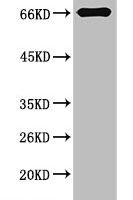

Mouse anti-Human/Rat/Mouse/Monkey/Dog/Cat/Hamster/Rabbit/Sheep/Insect/Yeast TUBB Monoclonal Antibody, HRP

Mouse anti-Human/Rat/Mouse/Monkey/Dog/Cat/Hamster/Rabbit/Sheep/Insect/Yeast TUBB Monoclonal Antibody, HRP — Tubulin is the major constituent of microtubules, a cylinder consisting of laterally associated linear protofilaments composed of alpha- and beta-tubulin heterodimers.

SKU: BCREC-000306MA Category:

Product Specifications

Uniprot No.P07437
Target NamesTUBB
Species ReactivityMouse
ImmunogenRecombinant Protein
Immunogen SpeciesH, R, M, Mk, Dg, C, Hm, Rb, Sh, Insect, Yeast
ConjugateHRP
IsotypeIgG
ClonalityMonoclonal
ApplicationsELISA,WB,IHC
BufferPBS, 50% glycerol, 0.05% Proclin 300, 0.05%BSA
StorageUpon receipt, store at -20°C or -80°C. Avoid repeated freeze.

Function

Tubulin is the major constituent of microtubules, a cylinder consisting of laterally associated linear protofilaments composed of alpha- and beta-tubulin heterodimers. Microtubules grow by the addition of GTP-tubulin dimers to the microtubule end, where a stabilizing cap forms. Below the cap, tubulin dimers are in GDP-bound state, owing to GTPase activity of alpha-tubulin.

Biological Context

Subcellular Location: Cytoplasm, cytoskeleton
Tissue Specificity: Ubiquitously expressed with highest levels in spleen, thymus and immature brain
Disease Association: Cortical dysplasia, complex, with other brain malformations 6 (CDCBM6) : A disorder of aberrant neuronal migration and disturbed axonal guidance. Affected individuals have microcephaly, ataxia, and severe delayed psychomotor development. Brain imaging shows variable malformations of cortical development, including white matter streaks, dysmorphic basal ganglia, corpus callosum abnormalities, brainstem and cerebellar hypoplasia, cortical dysplasia, polymicrogyria. [The disease is caused by variants affecting the gene represented in this entry] | Skin creases, congenital symmetric circumferential, 1 (CSCSC1) : An autosomal dominant disease characterized by multiple, symmetric, circumferential rings of folded skin, affecting primarily the limbs. Affected individuals also exhibit intellectual disability, cleft palate, and dysmorphic features. [The disease is caused by variants affecting the gene represented in this entry]

Product Specifications

Mouse anti-Human/Rat/Mouse/Monkey/Dog/Cat/Hamster/Rabbit/Sheep/Insect/Yeast TUBB Monoclonal Antibody, HRP is a recombinant protein. Suitable for ELISA and Western Blot applications.

Applications: ELISA,WB,IHC

Biological Activity: Not implied unless activity data are explicitly listed on this product page, the datasheet, or the CoA.

Storage: Upon receipt, store at -20°C or -80°C. Avoid repeated freeze.

Shipping & Lead Time: Availability, shipping conditions, and estimated lead time are confirmed in the formal quotation or order confirmation based on the product format, destination, and order requirements.

Protein Biology

Function

Tubulin is the major constituent of microtubules, a cylinder consisting of laterally associated linear protofilaments composed of alpha- and beta-tubulin heterodimers. Microtubules grow by the addition of GTP-tubulin dimers to the microtubule end, where a stabilizing cap forms. Below the cap, tubulin dimers are in GDP-bound state, owing to GTPase activity of alpha-tubulin

Subcellular Location

Cytoplasm, cytoskeleton

Disease Association

Cortical dysplasia, complex, with other brain malformations 6 (CDCBM6) : A disorder of aberrant neuronal migration and disturbed axonal guidance. Affected individuals have microcephaly, ataxia, and severe delayed psychomotor development. Brain imaging shows variable malformations of cortical development, including white matter streaks, dysmorphic basal ganglia, corpus callosum abnormalities, brainstem and cerebellar hypoplasia, cortical dysplasia, polymicrogyria. [The disease is caused by variants affecting the gene represented in this entry] | Skin creases, congenital symmetric circumferential, 1 (CSCSC1) : An autosomal dominant disease characterized by multiple, symmetric, circumferential rings of folded skin, affecting primarily the limbs. Affected individuals also exhibit intellectual disability, cleft palate, and dysmorphic features. [The disease is caused by variants affecting the gene represented in this entry]

Tissue Specificity

Ubiquitously expressed with highest levels in spleen, thymus and immature brain

Subunit

Heterodimer of alpha and beta chains (PubMed:26637975). A typical microtubule is a hollow water-filled tube with an outer diameter of 25 nm and an inner diameter of 15 nM. Alpha-beta heterodimers associate head-to-tail to form protofilaments running lengthwise along the microtubule wall with the beta-tubulin subunit facing the microtubule plus end conferring a structural polarity. Microtubules usually have 13 protofilaments but different protofilament numbers can be found in some organisms and specialized cells. Interacts with CIMAP3 (PubMed:20643351). Interacts with DIAPH1 (PubMed:23325789). Interacts with MX1 (By similarity). May interact with RNABP10 (By similarity). Interacts with CFAP157 (By similarity). Nascent tubulin polypeptide interacts (via beta-tubulin MREI motif) with TTC5/STRAP; this interaction results in tubulin mRNA-targeted degradation (PubMed:31727855)

Gene: TUBB  |  Organism: Homo sapiens  |  Synonyms: Tubulin beta-5 chain
Key Publications

Frequently Asked Questions

How do I order or inquire about this product?

Submit the Online Inquiry form with your required quantity and specifications, or email sales@biocrestsci.com. Available sizes, pricing, stock status, documentation, and estimated lead time are confirmed in the formal quotation.

What is the shipping and delivery time?

Availability, dispatch timing, shipping conditions, and delivery estimates depend on the product format, destination, and order requirements. These details are confirmed in the formal quotation or order confirmation.

How should this product be stored?

Follow the storage and handling instructions in the product-specific datasheet and Certificate of Analysis (CoA). Requirements may vary by product form and formulation; contact BioCrest Sci if product-specific guidance is needed.

What quality controls are performed on your products?

Quality-control data such as identity, purity, endotoxin level, or biological activity are provided only when specified on this product page, the datasheet, or Certificate of Analysis (CoA). Biological activity is not implied unless explicitly stated.

Shopping Cart
Scroll to Top