
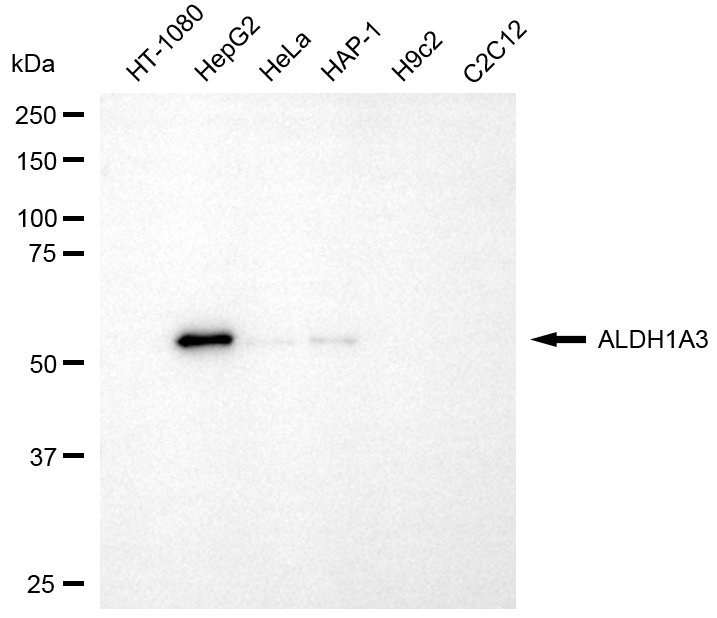
Mouse anti-Human sapiens (Human) ALDH1A3 Monoclonal Antibody

Mouse anti-Human sapiens (Human) ALDH1A3 Monoclonal Antibody — Catalyzes the NAD-dependent oxidation of aldehyde substrates, such as all-trans-retinal and all-trans-13,14-dihydroretinal, to their corresponding carboxylic acids, all-trans-retinoate and all-tran…

SKU: BCREC-000272MA Category:

Product Specifications

Uniprot No.P47895
Target NamesALDH1A3
Species ReactivityMouse
ImmunogenRecombinant Human ALDH1A3 protein
Immunogen SpeciesHomo sapiens (Human)
ConjugateNon-conjugated
IsotypeMouse IgG1
ClonalityMonoclonal
ApplicationsELISA, WB
BufferPBS, 50% glycerol, 0.05% Proclin 300, 0.05%BSA
StorageUpon receipt, store at -20°C or -80°C. Avoid repeated freeze.

Function

Catalyzes the NAD-dependent oxidation of aldehyde substrates, such as all-trans-retinal and all-trans-13,14-dihydroretinal, to their corresponding carboxylic acids, all-trans-retinoate and all-trans-13,14-dihydroretinoate, respectively. High specificity for all-trans-retinal as substrate, can also accept acetaldehyde as substrate in vitro but with lower affinity. Required for the biosynthesis of normal levels of retinoate in the embryonic ocular and nasal regions; a critical lipid in the embryonic development of the eye and the nasal region.

Biological Context

Subcellular Location: Cytoplasm
Tissue Specificity: Expressed at low levels in many tissues and at higher levels in salivary gland, stomach, and kidney
Disease Association: Microphthalmia, isolated, 8 (MCOP8) : A disorder of eye formation, ranging from small size of a single eye to complete bilateral absence of ocular tissues. Ocular abnormalities like opacities of the cornea and lens, scaring of the retina and choroid, and other abnormalities may also be present. [The disease is caused by variants affecting the gene represented in this entry]
Pathway: Cofactor metabolism; retinol metabolism

Product Specifications

Mouse anti-Human sapiens (Human) ALDH1A3 Monoclonal Antibody is a recombinant protein. Suitable for ELISA and Western Blot applications.

Applications: ELISA, WB

Biological Activity: Not implied unless activity data are explicitly listed on this product page, the datasheet, or the CoA.

Storage: Upon receipt, store at -20°C or -80°C. Avoid repeated freeze.

Shipping & Lead Time: Availability, shipping conditions, and estimated lead time are confirmed in the formal quotation or order confirmation based on the product format, destination, and order requirements.

Protein Biology

Function

Catalyzes the NAD-dependent oxidation of aldehyde substrates, such as all-trans-retinal and all-trans-13,14-dihydroretinal, to their corresponding carboxylic acids, all-trans-retinoate and all-trans-13,14-dihydroretinoate, respectively (By similarity) (PubMed:27759097). High specificity for all-trans-retinal as substrate, can also accept acetaldehyde as substrate in vitro but with lower affinity (PubMed:27759097). Required for the biosynthesis of normal levels of retinoate in the embryonic ocular and nasal regions; a critical lipid in the embryonic development of the eye and the nasal region (By similarity)

Subcellular Location

Cytoplasm

Disease Association

Microphthalmia, isolated, 8 (MCOP8) : A disorder of eye formation, ranging from small size of a single eye to complete bilateral absence of ocular tissues. Ocular abnormalities like opacities of the cornea and lens, scaring of the retina and choroid, and other abnormalities may also be present. [The disease is caused by variants affecting the gene represented in this entry]

Tissue Specificity

Expressed at low levels in many tissues and at higher levels in salivary gland, stomach, and kidney

Subunit

Homotetramer

Pathway

Cofactor metabolism; retinol metabolism

Gene: ALDH1A3  |  Organism: Homo sapiens  |  Synonyms: Aldehyde dehydrogenase 6; Aldehyde dehydrogenase family 1 member A3
Key Publications

Frequently Asked Questions

How do I order or inquire about this product?

Submit the Online Inquiry form with your required quantity and specifications, or email sales@biocrestsci.com. Available sizes, pricing, stock status, documentation, and estimated lead time are confirmed in the formal quotation.

What is the shipping and delivery time?

Availability, dispatch timing, shipping conditions, and delivery estimates depend on the product format, destination, and order requirements. These details are confirmed in the formal quotation or order confirmation.

How should this product be stored?

Follow the storage and handling instructions in the product-specific datasheet and Certificate of Analysis (CoA). Requirements may vary by product form and formulation; contact BioCrest Sci if product-specific guidance is needed.

What quality controls are performed on your products?

Quality-control data such as identity, purity, endotoxin level, or biological activity are provided only when specified on this product page, the datasheet, or Certificate of Analysis (CoA). Biological activity is not implied unless explicitly stated.

Shopping Cart
Scroll to Top