
,

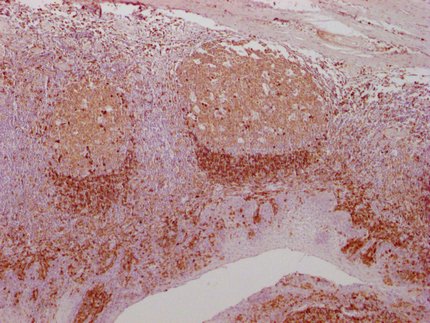
Mouse anti-Human sapiens (Human) CD79A Monoclonal Antibody

Mouse anti-Human sapiens (Human) CD79A Monoclonal Antibody — Required in cooperation with CD79B for initiation of the signal transduction cascade activated by binding of antigen to the B-cell antigen receptor complex (BCR) which leads to internalization of t…

SKU: BCREC-000909MA Categories: ,

Product Specifications

Uniprot No.P11912
Target NamesCD79A
Species ReactivityMouse
ImmunogenSynthesized peptide derived from human CD79a
Immunogen SpeciesHomo sapiens (Human)
ConjugateNon-conjugated
IsotypeIgG2a, Kappa
ClonalityMonoclonal
ApplicationsELISA, IHC
BufferPBS, 50% glycerol, 0.05% Proclin 300, 0.05%BSA
StorageUpon receipt, store at -20°C or -80°C. Avoid repeated freeze.

Function

Required in cooperation with CD79B for initiation of the signal transduction cascade activated by binding of antigen to the B-cell antigen receptor complex (BCR) which leads to internalization of the complex, trafficking to late endosomes and antigen presentation. Also required for BCR surface expression and for efficient differentiation of pro- and pre-B-cells. Stimulates SYK autophosphorylation and activation.

Biological Context

Subcellular Location: Cell membrane (Single-pass type I membrane protein)
Tissue Specificity: B-cells
Disease Association: Agammaglobulinemia 3, autosomal recessive (AGM3) : A primary immunodeficiency characterized by profoundly low or absent serum antibodies and low or absent circulating B-cells due to an early block of B-cell development. Affected individuals develop severe infections in the first years of life. [The disease is caused by variants affecting the gene represented in this entry. Two different mutations, one at the splice donor site of intron 2 and the other at the splice acceptor site for exon 3, have been identified. Both mutations give rise to a truncated protein]

Product Specifications

Mouse anti-Human sapiens (Human) CD79A Monoclonal Antibody is a recombinant protein. Suitable for ELISA and Western Blot applications.

Applications: ELISA, IHC

Biological Activity: Not implied unless activity data are explicitly listed on this product page, the datasheet, or the CoA.

Storage: Upon receipt, store at -20°C or -80°C. Avoid repeated freeze.

Shipping & Lead Time: Availability, shipping conditions, and estimated lead time are confirmed in the formal quotation or order confirmation based on the product format, destination, and order requirements.

Protein Biology

Function

Required in cooperation with CD79B for initiation of the signal transduction cascade activated by binding of antigen to the B-cell antigen receptor complex (BCR) which leads to internalization of the complex, trafficking to late endosomes and antigen presentation. Also required for BCR surface expression and for efficient differentiation of pro- and pre-B-cells. Stimulates SYK autophosphorylation and activation. Binds to BLNK, bringing BLNK into proximity with SYK and allowing SYK to phosphorylate BLNK. Also interacts with and increases activity of some Src-family tyrosine kinases. Represses BCR signaling during development of immature B-cells

Subcellular Location

Cell membrane (Single-pass type I membrane protein)

Disease Association

Agammaglobulinemia 3, autosomal recessive (AGM3) : A primary immunodeficiency characterized by profoundly low or absent serum antibodies and low or absent circulating B-cells due to an early block of B-cell development. Affected individuals develop severe infections in the first years of life. [The disease is caused by variants affecting the gene represented in this entry. Two different mutations, one at the splice donor site of intron 2 and the other at the splice acceptor site for exon 3, have been identified. Both mutations give rise to a truncated protein]

Tissue Specificity

B-cells

Subunit

Heterodimer of alpha and beta chains; disulfide-linked. Part of the B-cell antigen receptor complex where the alpha/beta chain heterodimer is non-covalently associated with an antigen-specific membrane-bound surface immunoglobulin of two heavy chains and two light chains (PubMed:35981043). Interacts through its phosphorylated ITAM domain with the SH2 domains of SYK which stimulates SYK autophosphorylation and activation. Also interacts, when phosphorylated on Tyr-210, with the SH2 domain of BLNK/SLP65, bringing BLNK into proximity with SYK and allowing SYK to phosphorylate BLNK which is necessary for trafficking of the BCR to late endosomes. Interacts with Src-family tyrosine kinases including FYN and LYN, increasing their activity (By similarity)

Gene: CD79A  |  Organism: Homo sapiens  |  Synonyms: Ig-alpha; MB-1 membrane glycoprotein; Membrane-bound immunoglobulin-associated protein; Surface IgM-associated protein
Key Publications

Frequently Asked Questions

How do I order or inquire about this product?

Submit the Online Inquiry form with your required quantity and specifications, or email sales@biocrestsci.com. Available sizes, pricing, stock status, documentation, and estimated lead time are confirmed in the formal quotation.

What is the shipping and delivery time?

Availability, dispatch timing, shipping conditions, and delivery estimates depend on the product format, destination, and order requirements. These details are confirmed in the formal quotation or order confirmation.

How should this product be stored?

Follow the storage and handling instructions in the product-specific datasheet and Certificate of Analysis (CoA). Requirements may vary by product form and formulation; contact BioCrest Sci if product-specific guidance is needed.

What quality controls are performed on your products?

Quality-control data such as identity, purity, endotoxin level, or biological activity are provided only when specified on this product page, the datasheet, or Certificate of Analysis (CoA). Biological activity is not implied unless explicitly stated.

Shopping Cart
Scroll to Top