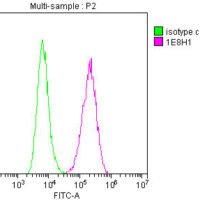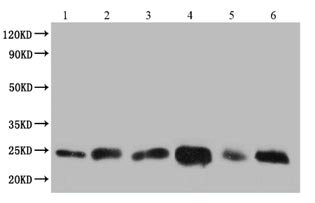
,

Mouse anti-Human sapiens (Human) CD9 Monoclonal Antibody

Mouse anti-Human sapiens (Human) CD9 Monoclonal Antibody — Integral membrane protein associated with integrins, which regulates different processes, such as sperm-egg fusion, platelet activation and aggregation, and cell adhesion.

SKU: BCREC-000148MA Categories: ,

Product Specifications

Uniprot No.P21926
Target NamesCD9
Species ReactivityMouse
ImmunogenRecombinant Human CD9 antigen protein (112-195AA)
ConjugateNon-conjugated
IsotypeIgG2a
ClonalityMonoclonal
ApplicationsELISA, WB, IHC
BufferPBS, 50% glycerol, 0.05% Proclin 300, 0.05%BSA
StorageUpon receipt, store at -20°C or -80°C. Avoid repeated freeze.

Function

Integral membrane protein associated with integrins, which regulates different processes, such as sperm-egg fusion, platelet activation and aggregation, and cell adhesion. Present at the cell surface of oocytes and plays a key role in sperm-egg fusion, possibly by organizing multiprotein complexes and the morphology of the membrane required for the fusion. In myoblasts, associates with CD81 and PTGFRN and inhibits myotube fusion during muscle regeneration.

Biological Context

Subcellular Location: Cell membrane (Multi-pass membrane protein); Membrane (Multi-pass membrane protein); Secreted, extracellular exosome
Tissue Specificity: Detected in platelets (at protein level). Expressed by a variety of hematopoietic and epithelial cells

Product Specifications

Mouse anti-Human sapiens (Human) CD9 Monoclonal Antibody is a recombinant protein. Suitable for ELISA and Western Blot applications.

Applications: ELISA, WB, IHC

Biological Activity: Not implied unless activity data are explicitly listed on this product page, the datasheet, or the CoA.

Storage: Upon receipt, store at -20°C or -80°C. Avoid repeated freeze.

Shipping & Lead Time: Availability, shipping conditions, and estimated lead time are confirmed in the formal quotation or order confirmation based on the product format, destination, and order requirements.

Protein Biology

Function

Integral membrane protein associated with integrins, which regulates different processes, such as sperm-egg fusion, platelet activation and aggregation, and cell adhesion (PubMed:14575715, PubMed:18541721, PubMed:8478605). Present at the cell surface of oocytes and plays a key role in sperm-egg fusion, possibly by organizing multiprotein complexes and the morphology of the membrane required for the fusion (By similarity). In myoblasts, associates with CD81 and PTGFRN and inhibits myotube fusion during muscle regeneration (By similarity). In macrophages, associates with CD81 and beta-1 and beta-2 integrins, and prevents macrophage fusion into multinucleated giant cells specialized in ingesting complement-opsonized large particles (PubMed:12796480). Also prevents the fusion between mononuclear cell progenitors into osteoclasts in charge of bone resorption (By similarity). Acts as a receptor for PSG17 (By similarity). Involved in platelet activation and aggregation (PubMed:18541721). Regulates paranodal junction formation (By similarity). Involved in cell adhesion, cell motility and tumor metastasis (PubMed:7511626, PubMed:8478605)

Subcellular Location

Cell membrane (Multi-pass membrane protein); Membrane (Multi-pass membrane protein); Secreted, extracellular exosome

Tissue Specificity

Detected in platelets (at protein level) (PubMed:19640571). Expressed by a variety of hematopoietic and epithelial cells (PubMed:19640571)

Subunit

Forms both disulfide-linked homodimers and higher homooligomers as well as heterooligomers with other members of the tetraspanin family (PubMed:14556650). Interacts (via the second extracellular domain) with integrin ITGAV:ITGB3 (PubMed:19640571, PubMed:27993971). Interacts with integrin ITGA6:ITGB1; interaction takes place in oocytes and is involved in sperm-egg fusion (By similarity). Part of integrin-tetraspanin complexes composed of CD81, beta-1 and beta-2 integrins in the membrane of monocyte/macrophages (PubMed:12796480). Interacts with CD63; identified in a complex with CD63 and ITGB3 (PubMed:19640571). Associates with CR2/CD21 and with PTGFRN/CD9P1 (PubMed:11278880). Part of a complex composed of CD9, CD81, PTGFRN and IGSF8 (By similarity). Interacts directly with IGSF8 (PubMed:11504738). Interacts with PDPN; this interaction is homophilic and attenuates platelet aggregation and pulmonary metastasis induced by PDPN (PubMed:18541721). Interacts (on T cell side) with CD81 at immunological synapses between antigen-presenting cells and T cells (PubMed:23858057)

Gene: CD9  |  Organism: Homo sapiens  |  Synonyms: 5H9 antigen; Cell growth-inhibiting gene 2 protein; Leukocyte antigen MIC3; Motility-related protein; Tetraspanin-29; p24
Key Publications

Frequently Asked Questions

How do I order or inquire about this product?

Submit the Online Inquiry form with your required quantity and specifications, or email sales@biocrestsci.com. Available sizes, pricing, stock status, documentation, and estimated lead time are confirmed in the formal quotation.

What is the shipping and delivery time?

Availability, dispatch timing, shipping conditions, and delivery estimates depend on the product format, destination, and order requirements. These details are confirmed in the formal quotation or order confirmation.

How should this product be stored?

Follow the storage and handling instructions in the product-specific datasheet and Certificate of Analysis (CoA). Requirements may vary by product form and formulation; contact BioCrest Sci if product-specific guidance is needed.

What quality controls are performed on your products?

Quality-control data such as identity, purity, endotoxin level, or biological activity are provided only when specified on this product page, the datasheet, or Certificate of Analysis (CoA). Biological activity is not implied unless explicitly stated.

Shopping Cart
Scroll to Top