
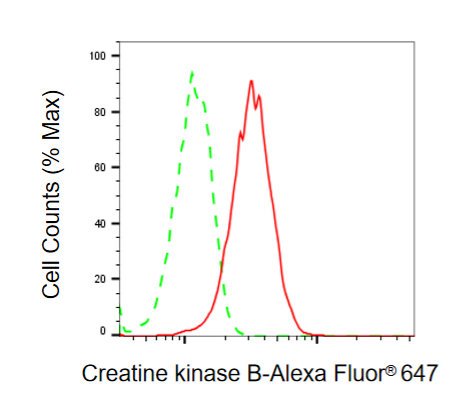
Mouse anti-Human sapiens (Human) CKB Monoclonal Antibody

Mouse anti-Human sapiens (Human) CKB Monoclonal Antibody — Reversibly catalyzes the transfer of phosphate between ATP and various phosphogens (e.

SKU: BCREC-000413MA Category:

Product Specifications

Uniprot No.P12277
Target NamesCKB
Species ReactivityMouse
ImmunogenRecombinant Human CKB protein
Immunogen SpeciesHomo sapiens (Human)
ConjugateNon-conjugated
IsotypeMouse IgG1
ClonalityMonoclonal
ApplicationsELISA, WB, FC, ICC
BufferPBS, 50% glycerol, 0.05% Proclin 300, 0.05%BSA
StorageUpon receipt, store at -20°C or -80°C. Avoid repeated freeze.

Function

Reversibly catalyzes the transfer of phosphate between ATP and various phosphogens (e.g. creatine phosphate). Creatine kinase isoenzymes play a central role in energy transduction in tissues with large, fluctuating energy demands, such as skeletal muscle, heart, brain and spermatozoa (Probable).

Biological Context

Subcellular Location: Cytoplasm, cytosol; Mitochondrion; Cell membrane

Product Specifications

Mouse anti-Human sapiens (Human) CKB Monoclonal Antibody is a recombinant protein. Suitable for ELISA and Western Blot applications.

Applications: ELISA, WB, FC, ICC

Biological Activity: Not implied unless activity data are explicitly listed on this product page, the datasheet, or the CoA.

Storage: Upon receipt, store at -20°C or -80°C. Avoid repeated freeze.

Shipping & Lead Time: Availability, shipping conditions, and estimated lead time are confirmed in the formal quotation or order confirmation based on the product format, destination, and order requirements.

Protein Biology

Function

Reversibly catalyzes the transfer of phosphate between ATP and various phosphogens (e.g. creatine phosphate) (PubMed:8186255). Creatine kinase isoenzymes play a central role in energy transduction in tissues with large, fluctuating energy demands, such as skeletal muscle, heart, brain and spermatozoa (Probable). Acts as a key regulator of adaptive thermogenesis as part of the futile creatine cycle: localizes to the mitochondria of thermogenic fat cells and acts by mediating phosphorylation of creatine to initiate a futile cycle of creatine phosphorylation and dephosphorylation (By similarity). During the futile creatine cycle, creatine and N-phosphocreatine are in a futile cycle, which dissipates the high energy charge of N-phosphocreatine as heat without performing any mechanical or chemical work (By similarity)

Subcellular Location

Cytoplasm, cytosol; Mitochondrion; Cell membrane

Subunit

Dimer of identical or non-identical chains, which can be either B (brain type) or M (muscle type). With MM being the major form in skeletal muscle and myocardium, MB existing in myocardium, and BB existing in many tissues, especially brain. Interacts with SLC12A6 (via C-terminus); the interaction may be required for SLC12A6 potassium-chloride cotransport activity (PubMed:18566107)

Gene: CKB  |  Organism: Homo sapiens  |  Synonyms: Brain creatine kinase; Creatine kinase B chain; Creatine phosphokinase B-type
Key Publications

Frequently Asked Questions

How do I order or inquire about this product?

Submit the Online Inquiry form with your required quantity and specifications, or email sales@biocrestsci.com. Available sizes, pricing, stock status, documentation, and estimated lead time are confirmed in the formal quotation.

What is the shipping and delivery time?

Availability, dispatch timing, shipping conditions, and delivery estimates depend on the product format, destination, and order requirements. These details are confirmed in the formal quotation or order confirmation.

How should this product be stored?

Follow the storage and handling instructions in the product-specific datasheet and Certificate of Analysis (CoA). Requirements may vary by product form and formulation; contact BioCrest Sci if product-specific guidance is needed.

What quality controls are performed on your products?

Quality-control data such as identity, purity, endotoxin level, or biological activity are provided only when specified on this product page, the datasheet, or Certificate of Analysis (CoA). Biological activity is not implied unless explicitly stated.

Shopping Cart
Scroll to Top