Mouse anti-Human sapiens (Human) ECT2 Monoclonal Antibody

Mouse anti-Human sapiens (Human) ECT2 Monoclonal Antibody — Guanine nucleotide exchange factor (GEF) that catalyzes the exchange of GDP for GTP.

SKU: BCREC-000832MA Category:

Product Specifications

Uniprot No.Q9H8V3
Target NamesECT2
Species ReactivityMouse
ImmunogenRecombinant Human ECT2 protein
Immunogen SpeciesHomo sapiens (Human)
ConjugateNon-conjugated
IsotypeMouse IgG1
ClonalityMonoclonal
ApplicationsELISA, WB, FC, ICC
BufferPBS, 50% glycerol, 0.05% Proclin 300, 0.05%BSA
StorageUpon receipt, store at -20°C or -80°C. Avoid repeated freeze.

Function

Guanine nucleotide exchange factor (GEF) that catalyzes the exchange of GDP for GTP. Promotes guanine nucleotide exchange on the Rho family members of small GTPases, like RHOA, RHOC, RAC1 and CDC42. Required for signal transduction pathways involved in the regulation of cytokinesis.

Biological Context

Subcellular Location: Nucleus; Cytoplasm; Cytoplasm, cytoskeleton, spindle; Cleavage furrow; Midbody; Cell junction; Cell junction, tight junction; Cytoplasm, cytoskeleton, microtubule organizing center, centrosome
Tissue Specificity: Expressed in lung epithelial cells (at protein level). Expressed in squamous cell carcinoma, primary non-small cell lung cancer tumors and lung adenocarcinoma

Product Specifications

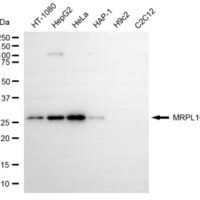
Mouse anti-Human sapiens (Human) ECT2 Monoclonal Antibody is a recombinant protein. Suitable for ELISA and Western Blot applications.

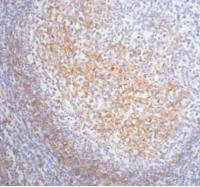
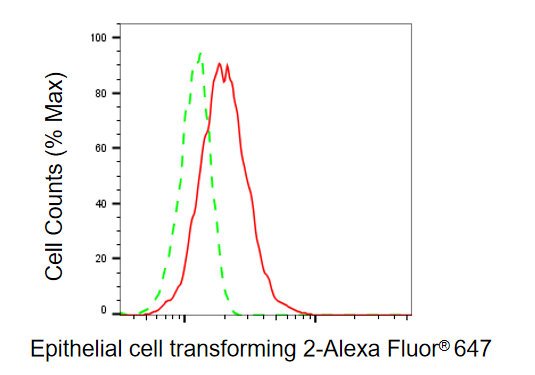
Applications: ELISA, WB, FC, ICC

Biological Activity: Not implied unless activity data are explicitly listed on this product page, the datasheet, or the CoA.

Storage: Upon receipt, store at -20°C or -80°C. Avoid repeated freeze.

Shipping & Lead Time: Availability, shipping conditions, and estimated lead time are confirmed in the formal quotation or order confirmation based on the product format, destination, and order requirements.

Protein Biology

Function

Guanine nucleotide exchange factor (GEF) that catalyzes the exchange of GDP for GTP. Promotes guanine nucleotide exchange on the Rho family members of small GTPases, like RHOA, RHOC, RAC1 and CDC42. Required for signal transduction pathways involved in the regulation of cytokinesis. Component of the centralspindlin complex that serves as a microtubule-dependent and Rho-mediated signaling required for the myosin contractile ring formation during the cell cycle cytokinesis. Regulates the translocation of RHOA from the central spindle to the equatorial region. Plays a role in the control of mitotic spindle assembly; regulates the activation of CDC42 in metaphase for the process of spindle fibers attachment to kinetochores before chromosome congression. Involved in the regulation of epithelial cell polarity; participates in the formation of epithelial tight junctions in a polarity complex PARD3-PARD6-protein kinase PRKCQ-dependent manner. Plays a role in the regulation of neurite outgrowth. Inhibits phenobarbital (PB)-induced NR1I3 nuclear translocation. Stimulates the activity of RAC1 through its association with the oncogenic PARD6A-PRKCI complex in cancer cells, thereby acting to coordinately drive tumor cell proliferation and invasion. Also stimulates genotoxic stress-induced RHOB activity in breast cancer cells leading to their cell death

Subcellular Location

Nucleus; Cytoplasm; Cytoplasm, cytoskeleton, spindle; Cleavage furrow; Midbody; Cell junction; Cell junction, tight junction; Cytoplasm, cytoskeleton, microtubule organizing center, centrosome

Tissue Specificity

Expressed in lung epithelial cells (at protein level). Expressed in squamous cell carcinoma, primary non-small cell lung cancer tumors and lung adenocarcinoma

Subunit

Homodimer (PubMed:14645260, PubMed:15545273, PubMed:16170345). Homooligomer (PubMed:15545273). Found in the centralspindlin complex (PubMed:16236794). Interacts with NR1I3 (By similarity). Interacts (Thr-359 phosphorylated form) with PARD6A; the interaction is observed in cancer cells (PubMed:15254234, PubMed:19617897). Interacts (Thr-359 phosphorylated form) with PRKCI; the interaction is observed in cancer cells (PubMed:19617897). Interacts with PKP4; the interaction is observed at the midbody (PubMed:22814378). Interacts with RACGAP1/CYK4; the interaction is direct, occurs in a microtubule-dependent manner, occurs at anaphase and during cytokinesis, is inhibited in metaphase by phosphorylation of ECT2 on Thr-373 and is stimulated in early anaphase by dephosphorylation of ECT2 probably on Thr-373 through CDK1 activity (PubMed:16103226, PubMed:16129829, PubMed:16236794, PubMed:19468300, PubMed:19468302, PubMed:25068414). Interacts with PLK1; the interaction is stimulated upon its phosphorylation on Thr-444 (PubMed:16247472). Interacts with RHOA; the interaction results in allosteric activation of ECT2 (PubMed:31888991). Interacts with KIF23, PARD3, PARD6B and PRKCQ (PubMed:15254234, PubMed:16236794). Interacts with NEDD9/HEF1 (PubMed:16394104)

Gene: ECT2  |  Organism: Homo sapiens  |  Synonyms: Epithelial cell-transforming sequence 2 oncogene
Key Publications

Frequently Asked Questions

How do I order or inquire about this product?

Submit the Online Inquiry form with your required quantity and specifications, or email sales@biocrestsci.com. Available sizes, pricing, stock status, documentation, and estimated lead time are confirmed in the formal quotation.

What is the shipping and delivery time?

Availability, dispatch timing, shipping conditions, and delivery estimates depend on the product format, destination, and order requirements. These details are confirmed in the formal quotation or order confirmation.

How should this product be stored?

Follow the storage and handling instructions in the product-specific datasheet and Certificate of Analysis (CoA). Requirements may vary by product form and formulation; contact BioCrest Sci if product-specific guidance is needed.

What quality controls are performed on your products?

Quality-control data such as identity, purity, endotoxin level, or biological activity are provided only when specified on this product page, the datasheet, or Certificate of Analysis (CoA). Biological activity is not implied unless explicitly stated.

Shopping Cart
Scroll to Top