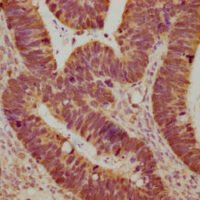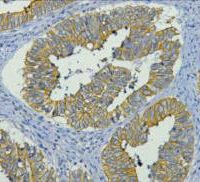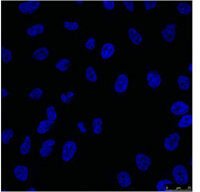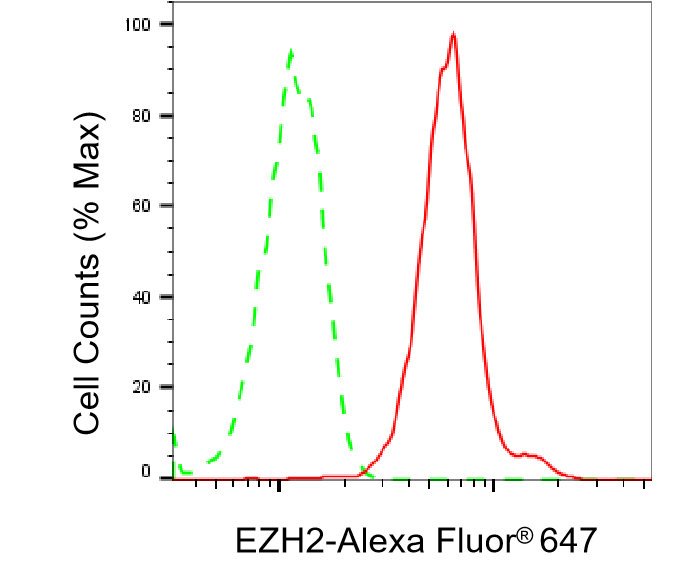
Mouse anti-Human sapiens (Human) EZH2 Monoclonal Antibody

Mouse anti-Human sapiens (Human) EZH2 Monoclonal Antibody — Catalytic subunit of the PRC2/EED-EZH2 complex, a Polycomb group (PcG) complex that methylates ‘Lys-9’ (H3K9me) and ‘Lys-27’ (H3K27me) of histone H3, leading to transcriptional repression of the af…

SKU: BCREC-000395MA Category:

Product Specifications

Uniprot No.Q15910
Target NamesEZH2
Species ReactivityMouse
ImmunogenRecombinant Human EZH2 protein
Immunogen SpeciesHomo sapiens (Human)
ConjugateNon-conjugated
IsotypeMouse IgG1 kappa
ClonalityMonoclonal
ApplicationsELISA, WB, FC, ICC
BufferPBS, 50% glycerol, 0.05% Proclin 300, 0.05%BSA
StorageUpon receipt, store at -20°C or -80°C. Avoid repeated freeze.

Function

Catalytic subunit of the PRC2/EED-EZH2 complex, a Polycomb group (PcG) complex that methylates 'Lys-9' (H3K9me) and 'Lys-27' (H3K27me) of histone H3, leading to transcriptional repression of the affected target gene. Able to mono-, di- and trimethylate 'Lys-27' of histone H3 to form H3K27me1, H3K27me2 and H3K27me3, respectively. Displays a preference for substrates with less methylation, loses activity when progressively more methyl groups are incorporated into H3K27, H3K27me0 > H3K27me1 > H3K27me2.

Biological Context

Subcellular Location: Nucleus
Tissue Specificity: In the ovary, expressed in primordial follicles and oocytes and also in external follicle cells (at protein level). Expressed in many tissues. Overexpressed in numerous tumor types including carcinomas of the breast, colon, larynx, lymphoma and testis
Disease Association: Weaver syndrome (WVS) : A syndrome of accelerated growth and osseous maturation, unusual craniofacial appearance, hoarse and low-pitched cry, and hypertonia with camptodactyly. Distinguishing features of Weaver syndrome include broad forehead and face, ocular hypertelorism, prominent wide philtrum, micrognathia, deep horizontal chin groove, and deep-set nails. In addition, carpal bone development is advanced over the rest of the hand. [The disease is caused by variants affecting the gene represented in this entry]

Product Specifications

Mouse anti-Human sapiens (Human) EZH2 Monoclonal Antibody is a recombinant protein. Suitable for ELISA and Western Blot applications.

Applications: ELISA, WB, FC, ICC

Biological Activity: Not implied unless activity data are explicitly listed on this product page, the datasheet, or the CoA.

Storage: Upon receipt, store at -20°C or -80°C. Avoid repeated freeze.

Shipping & Lead Time: Availability, shipping conditions, and estimated lead time are confirmed in the formal quotation or order confirmation based on the product format, destination, and order requirements.

Protein Biology

Function

Catalytic subunit of the PRC2/EED-EZH2 complex, a Polycomb group (PcG) complex that methylates 'Lys-9' (H3K9me) and 'Lys-27' (H3K27me) of histone H3, leading to transcriptional repression of the affected target gene (PubMed:14532106, PubMed:15225548, PubMed:15385962, PubMed:16618801, PubMed:16936726, PubMed:17344414, PubMed:22323599, PubMed:24474760, PubMed:26581166, PubMed:30026490, PubMed:30923826). Able to mono-, di- and trimethylate 'Lys-27' of histone H3 to form H3K27me1, H3K27me2 and H3K27me3, respectively (PubMed:15231737, PubMed:17210787, PubMed:18285464, PubMed:22323599, PubMed:30923826). Displays a preference for substrates with less methylation, loses activity when progressively more methyl groups are incorporated into H3K27, H3K27me0 > H3K27me1 > H3K27me2 (PubMed:22323599, PubMed:30923826). Compared to EZH1-containing complexes, it is more abundant in embryonic stem cells and plays a major role in forming H3K27me3, which is required for embryonic stem cell identity and proper differentiation (PubMed:19026781). The PRC2/EED-EZH2 complex may also serve as a recruiting platform for DNA methyltransferases, thereby linking two epigenetic repression systems (PubMed:16357870, PubMed:17200670). Genes repressed by the PRC2/EED-EZH2 complex include HOXC8, HOXA9, MYT1, CDKN2A and retinoic acid target genes (PubMed:16179254, PubMed:18086877, PubMed:20935635). EZH2 can also methylate non-histone proteins such as the transcription factor GATA4 and the nuclear receptor RORA (PubMed:23063525). Regulates the circadian clock via histone methylation at the promoter of the circadian genes (PubMed:16717091). Essential for the CRY1/2-mediated repression of the transcriptional activation of PER1/2 by the CLOCK-BMAL1 heterodimer; involved in the di and trimethylation of 'Lys-27' of histone H3 on PER1/2 promoters which is necessary for the CRY1/2 proteins to inhibit transcription (By similarity)

Subcellular Location

Nucleus

Disease Association

Weaver syndrome (WVS) : A syndrome of accelerated growth and osseous maturation, unusual craniofacial appearance, hoarse and low-pitched cry, and hypertonia with camptodactyly. Distinguishing features of Weaver syndrome include broad forehead and face, ocular hypertelorism, prominent wide philtrum, micrognathia, deep horizontal chin groove, and deep-set nails. In addition, carpal bone development is advanced over the rest of the hand. [The disease is caused by variants affecting the gene represented in this entry]

Tissue Specificity

In the ovary, expressed in primordial follicles and oocytes and also in external follicle cells (at protein level) (PubMed:31451685). Expressed in many tissues (PubMed:14532106). Overexpressed in numerous tumor types including carcinomas of the breast, colon, larynx, lymphoma and testis (PubMed:14532106)

Subunit

Component of the PRC2/EED-EZH2 complex, which includes EED, EZH2, SUZ12, RBBP4 and RBBP7 and possibly AEBP2. The minimum components required for methyltransferase activity of the PRC2/EED-EZH2 complex are EED, EZH2 and SUZ12. The PRC2 complex may also interact with DNMT1, DNMT3A, DNMT3B and PHF1 via the EZH2 subunit and with SIRT1 via the SUZ12 subunit. Interacts with HDAC1 and HDAC2. Binds ATRX via the SET domain (Probable). Interacts with PRAME. Interacts with CDYL. Interacts with CLOCK, BMAL1 and CRY1 (By similarity). Interacts with DNMT3L; the interaction is direct (By similarity). Interacts with EZHIP; the interaction blocks EZH2 methyltransferase activity (PubMed:30923826, PubMed:31086175, PubMed:31451685). Interacts with ZNF263; recruited to the SIX3 promoter along with other proteins involved in chromatin modification and transcriptional corepression where it contributes to transcriptional repression (PubMed:32051553). Interacts with ARMC12 (PubMed:30026490). Interacts with ZMYND8; the interaction is dependent on the presence of chromatin (PubMed:33323928, PubMed:36064715). Interacts with DDX18; this interaction inhibits the PRC2 complex (By similarity)

Gene: EZH2  |  Organism: Homo sapiens  |  Synonyms: ENX-1; Enhancer of zeste homolog 2; Lysine N-methyltransferase 6
Key Publications

Frequently Asked Questions

How do I order or inquire about this product?

Submit the Online Inquiry form with your required quantity and specifications, or email sales@biocrestsci.com. Available sizes, pricing, stock status, documentation, and estimated lead time are confirmed in the formal quotation.

What is the shipping and delivery time?

Availability, dispatch timing, shipping conditions, and delivery estimates depend on the product format, destination, and order requirements. These details are confirmed in the formal quotation or order confirmation.

How should this product be stored?

Follow the storage and handling instructions in the product-specific datasheet and Certificate of Analysis (CoA). Requirements may vary by product form and formulation; contact BioCrest Sci if product-specific guidance is needed.

What quality controls are performed on your products?

Quality-control data such as identity, purity, endotoxin level, or biological activity are provided only when specified on this product page, the datasheet, or Certificate of Analysis (CoA). Biological activity is not implied unless explicitly stated.

Shopping Cart
Scroll to Top