Mouse anti-Human sapiens (Human) HSPA1A Monoclonal Antibody

Mouse anti-Human sapiens (Human) HSPA1A Monoclonal Antibody — recombinant protein.

SKU: BCREC-000614MA Category:

Product Specifications

Uniprot No.P0DMV8
Target NamesHSPA1A
Species ReactivityMouse
ImmunogenRecombinant Human Heat shock 70 kDa protein 1A protein (291-641AA)
Immunogen SpeciesHomo sapiens (Human)
ConjugateNon-conjugated
IsotypeIgG2a
ClonalityMonoclonal
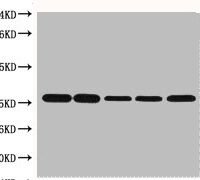
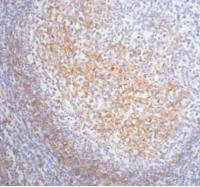
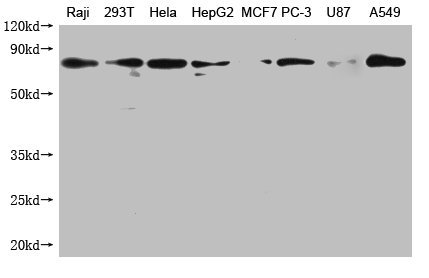
ApplicationsELISA, WB
BufferPBS, 50% glycerol, 0.05% Proclin 300, 0.05%BSA
StorageUpon receipt, store at -20°C or -80°C. Avoid repeated freeze.

Function

(Microbial infection) In case of rotavirus A infection, serves as a post-attachment receptor for the virus to facilitate entry into the cell.

Biological Context

Subcellular Location: Cytoplasm; Nucleus; Cytoplasm, cytoskeleton, microtubule organizing center, centrosome; Secreted
Disease Association: [In certain aggressive cases of activated B cell-like diffuse large B-cell lymphoma (ABC-DLBCL), plays a role in the cytoplasmic sequestration of misfolded N-terminal mutated PRDM1 proteins, promotes their association with SYNV1/HRD1 and degradation through the SYNV1-proteasome pathway. HSPA1A inhibition restores PRDM1 nuclear localization and transcriptional activity in lymphoma cell lines and suppresses growth in xenografts]

Product Specifications

Mouse anti-Human sapiens (Human) HSPA1A Monoclonal Antibody is a recombinant protein. Suitable for ELISA and Western Blot applications.

Applications: ELISA, WB

Biological Activity: Not implied unless activity data are explicitly listed on this product page, the datasheet, or the CoA.

Storage: Upon receipt, store at -20°C or -80°C. Avoid repeated freeze.

Shipping & Lead Time: Availability, shipping conditions, and estimated lead time are confirmed in the formal quotation or order confirmation based on the product format, destination, and order requirements.

Protein Biology

Function

(Microbial infection) In case of rotavirus A infection, serves as a post-attachment receptor for the virus to facilitate entry into the cell

Subcellular Location

Cytoplasm; Nucleus; Cytoplasm, cytoskeleton, microtubule organizing center, centrosome; Secreted

Disease Association

[In certain aggressive cases of activated B cell-like diffuse large B-cell lymphoma (ABC-DLBCL), plays a role in the cytoplasmic sequestration of misfolded N-terminal mutated PRDM1 proteins, promotes their association with SYNV1/HRD1 and degradation through the SYNV1-proteasome pathway. HSPA1A inhibition restores PRDM1 nuclear localization and transcriptional activity in lymphoma cell lines and suppresses growth in xenografts]

Subunit

Component of the CatSper complex. Identified in a IGF2BP1-dependent mRNP granule complex containing untranslated mRNAs (PubMed:17289661). Interacts with CHCHD3, DNAJC7, IRAK1BP1, PPP5C and TSC2 (PubMed:12853476, PubMed:15383005, PubMed:15963462, PubMed:17233114, PubMed:18620420, PubMed:21081504). Interacts with TERT; the interaction occurs in the absence of the RNA component, TERC, and dissociates once the TERT complex has formed (PubMed:11274138). Interacts with TRIM5 (via B30.2/SPRY domain) (PubMed:20053985). Interacts with METTL21A (PubMed:23921388). Interacts with DNAAF2 (By similarity). Interacts with PRKN (PubMed:24270810). Interacts with FOXP3 (PubMed:23973223). Interacts with NOD2; the interaction enhances NOD2 stability (PubMed:24790089). Interacts with DNAJC9 (via J domain) (PubMed:17182002). Interacts with ATF5; the interaction protects ATF5 from degradation via proteasome-dependent and caspase-dependent processes (PubMed:22528486). Interacts with RNF207 (via the C-terminus); this interaction additively increases KCNH2 expression (PubMed:25281747). Interacts with HSF1 (via transactivation domain); this interaction results in the inhibition of heat shock- and HSF1-induced transcriptional activity during the attenuation and recovery phase period of the heat shock response (PubMed:7935376, PubMed:9499401). Interacts with NAA10, HSP40, HSP90 and HDAC4. Interacts (via C-terminus) with STUB1 (via TPR repeats) (By similarity). The acetylated form and the non-acetylated form interact with HOPX and STUB1 respectively (PubMed:27708256). Interacts with NEDD1 (PubMed:27137183). Interacts (via NBD) with BAG1, BAG2, BAG3 and HSPH1/HSP105 (PubMed:24318877). Interacts with SMAD3 (PubMed:24613385). Interacts with DNAJC8 (PubMed:27133716). Interacts with NLRP12 (PubMed:17947705). Interacts with PGLYRP (By similarity). Forms a ternary complex with BAG3 and HSPB8 (PubMed:27884606). Interacts with TTC1 and HSP40/DNAJB1; these interactions prevent the negative role of HSPBP1 on HSP70 folding (PubMed:14503850)

Gene: HSPA1A  |  Organism: Homo sapiens  |  Synonyms: Heat shock 70 kDa protein 1; Heat shock protein family A member 1A
Key Publications

Frequently Asked Questions

How do I order or inquire about this product?

Submit the Online Inquiry form with your required quantity and specifications, or email sales@biocrestsci.com. Available sizes, pricing, stock status, documentation, and estimated lead time are confirmed in the formal quotation.

What is the shipping and delivery time?

Availability, dispatch timing, shipping conditions, and delivery estimates depend on the product format, destination, and order requirements. These details are confirmed in the formal quotation or order confirmation.

How should this product be stored?

Follow the storage and handling instructions in the product-specific datasheet and Certificate of Analysis (CoA). Requirements may vary by product form and formulation; contact BioCrest Sci if product-specific guidance is needed.

What quality controls are performed on your products?

Quality-control data such as identity, purity, endotoxin level, or biological activity are provided only when specified on this product page, the datasheet, or Certificate of Analysis (CoA). Biological activity is not implied unless explicitly stated.

Shopping Cart
Scroll to Top