
Mouse anti-Human sapiens (Human) KRT13 Monoclonal Antibody

Mouse anti-Human sapiens (Human) KRT13 Monoclonal Antibody — Structural component of intermediate filaments in mucosal stratified squamous epithelia.

SKU: BCREC-000594MA Category:

Product Specifications

Uniprot No.P13646
Target NamesKRT13
Species ReactivityMouse
ImmunogenSynthesized peptide derived from human Cytokeratin 13
Immunogen SpeciesHomo sapiens (Human)
ConjugateNon-conjugated
IsotypeIgG1, Kappa
ClonalityMonoclonal
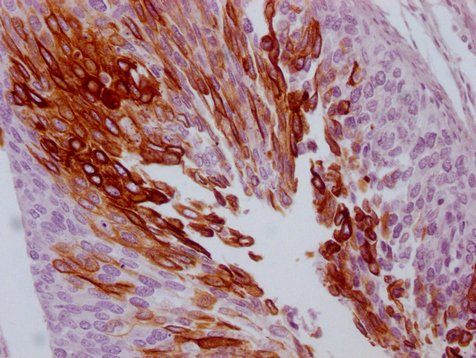
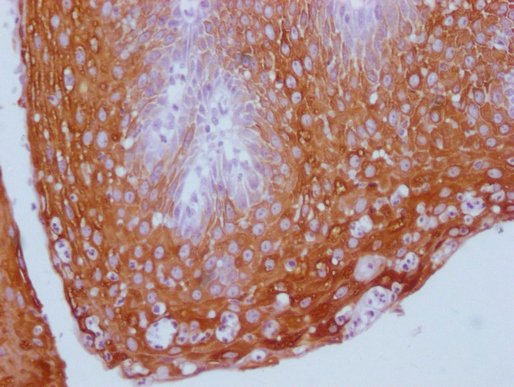
ApplicationsELISA, IHC
BufferPBS, 50% glycerol, 0.05% Proclin 300, 0.05%BSA
StorageUpon receipt, store at -20°C or -80°C. Avoid repeated freeze.

Function

Structural component of intermediate filaments in mucosal stratified squamous epithelia. Forms heteropolymers with the type II keratin KRT4, assembling into keratin intermediate filament networks that provides structural integrity and mechanical stability of the mucosal epithelium. Contributes to postnatal tongue mucosal cell homeostasis and tissue organization in response to mechanical stress, potentially through regulation of the G1/S phase cyclins CCNE1 and CCNE2.

Biological Context

Tissue Specificity: Expressed in some epidermal sweat gland ducts (at protein level) and in exocervix, esophagus and placenta
Disease Association: White sponge nevus 2 (WSN2) : A rare disorder characterized by the presence of soft, white, and spongy plaques in the oral mucosa. The characteristic histopathologic features are epithelial thickening, parakeratosis, and vacuolization of the suprabasal layer of oral epithelial keratinocytes. Less frequently the mucous membranes of the nose, esophagus, genitalia and rectum are involved. [The disease is caused by variants affecting the gene represented in this entry]

Product Specifications

Mouse anti-Human sapiens (Human) KRT13 Monoclonal Antibody is a recombinant protein. Suitable for ELISA and Western Blot applications.

Applications: ELISA, IHC

Biological Activity: Not implied unless activity data are explicitly listed on this product page, the datasheet, or the CoA.

Storage: Upon receipt, store at -20°C or -80°C. Avoid repeated freeze.

Shipping & Lead Time: Availability, shipping conditions, and estimated lead time are confirmed in the formal quotation or order confirmation based on the product format, destination, and order requirements.

Protein Biology

Function

Structural component of intermediate filaments in mucosal stratified squamous epithelia. Forms heteropolymers with the type II keratin KRT4, assembling into keratin intermediate filament networks that provides structural integrity and mechanical stability of the mucosal epithelium (PubMed:7493031). Contributes to postnatal tongue mucosal cell homeostasis and tissue organization in response to mechanical stress, potentially through regulation of the G1/S phase cyclins CCNE1 and CCNE2 (By similarity)

Disease Association

White sponge nevus 2 (WSN2) : A rare disorder characterized by the presence of soft, white, and spongy plaques in the oral mucosa. The characteristic histopathologic features are epithelial thickening, parakeratosis, and vacuolization of the suprabasal layer of oral epithelial keratinocytes. Less frequently the mucous membranes of the nose, esophagus, genitalia and rectum are involved. [The disease is caused by variants affecting the gene represented in this entry]

Tissue Specificity

Expressed in some epidermal sweat gland ducts (at protein level) and in exocervix, esophagus and placenta

Subunit

Heterodimers composed of one type I and one type II keratins; forms parallel coiled-coil heterodimers. Heterodimers associate in an antiparallel manner to form heterotetramers, which further assemble into higher-order keratin intermediate filaments

Gene: KRT13  |  Organism: Homo sapiens  |  Synonyms: Cytokeratin-13; Keratin-13
Key Publications

Frequently Asked Questions

How do I order or inquire about this product?

Submit the Online Inquiry form with your required quantity and specifications, or email sales@biocrestsci.com. Available sizes, pricing, stock status, documentation, and estimated lead time are confirmed in the formal quotation.

What is the shipping and delivery time?

Availability, dispatch timing, shipping conditions, and delivery estimates depend on the product format, destination, and order requirements. These details are confirmed in the formal quotation or order confirmation.

How should this product be stored?

Follow the storage and handling instructions in the product-specific datasheet and Certificate of Analysis (CoA). Requirements may vary by product form and formulation; contact BioCrest Sci if product-specific guidance is needed.

What quality controls are performed on your products?

Quality-control data such as identity, purity, endotoxin level, or biological activity are provided only when specified on this product page, the datasheet, or Certificate of Analysis (CoA). Biological activity is not implied unless explicitly stated.

Shopping Cart
Scroll to Top