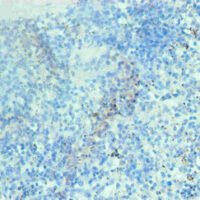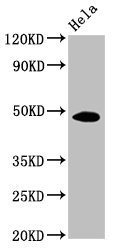
Mouse anti-Human sapiens (Human) MYC Monoclonal Antibody

Mouse anti-Human sapiens (Human) MYC Monoclonal Antibody — Transcription factor that binds DNA in a non-specific manner, yet also specifically recognizes the core sequence 5′-CAC[GA]TG-3′.

SKU: BCREC-000185MA Category:

Product Specifications

Uniprot No.P01106
Target NamesMYC
Species ReactivityMouse
ImmunogenRecombinant Human MYC protein (1-439AA)
ConjugateNon-conjugated
IsotypeIgG1
ClonalityMonoclonal
ApplicationsELISA, WB
BufferPBS, 50% glycerol, 0.05% Proclin 300, 0.05%BSA
StorageUpon receipt, store at -20°C or -80°C. Avoid repeated freeze.

Function

Transcription factor that binds DNA in a non-specific manner, yet also specifically recognizes the core sequence 5'-CAC[GA]TG-3'. Activates the transcription of growth-related genes. Binds to the VEGFA promoter, promoting VEGFA production and subsequent sprouting angiogenesis.

Biological Context

Subcellular Location: Nucleus, nucleoplasm; Nucleus, nucleolus; Nucleus; Cytoplasm; Chromosome
Disease Association: [A chromosomal aberration involving MYC may be a cause of a form of B-cell chronic lymphocytic leukemia. Translocation t(8;12)(q24;q22) with BTG1] | Burkitt lymphoma (BL) : A form of undifferentiated malignant lymphoma commonly manifested as a large osteolytic lesion in the jaw or as an abdominal mass. [The gene represented in this entry is involved in disease pathogenesis. Chromosomal aberrations involving MYC are usually found in Burkitt lymphoma. Translocations t(8;14), t(8;22) or t(2;8) which juxtapose MYC to one of the heavy or light chain immunoglobulin gene loci]

Product Specifications

Mouse anti-Human sapiens (Human) MYC Monoclonal Antibody is a recombinant protein. Suitable for ELISA and Western Blot applications.

Applications: ELISA, WB

Biological Activity: Not implied unless activity data are explicitly listed on this product page, the datasheet, or the CoA.

Storage: Upon receipt, store at -20°C or -80°C. Avoid repeated freeze.

Shipping & Lead Time: Availability, shipping conditions, and estimated lead time are confirmed in the formal quotation or order confirmation based on the product format, destination, and order requirements.

Protein Biology

Function

Transcription factor that binds DNA in a non-specific manner, yet also specifically recognizes the core sequence 5'-CAC[GA]TG-3' (PubMed:24940000, PubMed:25956029). Activates the transcription of growth-related genes (PubMed:24940000, PubMed:25956029). Binds to the VEGFA promoter, promoting VEGFA production and subsequent sprouting angiogenesis (PubMed:24940000, PubMed:25956029). Regulator of somatic reprogramming, controls self-renewal of embryonic stem cells (By similarity). Functions with TAF6L to activate target gene expression through RNA polymerase II pause release (By similarity). Positively regulates transcription of HNRNPA1, HNRNPA2 and PTBP1 which in turn regulate splicing of pyruvate kinase PKM by binding repressively to sequences flanking PKM exon 9, inhibiting exon 9 inclusion and resulting in exon 10 inclusion and production of the PKM M2 isoform (PubMed:20010808)

Subcellular Location

Nucleus, nucleoplasm; Nucleus, nucleolus; Nucleus; Cytoplasm; Chromosome

Disease Association

[A chromosomal aberration involving MYC may be a cause of a form of B-cell chronic lymphocytic leukemia. Translocation t(8;12)(q24;q22) with BTG1] | Burkitt lymphoma (BL) : A form of undifferentiated malignant lymphoma commonly manifested as a large osteolytic lesion in the jaw or as an abdominal mass. [The gene represented in this entry is involved in disease pathogenesis. Chromosomal aberrations involving MYC are usually found in Burkitt lymphoma. Translocations t(8;14), t(8;22) or t(2;8) which juxtapose MYC to one of the heavy or light chain immunoglobulin gene loci]

Subunit

Efficient DNA binding requires dimerization with another bHLH protein. Binds DNA as a heterodimer with MAX (PubMed:9680483). Interacts with TAF1C and SPAG9. Interacts with PARP10. Interacts with KDM5A and KDM5B. Interacts (when phosphorylated at Thr-73 and Ser-77) with FBXW7 (PubMed:17558397, PubMed:25775507). Interacts with PIM2. Interacts with RIOX1. The heterodimer MYC:MAX interacts with ABI1; the interaction may enhance MYC:MAX transcriptional activity. Interacts with TRIM6 (By similarity). Interacts with NPM1; the binary complex is recruited to the promoter of MYC target genes and enhances their transcription (PubMed:25956029). Interacts with CIP2A; leading to the stabilization of MYC (PubMed:17632056). Interacts with NUP205 (PubMed:22719065). Interacts with HEATR1; the interaction is required for localization of MYC to the nucleolus (PubMed:38225354)

Gene: MYC  |  Organism: Homo sapiens  |  Synonyms: Class E basic helix-loop-helix protein 39; Proto-oncogene c-Myc; Transcription factor p64
Key Publications

Frequently Asked Questions

How do I order or inquire about this product?

Submit the Online Inquiry form with your required quantity and specifications, or email sales@biocrestsci.com. Available sizes, pricing, stock status, documentation, and estimated lead time are confirmed in the formal quotation.

What is the shipping and delivery time?

Availability, dispatch timing, shipping conditions, and delivery estimates depend on the product format, destination, and order requirements. These details are confirmed in the formal quotation or order confirmation.

How should this product be stored?

Follow the storage and handling instructions in the product-specific datasheet and Certificate of Analysis (CoA). Requirements may vary by product form and formulation; contact BioCrest Sci if product-specific guidance is needed.

What quality controls are performed on your products?

Quality-control data such as identity, purity, endotoxin level, or biological activity are provided only when specified on this product page, the datasheet, or Certificate of Analysis (CoA). Biological activity is not implied unless explicitly stated.

Shopping Cart
Scroll to Top