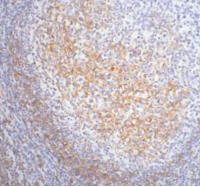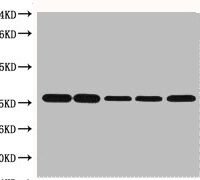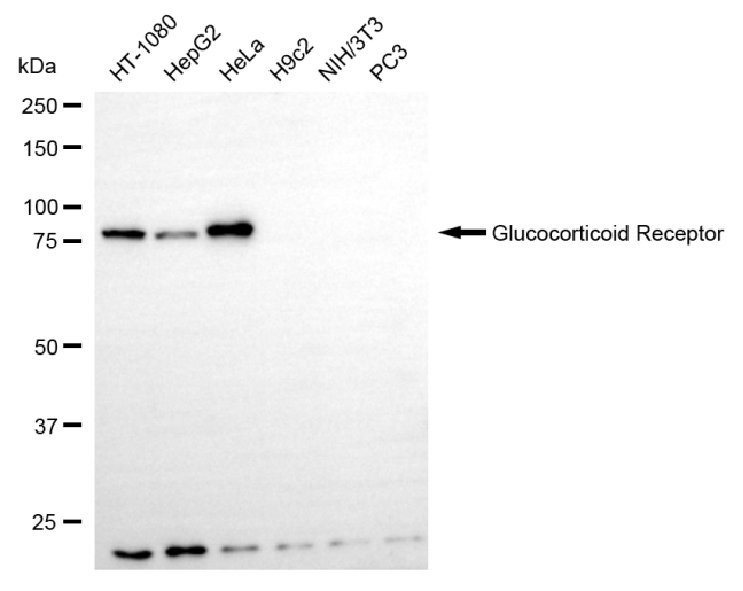
Mouse anti-Human sapiens (Human) NR3C1 Monoclonal Antibody

Mouse anti-Human sapiens (Human) NR3C1 Monoclonal Antibody — Has lowest transcriptional activation activity of all isoforms created by alternative initiation.

SKU: BCREC-000496MA Category:

Product Specifications

Uniprot No.P04150
Target NamesNR3C1
Species ReactivityMouse
ImmunogenRecombinant Human NR3C1 protein
Immunogen SpeciesHomo sapiens (Human)
ConjugateNon-conjugated
IsotypeMouse IgG1 kappa
ClonalityMonoclonal
ApplicationsELISA, WB
BufferPBS, 50% glycerol, 0.05% Proclin 300, 0.05%BSA
StorageUpon receipt, store at -20°C or -80°C. Avoid repeated freeze.

Function

Has lowest transcriptional activation activity of all isoforms created by alternative initiation. Has transcriptional repression activity.

Biological Context

Subcellular Location: Nucleus; Cytoplasm
Tissue Specificity: Widely expressed
Disease Association: Glucocorticoid resistance, generalized (GCCR) : An autosomal dominant disease characterized by increased plasma cortisol concentration and high urinary free cortisol, resistance to adrenal suppression by dexamethasone, and the absence of Cushing syndrome typical signs. Clinical features include hypoglycemia, hypertension, metabolic alkalosis, chronic fatigue and profound anxiety. [The disease is caused by variants affecting the gene represented in this entry]

Product Specifications

Mouse anti-Human sapiens (Human) NR3C1 Monoclonal Antibody is a recombinant protein. Suitable for ELISA and Western Blot applications.

SDS-PAGE: Single band at expected molecular weight confirming purity.

ELISA: Suitable as coating antigen or detection standard.

Western Blot: Compatible with standard Western Blot protocols.

Protein Interaction: Validated for SPR (Surface Plasmon Resonance) and BLI (Bio-Layer Interferometry) studies.

Shipping: Shipped at ambient temperature. Lyophilized protein is stable during transit.

Storage: Store lyophilized protein at -20°C to -80°C. Reconstituted protein should be aliquoted and stored at -80°C. Avoid repeated freeze-thaw cycles.

Shelf Life: 12 months from date of receipt when stored as recommended.

Shipping Time: Orders placed before 2 PM EST ship same day. International orders typically deliver within 5-10 business days.

Protein Biology

Function

Has lowest transcriptional activation activity of all isoforms created by alternative initiation (PubMed:15866175, PubMed:23820903). Has transcriptional repression activity (PubMed:23303127)

Subcellular Location

Nucleus; Cytoplasm

Disease Association

Glucocorticoid resistance, generalized (GCCR) : An autosomal dominant disease characterized by increased plasma cortisol concentration and high urinary free cortisol, resistance to adrenal suppression by dexamethasone, and the absence of Cushing syndrome typical signs. Clinical features include hypoglycemia, hypertension, metabolic alkalosis, chronic fatigue and profound anxiety. [The disease is caused by variants affecting the gene represented in this entry]

Tissue Specificity

Widely expressed

Subunit

Heteromultimeric cytoplasmic complex with HSP90AA1, HSPA1A/HSPA1B, and FKBP5 or another immunophilin such as PPID, STIP1, or the immunophilin homolog PPP5C (PubMed:21730050). Upon ligand binding FKBP5 dissociates from the complex and FKBP4 takes its place, thereby linking the complex to dynein and mediating transport to the nucleus, where the complex dissociates (By similarity). Probably forms a complex composed of chaperones HSP90 and HSP70, co-chaperones CDC37, PPP5C, TSC1 and client protein TSC2, CDK4, AKT, RAF1 and NR3C1; this complex does not contain co-chaperones STIP1/HOP and PTGES3/p23 (PubMed:29127155). Directly interacts with UNC45A (PubMed:16478993). Binds to DNA as a homodimer, and as heterodimer with NR3C2 or the retinoid X receptor. Binds STAT5A and STAT5B homodimers and heterodimers (By similarity). Interacts with NRIP1, POU2F1, POU2F2 and TRIM28 (By similarity). Interacts with several coactivator complexes, including the SMARCA4 complex, CREBBP/EP300, TADA2L (Ada complex) and p160 coactivators such as NCOA2 and NCOA6 (PubMed:10866662, PubMed:12151000, PubMed:12686538, PubMed:9154805, PubMed:9590696). Interaction with BAG1 inhibits transactivation (PubMed:10477749). Interacts with HEXIM1 and TGFB1I1 (PubMed:12415108, PubMed:15211577, PubMed:15941832). Interacts with NCOA1 (PubMed:9590696). Interacts with NCOA3, SMARCA4, SMARCC1, SMARCD1, and SMARCE1 (By similarity). Interacts with CLOCK, CRY1 and CRY2 in a ligand-dependent fashion (PubMed:19141540, PubMed:21980503, PubMed:22170608). Interacts with CIART (By similarity). Interacts with RWDD3 (By similarity). Interacts with UBE2I/UBC9 and this interaction is enhanced in the presence of RWDD3 (By similarity). Interacts with GRIP1 (PubMed:15769988, PubMed:17635946). Interacts with NR4A3 (via nuclear receptor DNA-binding domain), represses transcription activity of NR4A3 on the POMC promoter Nur response element (NurRE) (PubMed:15591535). Directly interacts with PNRC2 to attract and form a complex with UPF1 and DCP1A; the interaction leads to rapid mRNA degradation (PubMed:25775514). Interacts with GSK3B (PubMed:18838540). Interacts with FNIP1 and FNIP2 (PubMed:27353360). Interacts (via C-terminus) with HNRNPU (via C-terminus) (PubMed:9353307). Interacts with MCM3AP (PubMed:16914116). Interacts (via domain NR LBD) with HSP90AA1 and HSP90AB1 (By similarity). In the absence of hormonal ligand, interacts with TACC1 (PubMed:20078863). Interacts (via NR LBD domain) with ZNF764 (via KRAB domain); the interaction regulates transcription factor activity of NR3C1 by directing its actions toward certain biologic pathways (PubMed:28139699)

Gene: NR3C1  |  Organism: Homo sapiens  |  Synonyms: Nuclear receptor subfamily 3 group C member 1
Key Publications

Frequently Asked Questions

How do I order or inquire about this product?

Fill out the Online Inquiry form with your required quantity and specifications. You can also email sales@biocrestsci.com. Our team typically responds within 4 business hours with a quote and availability confirmation.

What is the shipping and delivery time?

Orders placed before 2 PM EST ship the same day. Domestic (US) delivery typically takes 2-3 business days. International orders deliver within 5-10 business days. All products are shipped at ambient temperature with appropriate packaging to ensure stability.

How should I store this recombinant protein?

Lyophilized proteins should be stored at -20°C to -80°C upon receipt. After reconstitution, aliquot and store at -80°C. Avoid repeated freeze-thaw cycles. Shelf life is 12 months from date of receipt when stored as recommended.

What quality controls are performed on your products?

Each product undergoes SDS-PAGE purity analysis (typically >85-95%), endotoxin testing, and bioactivity validation. Products are validated for ELISA, Western Blot, and SPR/BLI applications as specified on this product page. A Certificate of Analysis (CoA) is available upon request.

Shopping Cart
Scroll to Top