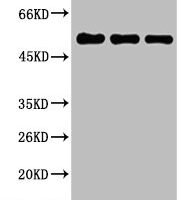
Mouse anti-Human sapiens (Human) PIK3C2A Monoclonal Antibody

Mouse anti-Human sapiens (Human) PIK3C2A Monoclonal Antibody — Generates phosphatidylinositol 3-phosphate (PtdIns3P) and phosphatidylinositol 3,4-bisphosphate (PtdIns(3,4)P2) that act as second messengers.

SKU: BCREC-000379MA Category:

Product Specifications

Uniprot No.O00443
Target NamesPIK3C2A
Species ReactivityMouse
ImmunogenRecombinant Human PIK3C2A protein
Immunogen SpeciesHomo sapiens (Human)
ConjugateNon-conjugated
IsotypeMouse IgG2a
ClonalityMonoclonal
ApplicationsELISA, WB, FC, ICC
BufferPBS, 50% glycerol, 0.05% Proclin 300, 0.05%BSA
StorageUpon receipt, store at -20°C or -80°C. Avoid repeated freeze.

Function

Generates phosphatidylinositol 3-phosphate (PtdIns3P) and phosphatidylinositol 3,4-bisphosphate (PtdIns(3,4)P2) that act as second messengers. Has a role in several intracellular trafficking events. Functions in insulin signaling and secretion.

Biological Context

Subcellular Location: Cell membrane; Cytoplasmic vesicle, clathrin-coated vesicle; Nucleus; Cytoplasm; Golgi apparatus, trans-Golgi network
Tissue Specificity: Expressed in columnar and transitional epithelia, mononuclear cells, smooth muscle cells, and endothelial cells lining capillaries and small venules (at protein level). Ubiquitously expressed, with highest levels in heart, placenta and ovary, and lowest levels in the kidney. Detected at low levels in islets of Langerhans from type 2 diabetes mellitus individuals
Disease Association: Oculoskeletodental syndrome (OCSKD) : An autosomal recessive syndrome characterized by congenital cataracts, short stature, dysmorphic features with coarse facies, dental anomalies, multiple skeletal abnormalities, and neurological manifestations. Other recurrent features include hearing loss, secondary glaucoma, and nephrocalcinosis. [The disease is caused by variants affecting the gene represented in this entry]

Product Specifications

Mouse anti-Human sapiens (Human) PIK3C2A Monoclonal Antibody is a recombinant protein. Suitable for ELISA and Western Blot applications.

Applications: ELISA, WB, FC, ICC

Biological Activity: Not implied unless activity data are explicitly listed on this product page, the datasheet, or the CoA.

Storage: Upon receipt, store at -20°C or -80°C. Avoid repeated freeze.

Shipping & Lead Time: Availability, shipping conditions, and estimated lead time are confirmed in the formal quotation or order confirmation based on the product format, destination, and order requirements.

Protein Biology

Function

Generates phosphatidylinositol 3-phosphate (PtdIns3P) and phosphatidylinositol 3,4-bisphosphate (PtdIns(3,4)P2) that act as second messengers. Has a role in several intracellular trafficking events. Functions in insulin signaling and secretion. Required for translocation of the glucose transporter SLC2A4/GLUT4 to the plasma membrane and glucose uptake in response to insulin-mediated RHOQ activation. Regulates insulin secretion through two different mechanisms: involved in glucose-induced insulin secretion downstream of insulin receptor in a pathway that involves AKT1 activation and TBC1D4/AS160 phosphorylation, and participates in the late step of insulin granule exocytosis probably in insulin granule fusion. Synthesizes PtdIns3P in response to insulin signaling. Functions in clathrin-coated endocytic vesicle formation and distribution. Regulates dynamin-independent endocytosis, probably by recruiting EEA1 to internalizing vesicles. In neurosecretory cells synthesizes PtdIns3P on large dense core vesicles. Participates in calcium induced contraction of vascular smooth muscle by regulating myosin light chain (MLC) phosphorylation through a mechanism involving Rho kinase-dependent phosphorylation of the MLCP-regulatory subunit MYPT1. May play a role in the EGF signaling cascade. May be involved in mitosis and UV-induced damage response. Required for maintenance of normal renal structure and function by supporting normal podocyte function. Involved in the regulation of ciliogenesis and trafficking of ciliary components (PubMed:31034465)

Subcellular Location

Cell membrane; Cytoplasmic vesicle, clathrin-coated vesicle; Nucleus; Cytoplasm; Golgi apparatus, trans-Golgi network

Disease Association

Oculoskeletodental syndrome (OCSKD) : An autosomal recessive syndrome characterized by congenital cataracts, short stature, dysmorphic features with coarse facies, dental anomalies, multiple skeletal abnormalities, and neurological manifestations. Other recurrent features include hearing loss, secondary glaucoma, and nephrocalcinosis. [The disease is caused by variants affecting the gene represented in this entry]

Tissue Specificity

Expressed in columnar and transitional epithelia, mononuclear cells, smooth muscle cells, and endothelial cells lining capillaries and small venules (at protein level). Ubiquitously expressed, with highest levels in heart, placenta and ovary, and lowest levels in the kidney. Detected at low levels in islets of Langerhans from type 2 diabetes mellitus individuals

Subunit

Part of a complex with ERBB2 and EGFR (PubMed:10805725). Interacts with clathrin trimers (PubMed:11239472, PubMed:16215232). Interacts with SBF2/MTMR13 (By similarity)

Gene: PIK3C2A  |  Organism: Homo sapiens  |  Synonyms: Phosphoinositide 3-kinase-C2-alpha
Key Publications

Frequently Asked Questions

How do I order or inquire about this product?

Submit the Online Inquiry form with your required quantity and specifications, or email sales@biocrestsci.com. Available sizes, pricing, stock status, documentation, and estimated lead time are confirmed in the formal quotation.

What is the shipping and delivery time?

Availability, dispatch timing, shipping conditions, and delivery estimates depend on the product format, destination, and order requirements. These details are confirmed in the formal quotation or order confirmation.

How should this product be stored?

Follow the storage and handling instructions in the product-specific datasheet and Certificate of Analysis (CoA). Requirements may vary by product form and formulation; contact BioCrest Sci if product-specific guidance is needed.

What quality controls are performed on your products?

Quality-control data such as identity, purity, endotoxin level, or biological activity are provided only when specified on this product page, the datasheet, or Certificate of Analysis (CoA). Biological activity is not implied unless explicitly stated.

Shopping Cart
Scroll to Top