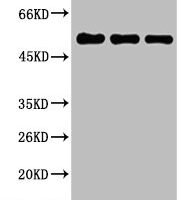
Mouse anti-Human sapiens (Human) PSMB8 Monoclonal Antibody

Mouse anti-Human sapiens (Human) PSMB8 Monoclonal Antibody — The proteasome is a multicatalytic proteinase complex which is characterized by its ability to cleave peptides with Arg, Phe, Tyr, Leu, and Glu adjacent to the leaving group at neutral or slightly …

SKU: BCREC-000766MA Category:

Product Specifications

Uniprot No.P28062
Target NamesPSMB8
Species ReactivityMouse
ImmunogenRecombinant Human PSMB8 protein
Immunogen SpeciesHomo sapiens (Human)
ConjugateNon-conjugated
IsotypeMouse IgG1 kappa
ClonalityMonoclonal
ApplicationsELISA, WB
BufferPBS, 50% glycerol, 0.05% Proclin 300, 0.05%BSA
StorageUpon receipt, store at -20°C or -80°C. Avoid repeated freeze.

Function

The proteasome is a multicatalytic proteinase complex which is characterized by its ability to cleave peptides with Arg, Phe, Tyr, Leu, and Glu adjacent to the leaving group at neutral or slightly basic pH. The proteasome has an ATP-dependent proteolytic activity. This subunit is involved in antigen processing to generate class I binding peptides.

Biological Context

Subcellular Location: Cytoplasm; Nucleus
Disease Association: Proteasome-associated autoinflammatory syndrome 1 (PRAAS1) : An autosomal recessive autoinflammatory disorder characterized by early childhood onset of recurrent fever, joint stiffness and severe contractures of the hands and feet, and erythematous skin lesions with subsequent development of lipodystrophy and laboratory evidence of immune dysregulation. Accompanying features may include muscle weakness and atrophy, hepatosplenomegaly, and microcytic anemia. [The disease is caused by variants affecting the gene represented in this entry]

Product Specifications

Mouse anti-Human sapiens (Human) PSMB8 Monoclonal Antibody is a recombinant protein. Suitable for ELISA and Western Blot applications.

Applications: ELISA, WB

Biological Activity: Not implied unless activity data are explicitly listed on this product page, the datasheet, or the CoA.

Storage: Upon receipt, store at -20°C or -80°C. Avoid repeated freeze.

Shipping & Lead Time: Availability, shipping conditions, and estimated lead time are confirmed in the formal quotation or order confirmation based on the product format, destination, and order requirements.

Protein Biology

Function

The proteasome is a multicatalytic proteinase complex which is characterized by its ability to cleave peptides with Arg, Phe, Tyr, Leu, and Glu adjacent to the leaving group at neutral or slightly basic pH. The proteasome has an ATP-dependent proteolytic activity. This subunit is involved in antigen processing to generate class I binding peptides. Replacement of PSMB5 by PSMB8 increases the capacity of the immunoproteasome to cleave model peptides after hydrophobic and basic residues. Involved in the generation of spliced peptides resulting from the ligation of two separate proteasomal cleavage products that are not contiguous in the parental protein (PubMed:27049119). Acts as a major component of interferon gamma-induced sensitivity. Plays a key role in apoptosis via the degradation of the apoptotic inhibitor MCL1. May be involved in the inflammatory response pathway. In cancer cells, substitution of isoform 1 (E2) by isoform 2 (E1) results in immunoproteasome deficiency. Required for the differentiation of preadipocytes into adipocytes

Subcellular Location

Cytoplasm; Nucleus

Disease Association

Proteasome-associated autoinflammatory syndrome 1 (PRAAS1) : An autosomal recessive autoinflammatory disorder characterized by early childhood onset of recurrent fever, joint stiffness and severe contractures of the hands and feet, and erythematous skin lesions with subsequent development of lipodystrophy and laboratory evidence of immune dysregulation. Accompanying features may include muscle weakness and atrophy, hepatosplenomegaly, and microcytic anemia. [The disease is caused by variants affecting the gene represented in this entry]

Subunit

(Microbial infection) Interacts with HIV-1 TAT protein

Gene: PSMB8  |  Organism: Homo sapiens  |  Synonyms: Low molecular mass protein 7; Macropain subunit C13; Multicatalytic endopeptidase complex subunit C13; Proteasome component C13; Proteasome subunit beta-5i; Really interesting new gene 10 protein
Key Publications

Frequently Asked Questions

How do I order or inquire about this product?

Submit the Online Inquiry form with your required quantity and specifications, or email sales@biocrestsci.com. Available sizes, pricing, stock status, documentation, and estimated lead time are confirmed in the formal quotation.

What is the shipping and delivery time?

Availability, dispatch timing, shipping conditions, and delivery estimates depend on the product format, destination, and order requirements. These details are confirmed in the formal quotation or order confirmation.

How should this product be stored?

Follow the storage and handling instructions in the product-specific datasheet and Certificate of Analysis (CoA). Requirements may vary by product form and formulation; contact BioCrest Sci if product-specific guidance is needed.

What quality controls are performed on your products?

Quality-control data such as identity, purity, endotoxin level, or biological activity are provided only when specified on this product page, the datasheet, or Certificate of Analysis (CoA). Biological activity is not implied unless explicitly stated.

Shopping Cart
Scroll to Top