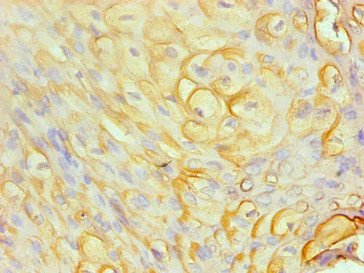
Mouse anti-Human sapiens (Human) S100A8 Monoclonal Antibody

Mouse anti-Human sapiens (Human) S100A8 Monoclonal Antibody — recombinant protein.

SKU: BCREC-000201MA Category:

Product Specifications

Uniprot No.P05109
Target NamesS100A8
Species Reactivitymouse
ImmunogenRecombinant Human S100A8
Immunogen SpeciesHomo sapiens (Human)
ConjugateNon-conjugated
IsotypeIgG1
ClonalityMonoclonal
ApplicationsELISA,IHC
BufferPBS, 50% glycerol, 0.05% Proclin 300, 0.05%BSA
StorageUpon receipt, store at -20°C or -80°C. Avoid repeated freeze.

Function

(Microbial infection) Upon infection by human coronavirus SARS-CoV-2, may induce expansion of aberrant immature neutrophils in a TLR4-dependent manner.

Biological Context

Subcellular Location: Secreted; Cytoplasm; Cytoplasm, cytoskeleton; Cell membrane (Peripheral membrane protein)
Tissue Specificity: Calprotectin (S100A8/9) is predominantly expressed in myeloid cells. Except for inflammatory conditions, the expression is restricted to a specific stage of myeloid differentiation since both proteins are expressed in circulating neutrophils and monocytes but are absent in normal tissue macrophages and lymphocytes. Under chronic inflammatory conditions, such as psoriasis and malignant disorders, also expressed in the epidermis. Found in high concentrations at local sites of inflammation or in the serum of patients with inflammatory diseases such as rheumatoid, cystic fibrosis, inflammatory bowel disease, Crohn's disease, giant cell arteritis, cystic fibrosis, Sjogren's syndrome, systemic lupus erythematosus, and progressive systemic sclerosis. Involved in the formation and deposition of amyloids in the aging prostate known as corpora amylacea inclusions. Strongly up-regulated in many tumors, including gastric, esophageal, colon, pancreatic, bladder, ovarian, thyroid, breast and skin cancers

Product Specifications

Mouse anti-Human sapiens (Human) S100A8 Monoclonal Antibody is a recombinant protein. Suitable for ELISA and Western Blot applications.

Applications: ELISA,IHC

Biological Activity: Not implied unless activity data are explicitly listed on this product page, the datasheet, or the CoA.

Storage: Upon receipt, store at -20°C or -80°C. Avoid repeated freeze.

Shipping & Lead Time: Availability, shipping conditions, and estimated lead time are confirmed in the formal quotation or order confirmation based on the product format, destination, and order requirements.

Protein Biology

Function

(Microbial infection) Upon infection by human coronavirus SARS-CoV-2, may induce expansion of aberrant immature neutrophils in a TLR4-dependent manner

Subcellular Location

Secreted; Cytoplasm; Cytoplasm, cytoskeleton; Cell membrane (Peripheral membrane protein)

Tissue Specificity

Calprotectin (S100A8/9) is predominantly expressed in myeloid cells. Except for inflammatory conditions, the expression is restricted to a specific stage of myeloid differentiation since both proteins are expressed in circulating neutrophils and monocytes but are absent in normal tissue macrophages and lymphocytes. Under chronic inflammatory conditions, such as psoriasis and malignant disorders, also expressed in the epidermis. Found in high concentrations at local sites of inflammation or in the serum of patients with inflammatory diseases such as rheumatoid, cystic fibrosis, inflammatory bowel disease, Crohn's disease, giant cell arteritis, cystic fibrosis, Sjogren's syndrome, systemic lupus erythematosus, and progressive systemic sclerosis. Involved in the formation and deposition of amyloids in the aging prostate known as corpora amylacea inclusions. Strongly up-regulated in many tumors, including gastric, esophageal, colon, pancreatic, bladder, ovarian, thyroid, breast and skin cancers

Subunit

Homodimer. Preferentially exists as a heterodimer or heterotetramer with S100A9 known as calprotectin (S100A8/A9). S100A8 interacts with AGER, ATP2A2 and with the heterodimeric complex formed by TLR4 and LY96 (By similarity). Interacts with GAPDH. Calprotectin (S100A8/9) interacts with CEACAM3 and tubulin filaments in a calcium-dependent manner. Heterotetrameric calprotectin (S100A8/A9) interacts with ANXA6 and associates with tubulin filaments in activated monocytes. S100A8 and calprotectin (S100A8/9) interact with NCF2/P67PHOX, RAC1 and RAC2. Calprotectin (S100A8/9) interacts with CYBA and CYBB. Calprotectin (S100A8/9) interacts with NOS2 to form the iNOS-S100A8/A9 transnitrosylase complex; induced by LDL(ox) (PubMed:25417112). Calprotectin (S100A8/9) interacts with CD69 (PubMed:26296369)

Gene: S100A8  |  Organism: Homo sapiens  |  Synonyms: Calgranulin-A; Calprotectin L1L subunit; Cystic fibrosis antigen; Leukocyte L1 complex light chain; Migration inhibitory factor-related protein 8; S100 calcium-binding protein A8; Urinary stone protein band A
Key Publications

Frequently Asked Questions

How do I order or inquire about this product?

Submit the Online Inquiry form with your required quantity and specifications, or email sales@biocrestsci.com. Available sizes, pricing, stock status, documentation, and estimated lead time are confirmed in the formal quotation.

What is the shipping and delivery time?

Availability, dispatch timing, shipping conditions, and delivery estimates depend on the product format, destination, and order requirements. These details are confirmed in the formal quotation or order confirmation.

How should this product be stored?

Follow the storage and handling instructions in the product-specific datasheet and Certificate of Analysis (CoA). Requirements may vary by product form and formulation; contact BioCrest Sci if product-specific guidance is needed.

What quality controls are performed on your products?

Quality-control data such as identity, purity, endotoxin level, or biological activity are provided only when specified on this product page, the datasheet, or Certificate of Analysis (CoA). Biological activity is not implied unless explicitly stated.

Shopping Cart
Scroll to Top